
Location and geographic setting
- Mermaid Street (Rye, UK): A medieval lane in the town of Rye, East Sussex (approx. 51° N), perched on a hill above marsh and tidal river outlets to the English Channel. Historically Rye was almost surrounded by sea; Mermaid Street climbs up from the old Strand (harbor area) into the old citadel. The street lies ~3 km from the open coast (Rye Harbour) and is in a temperate maritime setting.
- Rue du Petit-Champlain (Québec City, Canada): A short pedestrian street (≈0.26 km) in the Lower Town of Old Québec (46° 48′ N), at the foot of Cap Diamant cliffs and near the St. Lawrence River. It sits just below Québec’s fortified Upper Town (Château Frontenac area), snug along the riverbank and a short walk from the Old Port. The street is fully urban, cobbled, and wind-sheltered by the cliff above, with a continental climate characterized by cold, snowy winters and warm, humid summers.
Scale, form, and spatial hierarchy
- Mermaid Street: A narrow, short cobbled lane (one to two blocks) running steeply uphill, connecting the Strand/Watchbell Street area to the church and citadel square. It is one of the main historic routes into Rye’s old town. Buildings are tightly spaced with no setbacks, giving a closed, intimate medieval-scale character. Traffic is limited (mostly pedestrian) and the street forms part of the dense maze of lanes in Rye’s core.
- Rue du Petit-Champlain: The principal street of the Quartier du Petit-Champlain, running roughly north–south along the riverfront cliff. At ~250 m long, it is the main spine of a compact historic shopping quarter. The street is wide enough for pedestrians and frequent street furniture/terraces, but remains enclosed by 2–3 storey buildings on either side. It serves as the lower terminus of a series of steep stairways and the funicular, making it the focal pedestrian corridor in Québec City’s Lower Town.
Historical function
- Mermaid Street: Historically a working port street. In medieval and early modern times it ran from the harbor (the Strand) up to the town defenses. It housed sailors, shipbuilders and laborers (as seen in 1891 census records). The street gave its name to the 15th-century Mermaid Inn, which by the 17–18th centuries was notorious as a smugglers’ haunt (favored by the Hawkhurst Gang). Over time the area fell into relative poverty but remained a through-route in Rye. The historic function as a harbor access route is preserved in its layout and remaining old inns.
- Rue du Petit-Champlain: From New France onward, this was originally an artisan and residential quarter under the base of the town wall. In the 19th century it declined (notably after cholera outbreaks and cliff landslides buried buildings in the 1800s). It later became derelict until a 1970s heritage revitalization converted it into a commercial/artisan enclave. Thus its historic function shifted from local domestic/artisan use to a restored tourism and retail district. No heavy industrial or large-scale functions ever took place here; it has long been a mixed-use merchant/street environment.
Architectural language and visual identity
- Mermaid Street: Characterized by medieval and Tudor buildings. Many structures are timber-framed (15th–16th century cores) with plaster infill, steep pitched tiled roofs, dormer windows and projecting upper floors. For example, Nos. 5–6 is a Grade II listed timber-framed house from the 1400s. The street retains a variety of period styles (half-timber, flint and brick, gabled and jettied frontages). Overall the visual effect is a tightly textured medieval ensemble, with irregular facades, varied rooflines, leaded windows and muted earth-tones. (Rye itself is noted as “one of the best preserved medieval towns” in England.)
- Rue du Petit-Champlain: Dominated by French‐colonial (17th–18th century) masonry buildings. Structures are typically 2–3 storeys of painted stone or plaster, with high-pitched slate roofs and dormers in the steeply‐sloping mansard/euro style. Facades often have simple classical or vernacular trim (cornices, lintels). Many buildings feature period signage and wrought-iron balconies. The street’s visual identity is of a quaint European village: narrow cobbles and stone, with decorative touches (e.g. painted murals) but unified by consistent rooflines and warm pastel facades. By law and practice the facades are largely unaltered from their 18th-century appearance, due to conservation oversight in the historic district.
Climate, hazards and environmental risk
- Mermaid Street: Under a temperate maritime climate (Cfb). Winters are generally mild (seldom far below 0 °C) and summers moderate. Sussex annual rainfall is ~700 mm, with occasional heavy storms. As a low-elevation seaside town, Rye faces flood risk: sea levels have risen ~11 cm since 1993 and future projections put an extra ~50 cm by 2080 for Rye Bay. A tidal wall and river sluices protect the old town; about 1,200 homes (in the wider Rye area) rely on these defenses. There is also surface-water risk (flash flooding) on low streets due to high groundwater. Mermaid Street itself is elevated above immediate floodplains, so direct flooding is rare, but the town’s medieval drains and high tides have occasionally caused water to back up in nearby lanes. (No significant earthquake or other hazard. Snow/ice in winter is light.)
- Rue du Petit-Champlain: Québec City has a humid continental climate (Dfb): very cold snowy winters (January mean ~ –12.8 °C, heavy snow cover) and warm, humid summers (July mean ~19.3 °C, thunderstorms). Winter maintenance is needed on the cobbles and stairs (they can ice over). The major historic hazard was cliff instability: the Cap Diamant hillside has failed repeatedly, killing 86 people in 1759–89. Those old landslides led to extensive stabilization works in the early 1900s, and such catastrophic events no longer occur. There is no river flooding threat here (the street is above waterfront level). Modern hazards are minimal beyond normal winter cold, and the street is plowed/salted by city crews.
Commercial vs residential balance
- Mermaid Street: Today it is chiefly commercial/tourist-facing. Ground floors host a few pubs (e.g. the Mermaid Inn, Ye Olde Bell-Inn), cafés, gift shops and a tearoom. The upper floors of buildings are largely non-residential (vacation rooms or offices) or vacant, with no permanent residents noted. The 1891 census recorded many families on this street, but now it has essentially no regular households (as noted by local history sources). In sum, Mermaid Street functions as a historical boutique/high-street area of Rye, with only temporary occupancy.
- Rue du Petit-Champlain: Almost entirely commercial along its length. Every building frontage is occupied by a shop, boutique, restaurant or café. A few apartments exist above shops (often now converted to short-stay units), but primary use is retail/tourism. The district has been deliberately managed as a shopping/entertainment precinct since the 1970s revival. Streetscape surveys indicate that ground-floor vacancy is rare; even in winter most businesses stay open (many closing only between Christmas and Carnival). Residential use is negligible; it is essentially a pedestrian mall of commerce.
Viewpoints and photographic logic
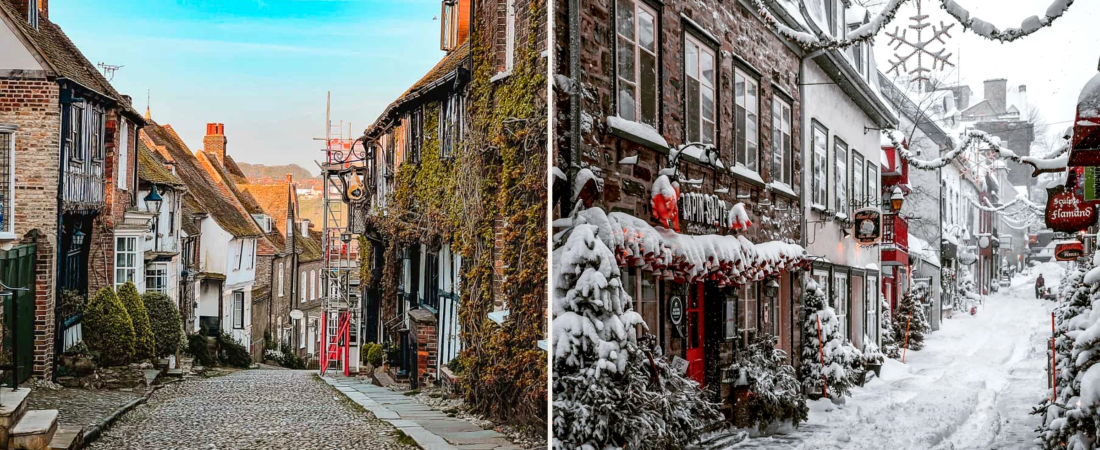
- Mermaid Street: Visitors photograph Mermaid Street mainly from the lower end looking uphill. The classic shot is taken from Watchbell Street, capturing the full rise of colored timbered houses toward the church square (the image shows a typical framed perspective). This upward convergence effect (steep cobbles, golden light) makes for dramatic depth. The street is narrower at the top, so wide-angle views can include all fronts. Photo guides note “one of the most photographed streets” in Britain. There are few overlooking points (no high stands); the best viewpoints are from ground level and the adjacent Lamb House garden or Ypres Tower if accessible. (The embedded image is taken at sunrise, illustrating the archival Tudor frontage under dawn light.)
- Rue du Petit-Champlain: The canonical view is from above or the middle of the block: many photos are taken from Place-Royale or from the Breakneck Steps, looking down the length of the street as it ascends the hill. The Escalier Casse-Cou provides a panoramic staircase viewpoint that frames the narrow street and the river beyond. Indeed, Quebec tourism notes the staircase as “one of the best photographic spots” in the city. The scene is often shot symmetrically (façades of boutiques leading up to the cliff), especially in winter or spring when decorations and falling snow add to the composition. The embedded image, taken midday in summer, shows how holiday decorations and café terraces contribute to the street’s visual character. In brief, photographers use either the stair-top/upper-town vantage or mid-street angles to capture the full length with the stone buildings as converging lines.
Visitor experience, accessibility, noise and crowds
- Mermaid Street: The experience is intimate and quiet. Traffic is usually limited to pedestrians; there are no through-cars, so ambient noise is low (footsteps, conversation). It can become slightly busy in summer afternoons, but it is short enough that even at peak there is little congestion. The surface is uneven cobble, and the 1:5 gradient makes it hard for strollers or wheelchairs. The street is not step-free (though ramps/alternative routes exist off to the side) so accessibility is partial. Signage and tourism brochures often advise arriving early (evening light is popular, but morning is least crowded). There are no loud bars or nightclubs on this short street, so it is relatively calm even during Rye’s festivals. Visitors note that it feels safe (the town has low crime) and unhurried – suited to leisurely walking or photography. Wheelchair users or those with mobility issues may need alternate routes to reach the church (via a gentler ramp from Monk’s Walk). Overall it is a low-stress, small-scale visitor spot where crowds are self-regulating by the street’s size.
- Rue du Petit-Champlain: In contrast, it is almost constantly busy during tourist season. Thousands walk it daily (the city estimates “many thousands of visitors” each year). This brings a continuous background noise of chatter, music from stores, and at times street performers, especially evenings in summer and holiday periods. Summer months and festivals see heavy foot traffic; in December it is thick with Christmas market revelers. Accessibility is mixed: the street itself is flat and paved, so easily walked; the funicular at its top provides accessible connection to Upper Town for those who can’t climb. However, crossing from higher streets requires using staircases (e.g. Breakneck Steps), which are not wheelchair-friendly. The funicular station (at 705 rue St. Jean) compensates for accessibility. Given the tourist focus, navigation is straightforward (good signage), but finding rest areas is limited (few benches). In short, Petit-Champlain is vibrant and crowded by day – it feels safe and family-friendly, but one should expect bustle, occasional loud streetcar or delivery noise, and limited space at peak times. Daytime visitors often linger for shopping and dining; nights are quiet once shops close (around 21:00).
Heritage status, conservation, and site management
- Mermaid Street: It lies within Rye’s designated Conservation Area, and many buildings are listed. Notably the Mermaid Inn complex (Nos. 5–6) is Grade II listed. The entire street is subject to local heritage planning controls. Maintenance is the responsibility of property owners under town council guidelines, with oversight by conservation officers. The Rye Heritage Centre and the Rye Castle Museum conduct tours and maintain archives (like the 1891 census study above). Management is informal: there is no single plaza authority, but the local chamber of commerce and planning authority promote heritage preservation (the Visit 1066 Country tourism site emphasizes medieval authenticity). Regular repainting and cobble repairs are done under council schemes; modern interventions (like street lights and shop signage) must follow strict design rules. In sum, the street’s heritage fabric is well-protected at the national (listed building) and local (town council conservation) levels, with periodic tourism-related enhancement (e.g. flower boxes, plaques).
- Rue du Petit-Champlain: This street is part of Quebec City’s UNESCO Historic District (inscribed 1985). It is subject to provincial and municipal heritage regulations. In practice, a cooperative of shop owners (“Quartier Petit Champlain” coop) works with the city to manage building restorations and streetscape (stemming from the 1977 revitalization project). Major façades are preserved; all exterior changes require city approval under the Old Québec heritage commission. The area even won a national “Great Places in Canada” award in 2011 for its successful blend of commerce and conservation. The city provides structural support (stabilizing Cap Diamant) and funds events (e.g. illumination during holidays). Thus management is active and institutional: routine cleaning, festive decor, and policing are coordinated by the municipal tourism office. In short, Petit-Champlain’s heritage status is very high (UNESCO-listed, national historic site in effect) and it is actively maintained by public-private partnership, ensuring the street retains its historic character for visitors.
Social openness, safety, and LGBTQ+ inclusiveness
- Mermaid Street (Rye): England (and East Sussex) has legal protections for LGBT individuals under the UK Equality Act 2010. Rye is a small town that is generally regarded as safe and tolerant. There are no known hate crimes or harassment issues specific to the street. The community atmosphere (based on travel blogs and local feedback) is welcoming; some shops and inns are LGBTQ-owned or -friendly. The UK government rates all public services (including tourism spots) as non-discriminatory by law. Anecdotally, visitors in same-sex couples have reported feeling as welcome here as anywhere in the UK. Crime rates in Rye are very low, and the street itself is well-lit and patrolled by the town beat police, adding to personal safety.
- Rue du Petit-Champlain (Québec City): Quebec is known for its progressive social attitudes. The provincial Charter of Human Rights explicitly bans sexual orientation discrimination, and Québec City hosts an annual Pride festival. The official tourism site states that Québec has “an atmosphere of freedom and security” for LGBTQ+ visitors. Visitors report that same-sex couples walk openly through Petit-Champlain without incident. Police statistics show low violent crime; pickpocketing is rare. In summary, Petit-Champlain feels very safe and inclusive – it is a mainstream tourist area in one of North America’s safest cities for LGBT rights. Signage and services cater to international guests (English signage, multilingual staff), further aiding a comfortable experience for all.
Traveller types and visit suitability
- Mermaid Street: Appeals to cultural heritage tourists, photographers, walkers and older travelers. It suits those interested in medieval history, literature (Lamb House), and architecture. Families with young children find the uneven paving challenging; it’s not a playground. Young party-goers won’t find nightlife here. It works well for day-trippers or couples looking for a quiet outing. Nature lovers may combine it with walks (Rye Harbour, Romney Marsh nearby). Accessibility issues (steep slope) make it less ideal for the very elderly or disabled, so some visitors opt for easier routes. Accommodation is available at inns on or near the street for those staying overnight. On balance, Mermaid Street is best for slow-paced sightseeing and history buffs, not for adventure or thrill-seekers.
- Rue du Petit-Champlain: Caters to a broad mass-tourist crowd. Good for couples (especially romantic winter walks under lights), families (toddler strollers are doable on the flat street), and cruise passengers (it’s close to the port) looking for shopping/dining. It also suits art and culture tourists drawn by old Québec’s charm. Shoppers can find souvenirs, crafts and local products. It is not an adrenaline or wilderness spot – more a cultural/lifestyle venue. Mobility-challenged visitors should use the funicular to avoid stairs. Safety and amenities are high, so solo travelers and groups alike frequent it. In short, it is highly accessible (save for the stairs), well-serviced (cafes, toilets, tourist help), and oriented to any traveler who enjoys historic urban ambience, mild exercise and commercial exploration.
Conclusion
Mermaid Street and Rue du Petit-Champlain are both historic pedestrian streets, but their traveler experiences differ sharply. Mermaid Street is small, intimate and rooted in English medieval town life, with timbered buildings and a quiet, low-key atmosphere. It is shaped by its hillside form and coastal hinterland, with heritage listings ensuring its old-world fabric endures. It tends to draw heritage-focused visitors and stays relatively uncrowded. Rue du Petit-Champlain is livelier and more commercial, reflecting its role as Québec’s premier souvenir and dining street. Its steep French-Colonial facades and festive decorations make it highly photogenic; by day it hums with tourists under the watch of Cap Diamant. While both streets are safe and well-maintained, Petit-Champlain is generally more crowded and seasonally busy (especially winter holiday crowds), whereas Mermaid Street feels more relaxed and village-like. Climate differences also stand out: Rye’s mild, wet winters contrast with Québec City’s snowy cold (though both manage their weather through local design). In heritage terms, Mermaid Street benefits from national listing protections; Petit-Champlain benefits from UNESCO and provincial stewardship. Neither place uses flowery “must-see” language – each offers its own depth of history and atmosphere. Travelers who relish history and calm pedestrian settings will prefer Mermaid Street, while those seeking a bustling Old Québec streetscape with shops and winter magic will gravitate to Petit-Champlain. Both are welcoming and iconic in context, each embodying its locale’s unique urban fabric and cultural ambience.
Sources: Authoritative tourism and heritage sites from Rye and Québec City (e.g. official municipal descriptions, Historic England listings, climate reports), as well as scholarly and local-historical documents.