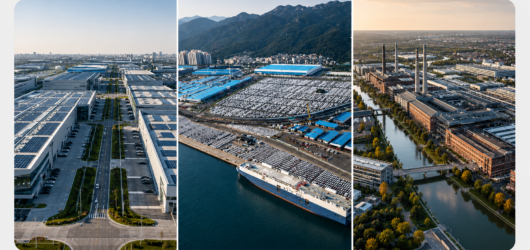
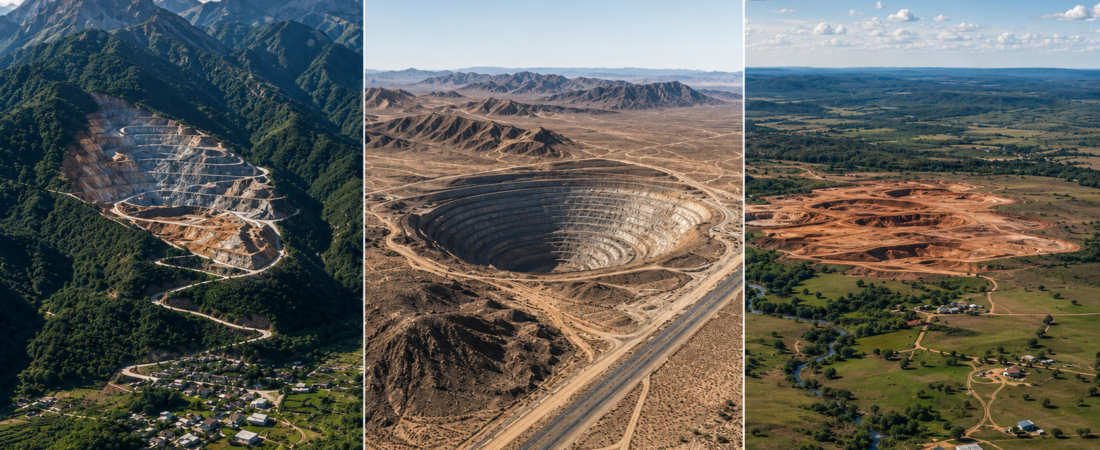
Each mine is a place formed by extraction: pit and waste landforms, nearby settlements, labour markets, transport routes, processing links, water use, regulation and closure prospects. Maoniuping is embedded in a settled mountain valley, Mountain Pass occupies a remote desert transport corridor, and Pela Ema spreads through a rural Cerrado landscape tied to Minaçu. The comparison follows those spatial and social relations rather than ore output alone.
Comparison snapshot
| Criterion | Maoniuping | Mountain Pass | Pela Ema |
|---|---|---|---|
| Location and setting | Settled Sichuan mountain valley. | Remote Mojave desert highway corridor. | Rural Cerrado uplands near Minaçu. |
| Pit and physical form | Consolidated hard-rock pit on steep slopes. | Deep, single benched hard-rock pit. | Shallow moving panels across saprolite. |
| Development status | Mature, operating state-controlled mine. | Operating mine; separation capacity expanding. | Producing during plant ramp-up. |
| Nearby settlements | Villages within and below the mine landscape. | No adjoining town; commuting workforce. | Rural properties nearby; workforce linked to Minaçu. |
| Local and regional economy | Feeds Chinese separation and manufacturing. | Supports US separation and Texas magnet production. | Regional jobs; local gains not yet measured. |
| Transport and export | Road-linked to domestic processors; routes undisclosed. | Interstate 15; domestic and Asian destinations. | Road haulage to the Port of Santos. |
| Processing and integration | Concentrates; downstream separation not traceable. | Onsite separation; magnets made in Texas. | Mixed carbonate; separation occurs elsewhere. |
| Environment and resources | Legacy waste, wet tailings and basin contamination. | Groundwater demand, dry tailings and chemical waste. | Clearing, sediment pollution and dry tailings. |
| Land, community and labour | Village-linked land history; weak current disclosure. | Commuting workforce; no collective bargaining. | Private rural land; some collective bargaining. |
| Governance, closure and identity | State-controlled; no public closure provision; rehabilitation narrative. | US-regulated; closure liability; supply-security identity. | Corrective licence; closure liability; Minaçu mining identity. |
Location and regional setting
Maoniuping lies near Maoniu Village in Mianning County, part of Liangshan Yi Autonomous Prefecture in Sichuan. The mine occupies steep, dissected mountain terrain in the Panxi mineral belt. Villages, farms, mine roads, waste sites and streams share a confined landscape. Mining is therefore close to settlement and to downstream water and debris pathways.
Mountain Pass is in the Clark Mountain Range of southeastern California, close to the Nevada border. It is a remote desert industrial site beside Interstate 15, the main road between Southern California and Las Vegas. The mine is not surrounded by a resident mining town. Its connections to people and markets run mainly along the highway corridor.
Pela Ema is about 30 kilometres west-northwest of Minaçu in northern Goiás. It lies in the Cerrado, among rolling uplands, headwater streams, pasture and scattered rural properties. Its licensed area extends across several mining tenements; its wider study area includes Minaçu, Trombas and Montividiu do Norte. The site is rural but not isolated from land use or water use around it.
The settings create three exposure patterns. Maoniuping shares a steep valley system with villages. Mountain Pass concentrates disturbance inside a desert industrial compound. Pela Ema spreads shallow workings across a vegetated and partly farmed upland landscape.
Pit size and physical form
Maoniuping and Mountain Pass are hard-rock open-pit mines, but their forms differ. Maoniuping follows bastnäsite-bearing mineralisation through steep mountain ground. Fragmented mining left numerous pits, waste piles and roads. A 2014 expansion approval proposed one large open pit covering the existing smaller workings, with annual ore capacity of 1.35 million tonnes. No dependable recent public source gives the current pit’s length, width, depth or disturbed area.
Mountain Pass has one deep, benched pit in carbonatite. NASA measured the visible excavation in a December 2022 satellite image at about 800 metres across and more than 180 metres deep. At the end of 2025, the operator reported 28.96 million short tons of proven and probable reserves at an average grade of 5.89% total rare-earth oxide. The remaining reserve plan has a waste-to-ore strip ratio of 5.8:1.
Pela Ema works a thin mineralised layer in weathered granite. The ore-bearing saprolite averages about 4.5 metres thick in the current company description. Mining advances through broad, shallow panels rather than one permanent deep pit. The authorised directly affected area covers 4,362.62 hectares of potential exploitation land, but that is not a measurement of land already cleared or mined. Older plans used two- to five-metre benches and described a very large, low-grade resource. Those plans explain the mine’s shape but are not a current reserve statement.
Mountain Pass moves large volumes of waste to deepen a compact pit. Pela Ema avoids a deep void but opens more surface area because its mineralised layer is thin and low grade. Maoniuping combines a large modern excavation with the remains of earlier workings on steep slopes.
History and development
Maoniuping was discovered in the 1980s. Rapid development produced more than 100 small mining and processing businesses by the late 1990s, according to provincial accounts. From the mid-2000s, access rules, mine consolidation and environmental works replaced that fragmented system with a large licensed operation. The mine is now operated by Zhongxi Liangshan Rare Earth, within the state-owned China Rare Earth Group.
Deep exploration changed the reported scale of Maoniuping in March 2026. Public announcements agreed that 9.666 to 9.67 million tonnes of rare-earth oxide had been newly identified. They did not agree on the cumulative total: Xinhua reported 10.408 million tonnes, while China Daily reported 11.46 million. No public reconciliation of those figures was found. Both totals concern geological resources, including deep mineralisation; neither measures the present open pit or annual permitted output.
Mountain Pass began with the identification of bastnäsite in 1949 and commercial mining in 1952. It supplied much of the world’s rare earths for part of the late twentieth century. Mining stopped in 2002 after processing had already contracted. Molycorp restarted production in 2012, entered bankruptcy in 2015, and left the site to new owners. MP Materials resumed mining and concentration in 2017. Commercial production of separated neodymium-praseodymium oxide began in 2023, followed by the continued rebuilding of chemical separation and magnet production.
Denham Capital acquired Serra Verde’s operating company in 2011 after earlier exploration in the region. Construction of the mine and processing plant began in 2020. Commissioning, first production and sales of mixed rare-earth carbonate occurred in 2024. Serra Verde announced commercial production that year, but its later financial disclosure described the project as still in development and pre-operational at the end of 2025. Sales were limited during 2025 while the plant was being altered and expanded. The facility was producing and selling material, but had not reached the sustained scale used by the company to define full commercial operations. The company expected to finish construction and reach that stage in 2027.
Relationship with nearby settlements
Maoniuping’s resource area and historical workings are directly interwoven with villages. Maoniu and Machang villages lie in or below the mining landscape. Earlier pits and 26 recorded waste piles increased debris-flow and drainage risks for more than 1,000 downstream residents. The 2014 environmental approval also required the relocation, before production, of Caojia Village residents considered severely exposed under a tailings-dam failure scenario.
Mountain Pass has no comparable village beside the pit. “Mountain Pass” is principally a mine, road junction and utility location rather than a civic settlement. Workers travel from Nevada and inland California, while Las Vegas and smaller highway communities supply labour, accommodation and services. Closure or expansion can affect commuters and contractors without determining the survival of an adjacent town.
Pela Ema depends much more directly on Minaçu than Mountain Pass does on any one settlement. Employees are mainly transported by bus from Minaçu. DFC documents identify Patrimônio Vicente, a village of about 310 people roughly 18 kilometres from the mine gates, as the closest defined community. No households were recorded within the project site. This finding covers the formally mapped footprint; it does not rule out effects on rural landowners and downstream water users outside it.
Minaçu was already shaped by asbestos mining and hydroelectric development before Pela Ema opened. Rare-earth production arrived while the future of the Cana Brava asbestos operation remained contested. Local reporting records expectations of replacement jobs and municipal revenue, alongside concern that another mine may reproduce a narrow economy dominated by one or two employers.
Role in the local and regional economy
Maoniuping supplies rare-earth, barite and fluorite concentrates to the Sichuan and wider Chinese minerals industry. Its approved design capacity included about 46,257 tonnes of rare-earth concentrate, 142,720 tonnes of barite concentrate and 110,750 tonnes of fluorite concentrate a year. These are design figures from 2014, not verified current output. Recent mine-level employment, wages, purchasing, tax payments and household-income effects are not publicly available. The mine’s economic importance is evident from its resource and production role, but its local distribution cannot be measured from the available record.
Mountain Pass is the main mined source in the United States’ rare-earth production programme. MP Materials reported 998 full-time-equivalent employees at the end of 2025, about 83% of them in field roles. That total covers the entire company, including the Texas magnet plant and other functions, and cannot be used as a Mountain Pass headcount. The mine supports specialised jobs, contractors and transport across a broad commuting region. Current county-level figures for wages, procurement and tax receipts are not separately reported.
Pela Ema has a current site workforce disclosure. At the end of 2025, Serra Verde reported about 350 employees and 260 contractor personnel working exclusively for the company. It expected another 300 full-time hires during the ramp-up to planned Phase I capacity. An Arcadis audit prepared for Serra Verde reported in 2024 that 72% of direct and indirect employees lived in the Minaçu region. That proportion is dated and has not been independently updated.
The larger economic claims for Pela Ema remain forecasts. Production was still below planned steady operation, and a run of dismissals in the local metallic-minerals sector was reported during part of 2024–25. Public data do not yet show how much of the mine’s spending stays in Minaçu, how royalty income is used, or whether household incomes have changed. Workforce numbers and municipal revenue do not show how benefits are distributed among residents.
Transport and export infrastructure
Maoniuping uses mine roads and internal haulage between the pit, concentrator, waste dumps and tailings facility. Concentrate then enters China’s domestic separation and manufacturing system. Public sources do not show a current mine-specific route, destination split or exported share. China’s national controls on rare-earth extraction, separation and exports also prevent a geological resource increase from translating automatically into higher shipments.
Mountain Pass sits directly beside Interstate 15. The road links the site with Las Vegas, Southern California, rail connections, customers and ports. Until July 2025, most concentrate was sold through a distributor serving refiners in China. MP Materials then ended all sales to China. The mine continues to make concentrate; material that is not processed into separated products or sold is stockpiled. Separated neodymium-praseodymium products are sold mainly to customers in Japan, South Korea and other Asian markets, and material also enters the company’s magnet operation in Fort Worth, Texas. Raw concentrate and separated products therefore follow different routes.
Pela Ema sends mixed rare-earth carbonate by truck. The current company disclosure names the Port of Santos as its primary delivery point and identifies BR-050 and BR-153 as links to Santos and other ports. Earlier public documents gave only general road access, which explains why older accounts could not identify the export chain. Initial shipments went to Chinese processing customers. Under the 2026 offtake agreement, a US-government-backed buyer is to take Phase I magnetic rare-earth output and may resell it to processors anywhere in the world. The agreement does not guarantee that separation or manufacturing will occur in Brazil or the United States.
Processing and industrial integration
Maoniuping crushes, grinds and floats hard-rock ore to make rare-earth concentrate, with barite and fluorite as associated products. The 2014 project linked the pit, concentrator, internal transport, waste sites and a wet-tailings facility. Individual rare-earth oxides are not publicly traceable from Maoniuping ore to named downstream plants. The mine nevertheless feeds a Chinese industrial system that already includes separation, metals, alloys, magnets, motors and other components. Its integration is broad at national scale but opaque at mine-to-product level.
Mountain Pass combines mining, flotation and an expanding separation plant at one site. It produced 2,599 tonnes of neodymium-praseodymium oxide in 2025, although separated-product throughput remained below design capacity. Heavy-rare-earth and samarium separation projects were being commissioned or built during 2026. Metals, alloys and magnets are made at the Independence facility in Fort Worth. The company is also installing systems at Mountain Pass to recover rare earths from manufacturing scrap and end-of-life magnets. Several downstream stages were still ramping, so this was an expanding production system rather than a fully balanced mine-to-magnet chain.
Pela Ema screens shallow ore, extracts rare-earth ions, precipitates the product and filters it into mixed rare-earth carbonate. It does not commercially separate the individual elements at the mine. The carbonate contains neodymium, praseodymium, dysprosium and terbium, but its constituents must be separated elsewhere before they can enter metal and magnet production.
An April 2026 purchase agreement allocated Phase I output to a buyer backed by US government and private capital. The buyer may resell globally. USA Rare Earth also agreed to acquire Serra Verde, but the transaction remained pending on 3 August 2026 and was expected to close during the third quarter. Plans to connect Pela Ema with separation, metal and magnet plants therefore remained partly contractual and partly proposed. They did not amount to current later-stage processing in Brazil.
Environmental pressures and resource use
Maoniuping’s steep terrain links land disturbance, waste stability and water quality. Uncoordinated mining left pits and waste piles vulnerable to erosion and debris flows. A severe 2013 rainstorm mobilised legacy mine waste and damaged restored ground. Published estimates of the amount moved conflict, so no single tonnage is used here. A 2025 peer-reviewed study identified Maoniuping mining as the main source of heavy-metal pollution in soils of the Nanhe River basin and described runoff as a transport route. It did not separate every current discharge from legacy waste and natural mineralisation.
The modern Maoniuping design added controlled dumps, water collection, wastewater treatment and a tailings facility. The approved wet-tailings dam was designed to reach 136 metres, hold 18.23 million cubic metres and operate for 24.3 years. The operator reports large-scale rehabilitation and “green mine” status, but those are institutional claims. Recent mine-level water balances, discharge series, tailings performance and independent rehabilitation checks were not found.
Mountain Pass uses dry-stacked tailings from beneficiation. Dewatering supplies about 95% of the water needed by the milling and flotation circuit, according to the operator. That percentage does not cover the entire mine and separation complex. Cracking, solvent extraction and finishing require additional water and chemicals, including high-purity water, while the site relies on groundwater wells, treatment equipment and brine recycling.
Dry stacking reduces water held in tailings and removes the failure mode of a conventional wet impoundment. It does not remove dust, seepage, radioactive constituents or long-term reclamation duties. EPA records describe wastewater and tailings-system spills in 1989 and 1990; the incidents were contained onsite and judged low risk at the time. Current environmental reporting is more regular than at Maoniuping, but many performance figures still come from the operator.
Pela Ema removes vegetation and soil across shallow panels. It avoids routine drilling and blasting in its licensed mining method and uses filtered or dry-stacked tailings. The company reports that about 90% of process water is recirculated. No public independent audit confirms a complete current water balance. Backfilling about half of the oversize material into mined panels is planned but remains subject to permits.
The mine’s operating record shows problems that cannot be resolved by reference to its shallow geometry. A Serra Verde-commissioned Arcadis audit documented a 2022 sediment release from the South Pile into the Taboca stream, which affected water at a nearby residence, as well as gaps in drainage, monitoring, emergency planning and biodiversity compensation. DFC later published the audit during its financing review; Arcadis was working for Serra Verde, not for DFC.
In March 2026, Goiás environmental-agency analysts reported findings from a joint state and federal inspection conducted in November 2025. They found excessive turbidity and metals in affected watercourses, inadequate monitoring, continued drainage failures and sediment entering the Laje stream. The record also described the use of explosives without authorisation under the licence. The agency issued infraction notices, including a proposed R$12.5 million penalty for pollution and R$120,000 for an incomplete water study, as well as seven other notices concerning clearing, mining and other irregularities. It reported more than 300 hectares of clearing without authorisation and about 140 hectares of mining outside the approved plan.
Rural residents have separately reported discoloured water and livestock losses. The official inspection supports concern about sediment and pollution in local streams. It does not establish that mine pollution caused every reported animal-health event. The company said it was working with regulators to settle the issues.
Land, community and labour relations
At Maoniuping, consolidation concentrated legal access to land and ore that had previously supported small miners, processors and village businesses. It also allowed coordinated waste control that the fragmented system had failed to provide. Public records do not show how former operators and affected households were compensated, absorbed into the larger workforce or excluded. Nor do they provide recent mine-level employment, contractor, wage, union, injury or grievance data. The mine is in a Yi autonomous prefecture, but published project information does not disaggregate land or labour effects for Yi residents.
MP Materials reported that none of its employees were covered by collective-bargaining agreements at the end of 2025. That statement is company-wide and says nothing about contractor representation. The available filings also do not give mine-only turnover, wage distribution or worker views.
Pela Ema’s authorised land consists mainly of private rural properties used for pasture and limited cropping. The DFC project summary found no known Indigenous Peoples affected under the financing standard it applied. That finding should not be extended to mean that no rural or culturally distinct communities use the wider landscape. The Serra Verde-commissioned audit recorded unresolved land-purchase negotiations, with some cases awaiting legal decisions.
Some Pela Ema employees are covered by collective-bargaining arrangements. The Arcadis audit recorded union representation, free transport and meals, and a workforce that was 71% male and 29% female, but those details were collected before the end of 2024 and should not be treated as current in August 2026. Public disclosure does not provide a current pay distribution, contractor bargaining coverage or injury record tested independently of company reporting.
Governance, closure and place identity
Maoniuping is governed as a state-controlled source of a regulated mineral. Zhongxi Liangshan Rare Earth operates within China Rare Earth Group, while national controls limit extraction and separation volumes. Provincial and county authorities remain responsible for land, roads, pollution control, public safety and village relations. The accessible record gives more information about project design and state policy than about current enforcement outcomes.
The 2014 Maoniuping approval assigned a 58-year operating life, but the 2026 deep discovery may change the mine plan. The original tailings facility was designed for only 24.3 years. No recent public closure plan, financial provision, final landform or post-closure water-treatment schedule was found. Official accounts present Maoniuping as a disorderly mining area converted into a rehabilitated state mine and industrial-heritage site. Rehabilitation is visible and documented, but the identity claim comes mainly from government and company institutions; comparable accounts from residents are scarce.
Mountain Pass is operated by a listed private company under county permits, California reclamation law, federal mine-safety rules and securities disclosure. US government loans, investment instruments, price protection and purchasing agreements now shape its production decisions. The mine is therefore both a commercial operation and an element of US industrial policy.
The current Mountain Pass reserve schedule runs mining to about the third quarter of 2047 and stockpile processing to early 2053. Its main operating permits currently extend to 2042 and would need to be renewed or extended. MP Materials records an asset-retirement obligation and expects major reclamation spending to begin in 2053. California law also requires a reclamation plan and financial assurance. These mechanisms disclose a timetable and liability, but do not by themselves prove that the eventual security will cover every closure cost. Mountain Pass is identified publicly with the decline and attempted rebuilding of US rare-earth production rather than with the civic identity of a nearby town.
Pela Ema remains subject to Brazilian mining law and environmental licensing even as US finance and purchasing arrangements influence its output. Its Corrective Operating Licence No. 225/2023 is valid to 18 October 2028 and contains conditions on water, erosion, vegetation, effluent, mine closure and reporting. The “corrective” form followed earlier unlicensed clearing and is relevant to the mine’s governance record. DFC agreed a US$565 million financing package in January 2026. A long-term purchase agreement with a US-backed buyer followed in April. The proposed USA Rare Earth acquisition had not closed by the date of this article.
The current Pela Ema plan supports more than 20 years of Phase I mining. At the end of 2025, the company recorded a liability of about US$4.4 million for decommissioning, reclamation and restoration. This is an accounting liability, not evidence of a separately funded closure guarantee. Shallow panels allow progressive reshaping and revegetation, but the recovery of Cerrado soils, vegetation and streams cannot be measured from backfilling alone.
Pela Ema is becoming part of Minaçu’s identity as the city faces the decline or eventual closure of asbestos mining. Local hopes centre on employment and municipal income; local criticism points to weak economic diversification and the environmental record of extraction. Maoniuping’s identity is framed mainly by the Chinese state, Mountain Pass by US supply policy, and Pela Ema by a municipality negotiating another period of dependence on mining.
Final takeaway
Maoniuping is a mountain mine embedded in villages and China’s separation and manufacturing system. Mountain Pass is a remote desert pit linked to expanding US separation and magnet production. Pela Ema is a shallow Cerrado operation tied to Minaçu’s labour market and regional waterways; it is producing during ramp-up while environmental cases remain unresolved. Public records cover mining, local effects and closure unevenly, so no overall performance ranking is supported.