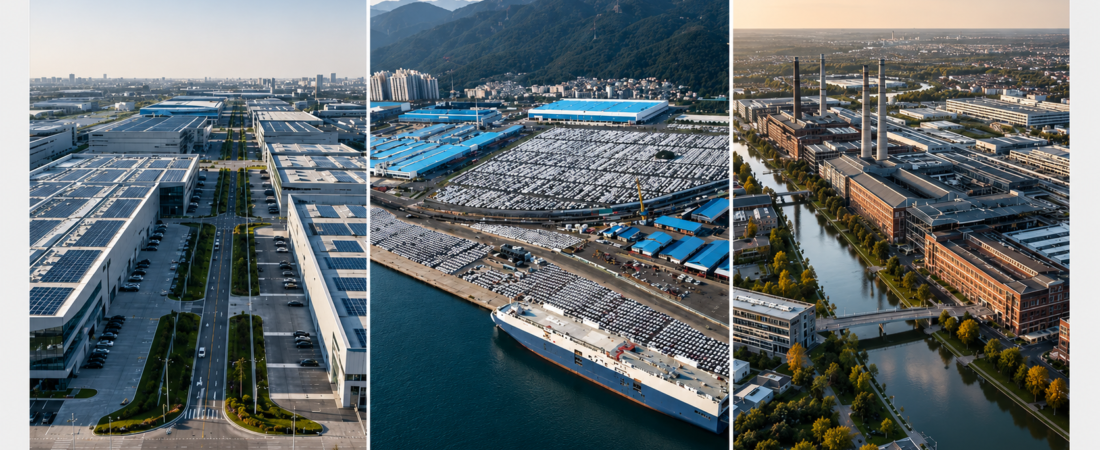
The three sites represent different institutional and spatial models of automobile-led urbanization. BYD Zhengzhou is a rapidly expanding new-energy-vehicle district assembled through state-led land development and infrastructure provision. Hyundai Ulsan is a mature coastal export complex created during South Korea’s industrial takeoff and repeatedly enlarged within its original location. Volkswagen Wolfsburg is an inland factory-city whose urban form, institutions and identity were built around one company and are now being tested by weaker European demand and industrial restructuring. Evidence was checked through 31 July 2026.
| Measure | BYD Zhengzhou | Hyundai Ulsan | Volkswagen Wolfsburg |
|---|---|---|---|
| Industrial origin | Agreement signed in September 2021; work began 37 days later; production started in 2023 | Ulsan designated a specific industrial zone in 1962; Hyundai plant completed in 1968 | Factory and workers’ city founded under the Nazi regime in 1938 |
| Physical setting | Flat inland development zone southeast of Zhengzhou, near the airport and new road and rail infrastructure | Coastal heavy-industrial belt with a factory-owned export dock | Inland canal-side complex immediately north of the planned city |
| Area | No settled public factory boundary. A secondary satellite estimate put the associated footprint at about 22.5 km2 in late 2025; the officially planned 31.4 km2 Auto City includes suppliers, services and urban-support land | About 5.0 km2 for the complex; the new 548,000 m2 EV-plant site is within that property | 6.5 km2, including 1.6 km2 of factory halls |
| Production organization | Vehicle assembly, batteries, power systems, molds and components in an integrated NEV cluster | Five established vehicle plants, engine and transmission production, research functions and export dock; dedicated EV plant due to begin operating in Q4 2026 | Vehicle assembly, components, headquarters and a large technical-development center |
| Recent plant figure | 545,000 vehicles in 2024; cumulative output exceeded one million by the end of 2025 | Hyundai Korea states annual capacity of 1.41 million; other Hyundai and trade pages cite 1.5-1.6 million, using different dates and definitions | Latest readily available official annual output: 490,000 vehicles in 2023 |
| Approximate workforce | About 60,000 in early February 2025, before a planned recruitment drive | About 34,000 on Hyundai’s current Korean plant page | About 60,500-70,000, depending on date and inclusion of headquarters, development and support functions |
| Public interface | Brand test circuit and science museum in the wider district; no dependable evidence of routine public production-line tours | Advance-reservation factory visits and a heritage exhibition; access remains controlled | Autostadt, bookable production tours and a forced-labor memorial inside the plant |
The figures are not fully equivalent. BYD land data often merges the factory with a larger supplier, service and residential district. Hyundai sources variously describe 1.41 million vehicles as current capacity, 1.5 million as annual production and 1.6 million as capacity. Volkswagen employment counts can include headquarters, technical development and central services. These differences are part of the comparison: each institution defines its industrial place differently.
Location and physical setting
BYD Zhengzhou occupies extensive, recently urbanized land in the Zhengzhou Airport Economy Zone, about 25 kilometers southeast of central Zhengzhou. The zone’s approved planning area is 747 km2 and is organized around Zhengzhou Xinzheng International Airport, high-speed and intercity rail, metro lines and expressways. The factory is therefore not a conventional inner-city works beside established neighborhoods. It forms part of an aerotropolis-scale growth corridor in which industrial estates, logistics yards, broad arterial roads, worker accommodation and new commercial services are being built together.
The setting is inland and predominantly flat, near the transition to the lower Yellow River alluvial plain. That terrain offers large contiguous parcels but has a long history of drainage, flood and drought management. The plant has no direct seaport or navigable canal, so export vehicles must travel overland to border crossings or distant ports. Its spatial advantage is abundant development land and multimodal connectivity rather than immediate maritime access.
Hyundai Ulsan occupies a different type of location: a dense coastal-industrial setting in southeastern South Korea. The city combines the Taehwa River and East Sea waterfront with port facilities, petrochemical estates, shipyards, machinery firms and vehicle production. Ulsan Port handled 197.304 million tonnes of cargo in 2025. The automobile works is one element of a much larger heavy-industrial basin, not an isolated manufacturing enclave.
The waterfront shortens the physical chain between assembly and ocean shipping. Finished vehicles can move from production and storage areas to roll-on/roll-off vessels within the complex. This gives Ulsan the most direct plant-to-ocean relationship of the three sites, without implying that every component is locally sourced or every vehicle leaves by sea.
Volkswagen Wolfsburg lies on the Mittelland Canal between Hanover and Magdeburg. The main factory occupies the north side of the canal and railway corridor, while the central city developed largely to the south. From the railway station and city center, the power-station chimneys and extensive brick production halls remain the dominant elements across the water and tracks.
Wolfsburg has neither Ulsan’s maritime access nor Zhengzhou’s recently assembled industrial land. It is a legacy inland logistics node that has expanded within an established urban and regional structure. Dense German and European rail and road networks support distribution, but major physical conversion must occur inside an interdependent headquarters campus rather than on an unconstrained greenfield site.
Origins and historical development
BYD Zhengzhou was built through accelerated contemporary industrial policy. BYD and the Zhengzhou Airport Economy Zone signed an agreement in September 2021. Work reportedly began 37 days later, and the project reached production within 17 months in 2023. By the end of 2025, cumulative output had exceeded one million vehicles. The speed reflects coordinated land assembly, infrastructure, permitting and supplier recruitment rather than gradual expansion over several industrial generations.
The Airport Economy Zone predates BYD. Initiated in the late 2000s and nationally approved in 2013, it was planned as a combination of logistics, advanced manufacturing and new urban districts. BYD changed its industrial emphasis by adding a large automobile-production core. Local authorities describe a 31.4 km2 Auto City built around the project, but that figure is a development-program boundary rather than a surveyed factory boundary.
Hyundai Ulsan emerged from South Korea’s postwar industrialization. Ulsan became a Specific Industrial Zone in January 1962. Hyundai Motor was established in 1967 and completed its Ulsan assembly plant in 1968. Its first vehicle was the Ford Cortina, assembled with Ford. The Pony, introduced in the mid-1970s, marked the move from licensed assembly toward a domestically directed production and export system, although its design and engineering drew on international specialists and components.
Ulsan then grew through cumulative specialization. Additional assembly plants, engine and transmission production, research facilities and an export dock were added around the original works. The current electrification program follows that pattern. A dedicated EV plant is being inserted on the former proving ground, while a hydrogen fuel-cell plant is planned on the site of former internal-combustion transmission production. Established industrial land is being reassigned rather than abandoned.
Wolfsburg has the most politically burdened origin. The factory and the “City of the KdF Car” were founded in 1938 as a National Socialist mass-motorization project. Promised civilian mass production did not occur before the plant shifted to military production during the Second World War. Jewish and non-Jewish forced laborers, prisoners of war and concentration-camp inmates worked at the site. The United States Holocaust Memorial Museum records four concentration camps and eight forced-labor camps on Volkswagen property; forced laborers eventually made up about 60 percent of the workforce.
American troops liberated the plant and about 7,700 forced laborers on 11 April 1945. Under British military administration, the works was retained and civilian production restarted. Refugees, displaced people and later foreign workers supported postwar expansion. Wolfsburg’s prosperity rests on a sharp institutional rupture: a Nazi armaments factory-city became a major West German employer and exporter, while its wartime history remained embedded in the place.
Site scale, spatial form and land use
BYD Zhengzhou is the hardest site to measure. The official 31.4 km2 boundary belongs to Zhengzhou Airport Auto City and includes suppliers, aftermarket activities, commercial and residential support, and other manufacturers. A secondary analysis of satellite imagery estimated a visible BYD-associated footprint of about 22.5 km2 by late 2025, while another site-visit report used 10.67 km2. These are different spatial definitions, not reliable measurements of one cadastral factory parcel. The defensible conclusion is that Zhengzhou is the most expansive district-scale development when associated construction and suppliers are included; an exact like-for-like plant area is unavailable.
Its form is horizontal and district-like: large single-story production buildings, battery and component facilities, vehicle yards, construction parcels, internal roads, dormitories, service areas and an all-terrain vehicle circuit. The weak distinction between factory, supplier park and new town is itself significant. It lets production and urban-support functions expand together, but it also lengthens internal journeys and concentrates several stages of the production chain in one infrastructure district.
Hyundai’s Ulsan complex covers about 5.0 km2 and contains five established vehicle factories, with the new EV plant occupying a 548,000 m2 site within the property. Production halls, internal circulation, storage yards, engine and transmission operations, research functions and the shipping dock form a dense compound. Future production increasingly requires infill or the replacement of older uses.
Wolfsburg covers 6.5 km2, including 1.6 km2 of halls, 75 kilometers of roads and 60 kilometers of railway track. Headquarters, technical development, components, assembly, power generation and logistics share the campus. Its built form records repeated adaptation: early brick halls and power stations coexist with newer production equipment, research buildings, offices and Autostadt. Conversion therefore affects a linked headquarters and engineering system, not only assembly machinery.
Production system and industrial specialization
BYD Zhengzhou specializes in new-energy vehicles but is not battery-electric only. In 2024 it produced 545,000 vehicles, 169.8 percent more than in 2023. Reported models included the Song Pro, Song L DM-i and Seal 07 DM-i, combining battery-electric and plug-in-hybrid production. The wider base also contains or is adding battery, power-system, mold and component operations.
This arrangement reflects BYD’s wider vertical-integration model. Assembly sits near battery cells and packs, power electronics, molds and other component production, and more than 100 upstream and downstream firms have reportedly accumulated around the project. Colocation can shorten material movements and engineering feedback loops, but public information does not establish supplier ownership, inventory levels or dual-sourcing resilience. The same concentration also creates common exposure to local power, drainage, transport and workforce disruptions.
Local sources say selected lines are 98 percent automated and can release a vehicle in under one minute. Those are company or government performance claims, not independently audited measures. The definition of automation is unclear, and a line-cycle time is not annual output. The more comparable evidence is the documented 2024 plant output and the cumulative one-million-vehicle milestone.
Hyundai Ulsan manages a large, mature and mixed-powertrain portfolio. Hyundai’s current Korean plant page lists five vehicle factories, 15 models, about 34,000 employees and annual capacity of 1.41 million vehicles. A Hyundai European heritage page cites 1.6 million capacity, while a 2025 trade feature describes approximately 1.5 million annual production and 18 models. Those figures should not be collapsed into one precise current output number.
Electrification is being added through a dedicated plant with nominal capacity of 200,000 vehicles a year. Hyundai originally scheduled mass production for the first quarter of 2026; an official July 2026 update moved expected operation to the fourth quarter. The company says the plant may eventually accommodate as many as 12 EV models using robotics, digital simulation, predictive maintenance and flexible production. Planned capacity is not current output, and no initial utilization rate has been disclosed.
Ulsan is also retaining propulsion diversity. A new hydrogen facility is planned to manufacture 30,000 fuel-cell units annually from 2027, while existing plants continue to produce combustion-engine, hybrid and electric vehicles. This flexibility spreads product-market risk but requires parallel equipment, skills and supply chains.
Wolfsburg currently produces the Golf family, Tiguan, Touran and Tayron, alongside components such as drive shafts and injection-molded parts. It also contains Volkswagen Passenger Cars headquarters and a technical-development center that Volkswagen said employed about 11,500 people in 2022. The site’s role therefore combines assembly, components, engineering and corporate administration.
Its central problem is underused and costly legacy capacity rather than an absence of technology. Volkswagen’s December 2024 agreement with employee representatives called for assembly lines to fall from four to two, Golf and Golf Estate production to move to Puebla from 2027, and about 4,000 technical-development jobs in Wolfsburg to be cut by 2030. In July 2026 Volkswagen officially announced a group target of approximately nine million vehicles of capacity and a model-range reduction of up to 50 percent. Reports identified Emden, Hanover, Zwickau and Audi’s Neckarsulm site as possible closure candidates, but those closures were not adopted in the official plan and Wolfsburg was not among the reported candidates.
The comparison is therefore not simply new against old. BYD has the newest and most battery-centered base, but part of its vehicle output is plug-in hybrid. Hyundai is adding a dedicated EV plant while preserving a large mixed-powertrain system. Wolfsburg has the oldest physical plant and the clearest contraction pressure, but it retains engineering, component and institutional functions that assembly volume does not measure.
Transport, logistics and regional embedding
Zhengzhou’s logistics advantage is multimodality. The Airport Economy Zone combines aviation, high-speed and intercity rail, metro and expressways. The planned Zhengzhou International Land Port covers about 50 km2 and connects with major national rail corridors. Its western operating area recorded more than 100,000 vehicle arrivals and departures in the first five months of 2026. That total covers vehicles handled by the port.
The airport is central to the district’s development model but is not the main mode for finished automobiles. Vehicles move by road or rail to domestic markets, border crossings and seaports; BYD’s roll-on/roll-off fleet then handles part of the ocean leg. Zhengzhou has broad route choice and strong access to China’s domestic market, but export involves longer inland movement and more transfers than Ulsan. No reliable public modal split is available for Zhengzhou-built vehicles.
The BYD base has become an anchor of the Airport Zone’s current industrial expansion. A March 2026 provincial account said the base produced about 70 percent of Henan’s NEVs, while Zhengzhou as a whole accounts for more than 80 percent of Henan’s total automobile output. More than 100 upstream and downstream firms have reportedly gathered around the project. These figures establish industrial concentration, but they do not by themselves quantify the zone’s employment, fiscal or value-added dependence on BYD.
Ulsan has the most direct plant-to-ocean export system. Vehicle storage and the factory dock sit beside production, allowing finished cars to be driven onto vessels without an intermediate railway journey to another port.
Hyundai Motor is a major regional anchor, but Ulsan also contains large petrochemical, shipbuilding, machinery and port-service industries. In 2024 the city accounted for 24.2 percent of South Korea’s automobile manufacturing output by value, while also holding large national shares in petrochemicals and shipbuilding. Sectoral diversity makes Ulsan less legible as a single-company city than Wolfsburg, although a full dependence comparison would require regional employment, value-added and fiscal data.
Wolfsburg’s rail network and canal-side position connect the works to continental supply and distribution systems. The canal mattered to the original site choice, but finished-car distribution now relies heavily on rail and road. Volkswagen does not publish a current plant-level modal split.
The relationship with the host city is more direct than at the other two sites. Wolfsburg was created to house the plant workforce; the city center, station, Autostadt and factory still face one another across the canal and tracks. Volkswagen employs roughly 60,500-70,000 people at the site in a city of about 126,000 residents, although many employees commute and the workforce figure includes non-production functions. The scale clearly exposes suppliers, retailers, civic institutions and municipal finances to Volkswagen’s performance, but the article’s sources do not support a precise dependency ratio.
Workforce, social geography and public inclusion
BYD employed about 60,000 people in Zhengzhou by early February 2025 and announced plans to recruit another 20,000 during the first quarter, including manufacturing and research roles. Government media reported that more than 90 percent of the existing workforce came from Zhengzhou or surrounding areas. The local share is plausible in Henan’s large labor market but comes from official reporting rather than a published workforce dataset.
The site combines regional recruitment with an enclave-like employment landscape. Public accounts refer to company accommodation, shuttle services and on-site facilities that respond to the distance from central Zhengzhou and the scale of shift work. They also make the employer a provider of daily mobility and services. Independent data on dormitory occupancy, rents, hours, pay, worker representation, subcontracting, injuries and turnover remain sparse. The site’s physical expansion is therefore much more visible than its employment conditions.
Public access in the wider Zhengzhou district focuses on products and technology. BYD opened an all-terrain NEV circuit in August 2025, and the D Space NEV science museum opened in Zhengzhou in 2024. The circuit creates a civilian-facing edge to the industrial district, but it is a branded driving facility rather than routine access to production, labor history or environmental performance. No dependable evidence was found of regularly bookable production-line tours for ordinary visitors.
Hyundai Ulsan employs about 34,000 people on the company’s current Korean plant page. Its labor institutions developed over decades and can interrupt production. Hyundai’s Korean union had about 40,000 members across Ulsan, Asan and Jeonju in 2025.
Ulsan’s public interface is controlled but real. Hyundai operates an online reservation system for plant visits, and a heritage exhibition has been advertised as public. These facilities interpret production largely through corporate history and technology.
Wolfsburg’s workforce is difficult to separate from headquarters. Volkswagen reported about 70,000 employees at the site in its March 2024 plant profile, while a careers page gives about 60,500. That concentration provides high-skilled engineering and administrative work as well as production jobs, while exposing the city to white-collar and development cuts.
Migration has repeatedly reshaped Wolfsburg. Volkswagen recruited Italian workers from 1962 and housed many in a segregated settlement known as the Italian Village. Some returned to Italy; others settled and helped create a lasting Italian-German community. The episode shows how the factory produced residential and cultural geographies beyond the original German workers’ city.
Wolfsburg has the broadest documented public interface. The 28-hectare Autostadt combines customer collection, brand pavilions, landscaped areas and a mobility museum. Visitors can book a production-dependent weekday factory tour lasting about one hour. The plant also contains a free, appointment-only memorial to forced labor, with German- and English-language tours and wheelchair-accessible archives and exhibition areas.
Environmental impact, resilience and disclosure
BYD Zhengzhou’s product mix includes battery-electric vehicles, which have no tailpipe emissions and can have lower life-cycle emissions under favorable electricity and battery-supply conditions. That does not make the industrial site emission-free. Battery-cell production, metal forming, painting, plastics, heating, electricity and logistics all create environmental burdens.
Comparable plant-level data are unavailable. Environmental-assessment notices confirm further battery and component projects, but accessible summaries do not provide a consolidated annual inventory for the full Zhengzhou base. BYD’s corporate sustainability reporting is global and does not disclose Zhengzhou-specific Scope 1 and 2 emissions, electricity mix, water withdrawal, wastewater, waste or local air emissions. Among the three sites, Zhengzhou has the thinnest publicly accessible plant-level environmental record.
Its setting raises resilience questions that should not be converted into unsupported risk scores. The lower Yellow River plain has a long history of flood, drainage and drought management, and the district’s paved area increases the importance of stormwater systems. No public site-specific assessment was found that would support a factory flood probability. Concentrated assembly, battery, supplier and worker-accommodation functions also share exposure to local power, transport and water interruptions.
Hyundai provides the strongest plant-specific operational carbon disclosure among the three. Its independently verified 2026 sustainability report gives 2025 Ulsan Scope 1 emissions of 334,683.517 tCO2e and location-based Scope 2 emissions of 579,139.909 tCO2e, with a reported combined total of 913,823 tCO2e. Energy consumption was 3,153,708 MWh, of which 10,906 MWh was renewable – about 0.35 percent.
Hyundai reports about 15 MW of photovoltaic capacity across Ulsan roofs, the logistics-tower parking structure and the EV plant. It is also procuring renewable electricity through a Korean power-purchase agreement. The small renewable share in the 2025 inventory shows that the transition was still at an early stage even as procurement and on-site capacity expanded.
Ulsan’s environmental burden also belongs to a wider industrial basin of refining, petrochemicals, shipbuilding, automobile production and port activity. Local air and water impacts cannot be attributed to Hyundai alone. Hyundai’s 2026 report records a KRW 30 million fine at Ulsan for violations of the Clean Air Conservation Act and environmental testing and inspection rules, showing that a formal management system does not eliminate compliance failures.
The coastal site is exposed to typhoons, intense precipitation and maritime disruption. Its private dock reduces normal export transfers but becomes a critical interface when shipping stops. Hyundai’s 2026 report includes group-level physical-risk analysis, but no public plant-specific adaptation model was found that permits a quantified comparison with Zhengzhou or Wolfsburg.
Volkswagen’s plant profile reports a 38.1 percent reduction in a composite production-related environmental-impact indicator at Wolfsburg relative to 2010. The profile does not provide a transparent current plant emissions inventory or explain the indicator well enough for direct comparison with Hyundai’s verified GHG figures.
The clearest intervention is the conversion of Volkswagen’s cogeneration system from hard coal to natural gas. The North/South conversion was completed in 2021, the West gas-and-steam facilities were commissioned in December 2023, and the last West coal blocks shut on 1 April 2024. Volkswagen states that the full conversion can reduce power-and-heat emissions by about 1.5 million tonnes of CO2 a year, roughly 60 percent relative to the former system. That is a company estimate; natural gas remains a fossil fuel exposed to carbon-price, supply and methane risks.
The power stations demonstrate the interdependence of factory and city because they provide power and heat to the plant and district heating to Wolfsburg. Combined heat and power can improve energy efficiency, but it ties part of urban heat provision to automobile-company infrastructure.
In the evidence reviewed, economic and technological restructuring is Wolfsburg’s most visible current resilience issue. The planned halving of assembly lines, transfer of Golf production and repeated group restructuring show adaptation under contraction.
No defensible ranking of total environmental performance is possible. Hyundai discloses the most usable plant-level emissions data, but better disclosure must not be mistaken for worse performance. BYD produces a high share of electrified vehicles but publishes the least plant-specific environmental information. Volkswagen documents a major energy conversion but lacks an equally current, consolidated plant inventory in the reviewed sources.
Distinctive place identity and final takeaway
Zhengzhou is a factory-led new urban district whose identity comes from speed, scale and integration. Production, suppliers, batteries, worker accommodation, logistics and consumer facilities have expanded together. Its publicly accessible social and historical record is thinner and more recent than those of Ulsan and Wolfsburg, and key boundaries between company land, supplier land and public city remain unclear.
Ulsan is a port-industrial production landscape. The automobile works combines high-volume assembly with direct maritime export inside a city also shaped by shipbuilding, petrochemicals and machinery. Its identity is less that of a company town than a diversified national industrial city, although Hyundai remains a major anchor.
Wolfsburg is a factory-city in the literal sense. Volkswagen preceded the completed city, influenced housing and migration, supplies part of its energy and concentrates a workforce unusually large relative to the population. Autostadt and the forced-labor memorial place corporate presentation and historical responsibility beside the works. The same concentration makes industrial contraction a citywide concern.
The three places should therefore be read across separate dimensions. Zhengzhou illustrates a state-enabled, vertically integrated automobile district built at exceptional speed, but its exact footprint, labor conditions and environmental record are least transparent. Ulsan has the most direct relationship between mass assembly and ocean export and the strongest plant-specific emissions disclosure, but it operates within a dense coastal heavy-industrial basin. Wolfsburg has the deepest documented urban and institutional relationship with its manufacturer and the most formalized labor representation, but it is also the site most visibly adapting to structural downsizing.
Sources
- Zhengzhou Airport Economy Zone: 2024 output, employment and local recruitment
- Zhengzhou Airport Economy Zone: Auto City scale and cumulative output, July 2026
- Henan government: BYD Zhengzhou share of provincial NEV output
- Zhengzhou government: city share of Henan automobile production
- Henan government: BYD D Space and project-development timeline
- Zhengzhou Airport Economy Zone: International Land Port vehicle handling, 2026
- Business Insider Japan: satellite estimate of BYD-associated footprint
- Hyundai Korea: Ulsan plant profile
- Hyundai Europe: heritage and 1.6-million capacity statement
- Hyundai: Ulsan EV-plant announcement
- Hyundai Motor Group: July 2026 Yeongnam industrial-hub update
- Hyundai: 2026 Sustainability Report
- Ulsan investment agency: port cargo
- Ulsan investment agency: automobile-industry data
- Autocar: 2025 Ulsan plant feature
- Yonhap: Hyundai partial strikes, July 2026
- Volkswagen: Wolfsburg plant profile
- Volkswagen: Wolfsburg employment profile
- Volkswagen: 49-million-vehicle milestone and current model list, February 2026
- Volkswagen: December 2024 company and employee agreement
- Volkswagen Group: July 2026 future plan
- Volkswagen Group: 2025 Annual Report climate section
- US Holocaust Memorial Museum: Volkswagen and forced labor
- Volkswagen: liberation of the plant and forced laborers
- Autostadt: Volkswagen factory tour
- Volkswagen Group: Place of Remembrance visitor information