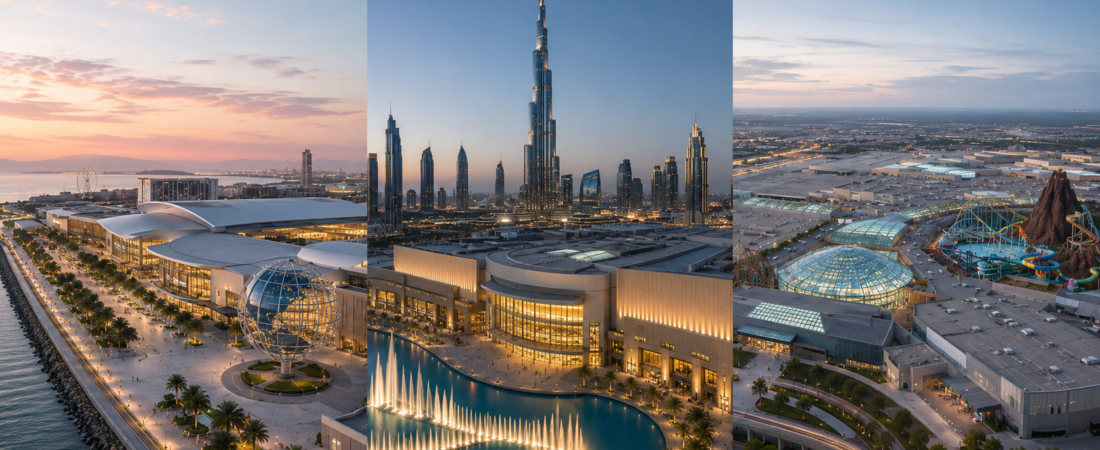
SM Mall of Asia (MOA), Dubai Mall and West Edmonton Mall (WEM) represent three forms of mall urbanism. MOA is the retail anchor of a bayfront business and entertainment district built on reclaimed land. Dubai Mall is part of a dense, tourism-oriented downtown development. WEM is a suburban retail and entertainment complex designed as an enclosed destination in its own right.
The published area figures are not fully equivalent. MOA is commonly measured by gross floor area, Dubai Mall by total built area and WEM by gross building area. The figures below describe their reported scale without presenting them as a precise ranking.
| Measure | SM Mall of Asia | Dubai Mall | West Edmonton Mall |
|---|---|---|---|
| Place model | Mall-led bayfront district | Downtown tourism and retail anchor | Suburban retail-entertainment destination |
| Setting | Reclaimed Manila Bay land in Pasay | Downtown Dubai, beside Burj Khalifa and Dubai Fountain | West Edmonton, surrounded by established neighbourhoods and commercial development |
| Opening | 21 May 2006 | 4 November 2008 | 1981, followed by later phases |
| Developer and ownership | SM Prime | Emaar Properties | Triple Five Group |
| Reported scale | About 407,000 m² gross floor area in the current Pasay city profile | About 1,124,000 m² total area | About 5.3 million ft², or 492,000 m², gross building area |
| Public transport | Bus and road access; no direct rail connection | Dubai Metro Red Line | Bus transit centre; Valley Line West LRT under construction |
| Publicly reported visits | No current MOA-only figure published | 111 million in 2024 | Approximately 30.8 million annually |
Regional setting and development
MOA occupies reclaimed land in Pasay within the Bay City reclamation area. The Philippine Reclamation Authority identifies Central Business Park I-A as a 200-hectare reclaimed district whose major landowners include SM Group, Metrobank Group and the authority. SM Prime describes the mall as the anchor of its 60-hectare Mall of Asia Complex.
The distinction between mall and complex is important. MOA itself contains the main retail, dining and entertainment spaces. The wider Mall of Asia Complex contains offices, residences, hotels, SMX Convention Center, Mall of Asia Arena and waterfront leisure uses. Together they form a privately developed mixed-use district rather than a stand-alone shopping building.
Dubai Mall forms part of Emaar’s two-square-kilometre Downtown Dubai development. The district combines the mall with Burj Khalifa, housing, hotels, offices, Dubai Opera and the fountain precinct. The mall opened in November 2008 as one of Downtown’s principal public destinations. Emaar Properties is listed on the Dubai Financial Market; Dubai Holding, owned by the Government of Dubai, held 29.73% of its shares after a May 2026 transaction.
WEM opened in west Edmonton in 1981 and expanded in phases. Its growth produced a large, internally varied complex instead of a single uniformly planned building. It is owned and operated by Triple Five Group, controlled by the Ghermezian family. Although originally developed near Edmonton’s suburban edge, WEM is now surrounded by established residential districts, commercial sites, a hospital and arterial roads.
The development models are therefore distinct. MOA became the nucleus of a new waterfront district; Dubai Mall was planned as one component of a high-density central development; WEM accumulated retail, leisure and hospitality functions within an expanding suburban complex.
Scale and spatial form
MOA has the least settled public area figure. The Pasay City Government gives approximately 407,000 m² of gross floor area. The Philippine Reclamation Authority publishes a historical figure of 386,000 m², while SM Prime described the mall as more than 400,000 m² at opening. Larger figures in secondary sources appear to include later expansion or use a wider boundary.
The original mall comprised the Main Mall, the open-air Entertainment Mall and North and South Parking Buildings connected by walkways. Subsequent redevelopment and additions have expanded this arrangement. Mall of Asia Arena and SMX Convention Center remain separate venues within the wider complex and are not included here as internal mall space.
Emaar reports a total area of approximately 1,124,000 m² for Dubai Mall. Its retail and leisure areas form a largely continuous, multi-level interior connected to Downtown Dubai, nearby hotels and the fountain precinct. Figures of approximately 550,000 m² of internal floor area and 350,000 m² of leasable area describe narrower measurements of the same property.
WEM reports 5.3 million square feet, or approximately 492,000 m², of gross building area. Its principal retail levels are divided into colour-coded phases and themed areas. Stores, attractions, hotels and services are embedded within the same extensive building, creating a sequence of interior districts.
Dubai Mall has the largest reported total-area figure. WEM is smaller by gross building area but contains an unusually large concentration of internal leisure and hotel functions. MOA distributes more of its destination activity across the surrounding mixed-use complex.
Urban integration and transport
MOA is tied to the wider Mall of Asia district through offices, residences, hotels, conventions, concerts, sport and waterfront activity. These uses generate movement beyond shopping hours and draw visitors between several buildings and outdoor spaces. The open-air Entertainment Mall and bayfront edge also give MOA a stronger outdoor component than either Dubai Mall or WEM.
Access remains based mainly on buses, taxis, ride-hailing services and private vehicles. MOA has no direct rail connection. Passengers arriving by LRT-1 must transfer to road-based transport. The official LRT-1 southern extension serves Redemptorist–ASEANA, MIA Road, PITX/Asia World, Ninoy Aquino Avenue and Dr. Santos.
Dubai Mall has the strongest current rail connection. Burj Khalifa/Dubai Mall station is on the Metro Red Line, with a climate-controlled pedestrian connection into the Downtown area. The Roads and Transport Authority and Emaar are expanding the station to increase its daily capacity to 220,000 passengers. Taxis, buses, private vehicles and extensive parking supplement the Metro connection.
WEM is served by Edmonton’s road and bus networks. Its transit centre is on 90 Avenue, and Dedicated Accessible Transit Service stops operate at several entrances. The immediate road structure is formed by 170 Street and 87 Avenue.
The Valley Line West project will add an elevated station at WEM. The City of Edmonton expects construction to finish in 2028, followed by testing and commissioning. The line will connect the mall more directly with central Edmonton and the rest of the Valley Line corridor.
Retail, leisure and public role
MOA combines retail, dining, cinemas, an ice rink and event spaces. The surrounding complex extends the visitor offer through the arena, convention centre, hotels and waterfront attractions. The Pasay City Government reports more than 1,000 shops, although the total changes with tenant turnover and the boundary used.
Dubai Mall reports more than 1,200 shops and more than 200 dining venues. Its attractions include Dubai Aquarium and Underwater Zoo, Dubai Ice Rink, KidZania, Play DXB and a large cinema complex. The connection with Burj Khalifa and the fountain precinct makes it part of a wider sightseeing circuit as well as a shopping destination.
WEM reports more than 800 stores and services, more than 100 dining venues, 16 attractions and two hotels. World Waterpark, Galaxyland and the Ice Palace are major parts of the complex rather than small supplementary amenities. The hotels and indoor attractions support longer visits and reinforce WEM’s resort-like character.
The principal difference is spatial. WEM concentrates shopping, leisure and accommodation inside one enormous enclosure. MOA spreads major functions across a waterfront district. Dubai Mall combines a huge interior complex with closely integrated outdoor landmarks and high-rise uses.
These are also privately managed public-facing places. Visitors can enter without buying a ticket, move through common areas and use them as meeting places, but access and behaviour remain governed by mall rules. Their public role is therefore substantial but conditional on private ownership and commercial management.
Attendance and economic role
Emaar reported 111 million visits to Dubai Mall in 2024, six per cent more than in 2023. The mall’s position beside Burj Khalifa and the fountain makes it a central part of Dubai’s tourism economy as well as its retail market.
WEM reports average annual attendance of approximately 30.8 million and describes the complex as Alberta’s leading tourist attraction. Its economic role combines metropolitan retail, hospitality, entertainment and destination tourism.
SM Prime does not publish a current MOA-only attendance figure. Its 1.4 billion visits in 2025 covered the entire Philippine SM Supermalls network, not MOA individually. MOA’s economic role is clearest in the concentration of retail, events, hotels, offices and residences that has developed around it in Pasay.
Physical accessibility, neurodivergence and noise
Dubai Mall and WEM publish detailed information on physical access. Dubai Mall provides wheelchairs, strollers, guest-service desks, porter services, prayer rooms, taxi support and public-transport assistance. WEM’s accessibility information covers ramps, automatic entrance doors, elevators, accessible washrooms, wheelchair and scooter rental, service animals, accessible digital directions and Dedicated Accessible Transit Service stops.
MOA added a significant sensory-accessibility facility in January 2026. The Philippine Department of Social Welfare and Development and SM Supermalls opened the country’s first mall-based Sensory Lab at MOA. It provides a controlled environment for autistic people, other neurodivergent visitors and people who need relief from sensory stimulation. The separate MOA Arena also hosts the annual Angels Walk for Autism and presents itself as a PWD-friendly venue.
At Dubai Mall, several Emaar attractions—including Reel Cinemas, Dubai Aquarium and Underwater Zoo, Dubai Ice Rink, KidZania and Play DXB—hold Certified Autism Center designations. Staff receive autism-specific training, and sensory guides identify noise levels, lighting intensity and possible triggers. These measures apply to named attractions rather than automatically to every corridor, shop and public area in the mall.
WEM’s current accessibility page concentrates on mobility and does not list a permanent sensory room, a whole-mall sensory map or regular reduced-stimulation shopping hours. Sensory-friendly Santa visits have been held before normal opening, but an occasional event does not provide an everyday low-stimulation option.
Noise and sensory intensity vary sharply within all three places. Crowds, public-address systems, background music, cinemas, arcades, rides, restaurants and live events can overlap. MOA also has traffic and outdoor-event noise across the wider complex. Dubai Mall’s aquarium, ice rink, entertainment attractions and large atria create abrupt changes in sound and light. At WEM, amusement rides, the waterpark, ice rink and themed entertainment sit close to retail circulation.
None of the three publishes continuous sound-level data for its common areas. MOA currently provides the clearest dedicated decompression space, while Dubai Mall provides the most developed attraction-specific sensory guidance. WEM documents physical accessibility well but gives neurodivergent visitors less advance information about noise, lighting and quiet spaces.
Environmental performance and resilience
MOA’s best-documented environmental project is its solar carpark. Completed in 2016, the 2.7 MW installation comprised approximately 10,426 panels and was expected to supply almost 20% of the mall’s electricity at completion. Its coastal reclaimed setting also makes drainage, subsidence, storm surge and rising sea levels important long-term design and maintenance issues.
Dubai Mall achieved LEED Platinum certification under the LEED v4.1 Operations and Maintenance system in 2025; certification was recorded in January 2026. The certification covers operational practices in a building whose cooling, aquarium and ice-rink systems require substantial energy. Extreme heat makes cooling reliability and electricity demand central to the mall’s operation.
WEM has implemented lighting, fan-control and air-filtration improvements. A Natural Resources Canada case study documented lighting and variable-frequency-drive retrofits. A later BGE Clean Air case study reported longer filter life, lower air resistance, lower labour and disposal costs, and approximately 3,600 fewer discarded filters. WEM’s enclosed form must also maintain stable indoor conditions through Edmonton winters and periods of wildfire smoke.
The three properties disclose different parts of their environmental performance. MOA documents substantial on-site solar generation; Dubai Mall has current operational certification; WEM records a series of efficiency retrofits. Comparable figures for total energy, water, waste and operational emissions are not published for all three sites.
Distinctive identity and final takeaway
MOA is a mall-led waterfront district. Its globe, open-air entertainment areas and Manila Bay setting give it a recognizable identity, while the wider complex expands its role into business, conventions, sport, residence and leisure.
Dubai Mall is a downtown tourism anchor. Its identity depends on its connection with Burj Khalifa, the fountain precinct, high reported attendance and a concentration of retail and leisure attractions.
WEM is an interior resort and theme-park mall. Its phased layout, waterpark, amusement park, rink and hotels transform a suburban shopping centre into a regional destination.
MOA externalizes many activities into a mixed-use district; Dubai Mall joins an immense interior destination to a high-density metropolitan centre; WEM internalizes shopping, leisure and accommodation within a mature suburban complex. These different relationships between building, district and city are more significant than a simple ranking by floor area or visitor count.