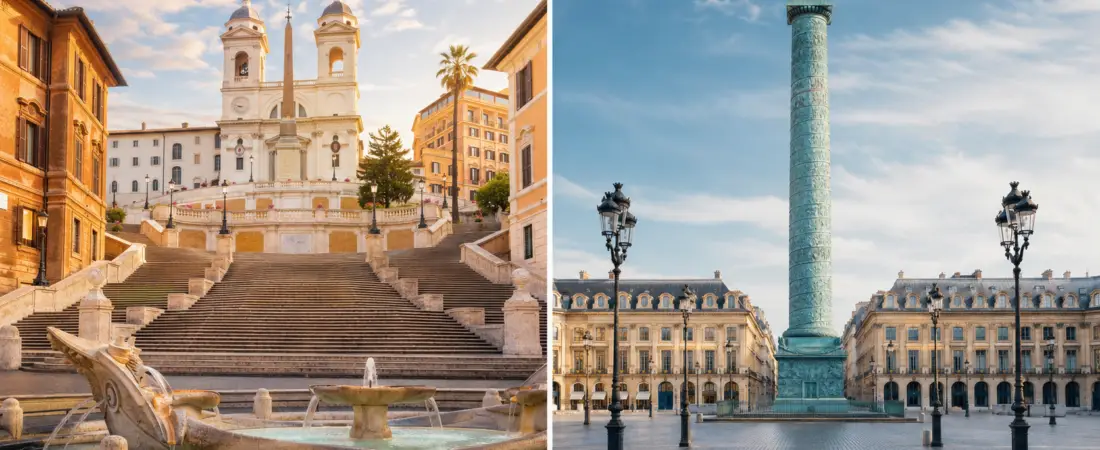
Piazza di Spagna and Place Vendôme occupy comparable positions in Rome and Paris: both are historic central spaces, internationally recognised luxury addresses and concentrated expressions of their cities. Their urban logic is opposite. Piazza di Spagna is an irregular, multi-level sequence shaped by movement, water and spectacle; Place Vendôme is a planned enclosure shaped by symmetry, uniform façades and a central monument.
Snapshot
| Criterion | Piazza di Spagna | Place Vendôme |
|---|---|---|
| Urban setting | Campo Marzio, below the Pincio Hill | Paris’s 1st arrondissement, between the Tuileries and Opéra |
| Spatial form | Irregular, porous and strongly vertical | Regular, enclosed and predominantly horizontal |
| Organising feature | Spanish Steps and Barcaccia fountain | Vendôme Column and uniform façades |
| Dominant movement | Climbing, descending, gathering and crossing | Circulating around the column and moving along a formal axis |
| Surrounding functions | Monuments, diplomacy, literature, hospitality and luxury retail | State institutions, luxury jewellery, hospitality and offices |
| Public-space character | Crowded visitor theatre | Ceremonial prestige space |
| Green space | Almost entirely mineral | Entirely mineral |
| Main constraint | Crowd pressure and restricted accessibility | Traffic, limited public comfort and commercial exclusivity |
| Core identity | Romantic urban theatre | Royal-imperial luxury geometry |
Location and urban form
Piazza di Spagna lies in Rome’s Campo Marzio district at the foot of the Pincio Hill. Via dei Condotti links the piazza to Rome’s principal luxury-shopping area, while the Spanish Steps rise toward Trinità dei Monti. The space therefore works horizontally as a street junction and vertically as a monumental hillside route.
Its form is best understood as a sequence rather than a single figure. The lower piazza bends around the Fontana della Barcaccia and opens into several streets. Built between 1723 and 1726, the Spanish Steps divide into curved and converging flights before reaching the upper terrace and the twin-towered church façade. The route, viewpoints and changing levels repeatedly redirect both movement and attention.
Place Vendôme occupies a flatter position in Paris’s 1st arrondissement. Rue de la Paix connects it northward toward Opéra; Rue de Castiglione leads south toward Rue de Rivoli and the Tuileries; Rue Saint-Honoré passes immediately beside it. Its rectangular plan, cut corners and consistent façades create an almost octagonal enclosure. The column fixes the centre, and the architecture subordinates individual buildings to a unified composition.
Piazza di Spagna operates as an unfolding urban sequence. Place Vendôme operates as a self-contained composition.
Accessibility and public use
Piazza di Spagna has direct metro access through Spagna station on Line A and strong walking connections to Piazza del Popolo, Via del Corso, the Trevi Fountain area and the Pincio. Its celebrated route to Trinità dei Monti, however, consists of multiple stair flights. Crowding, changes in level and uneven historic surfaces further limit physical comfort and universal access.
The fountain, branching streets and elevated viewpoints encourage movement, pausing and observation, although mass tourism now dominates the atmosphere. Rome’s 2019 urban-police rules restrict behaviour around historic monuments, and sitting on the Spanish Steps can be penalised. The rules expose a tension between the staircase’s traditional social function and its protection as a monument.
Place Vendôme has no station inside the square, but Tuileries, Opéra and Madeleine metro stations and the Auber RER station are nearby. Its flat layout makes orientation and crossing simpler, although curbs, stone surfaces and moving vehicles remain obstacles. Limited seating and almost no vegetation give visitors little reason to remain unless they are using the surrounding businesses or institutions.
POIs and surrounding functions
Piazza di Spagna combines monuments, diplomacy, literature, hospitality, residence and commerce. Its principal elements are the Spanish Steps, the Barcaccia fountain, Trinità dei Monti, Palazzo di Spagna, the Keats-Shelley House and the luxury shops around Via dei Condotti. The Keats-Shelley House preserves the apartment in which John Keats died in 1821, giving the square a direct connection to British Romanticism.
Place Vendôme has a narrower but more concentrated profile. The Vendôme Column, Ministry of Justice, Ritz Paris, offices and jewellery houses dominate the square and its continuation along Rue de la Paix. Residential use exists in both locations but is less visible than retail, hospitality and institutional activity around Place Vendôme.
Noise and air quality
The squares have different likely noise profiles, but available evidence does not support a precise ranking. Voices, tour groups and continuous pedestrian movement dominate Piazza di Spagna at busy times. At Place Vendôme, taxis, deliveries and through-traffic are more structurally embedded. Piazza di Spagna is therefore more exposed to crowd noise, while Place Vendôme is more exposed to routine traffic noise.
Neither square contains an air-quality monitoring station. Airparif reported a slight deterioration across Île-de-France in 2025 after long-term improvement, while ARPA Lazio reported no annual PM2.5 or nitrogen-dioxide limit exceedance at municipal level in the Rome agglomeration. The networks, models and geographic units differ, so the figures cannot support a reliable square-to-square ranking. Both locations remain dense central-city spaces affected by transport, commerce and extensive mineral surfaces.
Green space, heat and natural hazards
Neither square performs well as green public space. Piazza di Spagna consists mainly of paving, travertine stairs, façades and the Barcaccia fountain. The azaleas displayed on the Steps in spring are seasonal decoration rather than permanent landscape infrastructure. Place Vendôme is even more consistently mineral: its paved centre and stone façades provide virtually no vegetation or shade. The nearby Tuileries do not form an adjoining green edge.
Rome’s Mediterranean climate gives Piazza di Spagna a higher baseline exposure to prolonged summer heat. Place Vendôme has a cooler climatic context, but its exposed stone surface remains vulnerable during Parisian heatwaves. Both cities’ adaptation strategies identify shade, vegetation and reduced mineral exposure as important responses.
The regulatory seismic difference is clearer. Piazza di Spagna lies in Rome’s Municipio I, classified as seismic subzone 3A, indicating relatively low but non-zero hazard. Paris is in France’s Zone 1, denoting very low seismicity. Place Vendôme therefore has the lower current regulatory seismic classification.
Safety
No consistent public crime dataset isolates either square, so a categorical safety ranking would be unsupported. Both are prestigious, heavily visited central spaces where the main routine concerns are pickpocketing, distraction theft, crowd pressure and traffic rather than an unusually high violent-crime profile. Piazza di Spagna’s denser visitor concentrations may create more opportunities for theft; Place Vendôme’s open surface reduces crowd compression but exposes pedestrians more directly to vehicles.
Economic context
Both are luxury addresses, but their economic landscapes differ. At Piazza di Spagna, high-end retail forms part of a broader mixture of monuments, religious and diplomatic buildings, museums, hotels and residential property. The luxury axis is strongest along Via dei Condotti and adjoining streets rather than uniformly around the piazza.
At Place Vendôme, luxury is more concentrated and architecturally dominant. Jewellery houses, the Ritz and prestige offices occupy much of the visible frontage, while state uses reinforce the square’s exclusivity.
Property portals also indicate higher nominal residential values at Place Vendôme. SeLoger estimated an average apartment price of approximately €14,539 per square metre in January 2026; Immobiliare.it reported an average asking price of €7,825 per square metre for Piazza di Spagna in June 2026. Because the platforms, dates and methods differ, the figures indicate direction rather than an exact price ratio.
LGBTQ context
Neither Piazza di Spagna nor Place Vendôme is an LGBTQ district, so the comparison belongs at city and national-policy level. ILGA-Europe’s 2026 Rainbow Map scored France at 60% and Italy at 24% across its legal and policy criteria. The index measures legislation and public policy, not whether an individual visitor will feel welcome in a particular square. Both are international visitor environments, but Place Vendôme sits within the more protective national legal framework.
Heritage, institutions and symbolism
Piazza di Spagna forms part of the UNESCO-listed Historic Centre of Rome. The designation recognises the wider urban ensemble rather than the square as an isolated listing. Trinità dei Monti and Palazzo di Spagna embody French religious and Spanish diplomatic presence in papal Rome.
Place Vendôme is not individually inscribed on the UNESCO World Heritage List, but multiple buildings receive direct protection under the French historic-monument system. Official records protect façades, roofs and selected interiors at several addresses, including buildings occupied by the Ritz. The two systems are not directly rankable: Piazza di Spagna benefits from international recognition as part of a historic urban ensemble, while Place Vendôme has extensive building-by-building controls.
Their symbolic meanings follow their forms. Piazza di Spagna layers papal planning, Spanish diplomacy, a French church, Baroque engineering, British Romantic memory and modern luxury commerce. Its irregularity allows these elements to coexist visibly. Place Vendôme began as a royal statement under Louis XIV, acquired Napoleonic symbolism and later became an international address for jewellery and luxury hospitality. Political power was absorbed into a commercial language of prestige.
Curious facts
The Barcaccia’s low, half-submerged boat form responds partly to the weak water pressure available from the Acqua Vergine. Its theme is also traditionally associated with the Tiber flood of 1598, when floodwater reportedly carried boats into the area. Pietro Bernini constructed the fountain between 1626 and 1629.
The Vendôme Column has not remained politically stable. Erected under Napoleon to commemorate Austerlitz, it was pulled down during the Paris Commune in 1871 as a symbol of imperial militarism and later reconstructed. The episode places revolutionary destruction at the centre of what is now one of Europe’s most controlled luxury environments.
Conclusion
Piazza di Spagna offers the richer experience of movement, visual sequence and cultural mixture. Its fountain, streets, staircase, church and viewpoints turn the visitor into a participant in the composition. The same spatial intensity produces its main constraints: crowd pressure, difficult universal access, limited seating and conflict between public use and monument protection.
Place Vendôme offers the more coherent formal composition. Uniform façades, cut corners, a central column and axial streets create a controlled urban enclosure, but the square provides little greenery, limited public comfort and fewer reasons to remain outside its luxury economy. Piazza di Spagna is best understood as Romantic urban theatre; Place Vendôme as royal-imperial luxury geometry.
Scope and method
Square-level observations cover the open spaces and the buildings directly facing them. Noise, air quality, climate, safety and LGBTQ context rely partly on city-level evidence because comparable square-level datasets are unavailable. Property figures are indicative portal estimates, not directly comparable transaction data. Where evidence does not support a ranking, the comparison remains qualitative.
Sources
Accessed July 2026. Current figures retain the reference period stated by the originating source.
- Turismo Roma — Piazza di Spagna
- Turismo Roma — The Spanish Steps
- Turismo Roma — The Barcaccia Fountain
- Turismo Roma — May in Rome: Capitoline azaleas
- Keats-Shelley House — Museum and collection
- Paris je t’aime — Place Vendôme
- Paris je t’aime — The Vendôme Column
- Roma Capitale — Urban Police Regulation, Resolution No. 43 of 2019
- Bruitparif — Strategic noise maps for Île-de-France
- Airparif — Air quality assessment for Île-de-France in 2025
- ARPA Lazio — Air quality assessment for Lazio in 2025
- Roma Capitale — Climate Adaptation Strategy
- City of Paris — Paris Climate Action Plan 2024–2030
- Paris je t’aime — Visitor safety guidance
- Roma Capitale — General Civil Protection Plan: Seismic Risk
- Prefecture of the Île-de-France Region — Natural and technological risk statement for Paris
- SeLoger — Residential price estimate for Place Vendôme
- Immobiliare.it — Residential asking-price estimate for Piazza di Spagna
- ILGA-Europe — Rainbow Map 2026
- UNESCO World Heritage Centre — Historic Centre of Rome
- French Ministry of Culture, POP database — Former hotels of Gramont and Crozat, now the Ritz
- French Ministry of Culture, POP database — Buildings at 2, 4 and 6 Place Vendôme