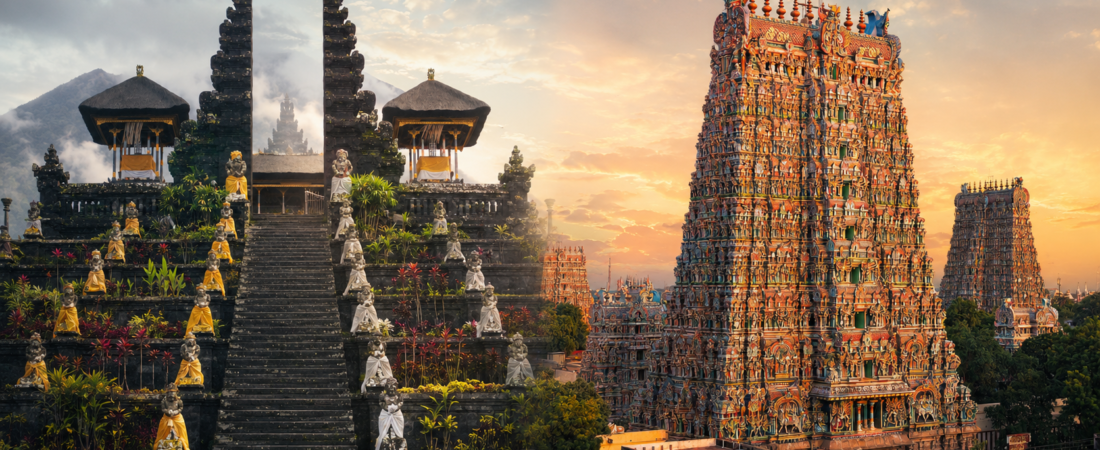
Pura Besakih is an upland Balinese temple federation on the slopes of Mount Agung, tied to island-wide sacred geography, customary communities, and a distributed ritual hierarchy. Meenakshi Amman Temple is the ritual center of an old South Indian temple-city, where streets, markets, festivals, and daily worship remain organized around a goddess-led Shaiva sacred core.
The comparison is useful because the two sites represent different forms of Hindu sacred space: one structured by mountain, ascent, and island-wide ritual geography; the other by urban density, processional streets, daily worship, and temple-city life. [1]
Comparison table
| Criterion | Analysis |
| 1. Religious identity and living function | Besakih works as Bali’s island-scale sacred system. Meenakshi works as a dense urban Shaiva temple where the goddess Meenakshi remains ritually central. |
| 2. Location and geographic setting | Besakih’s Mount Agung setting is part of its sacred meaning. Meenakshi’s lowland Madurai setting is defined by heat, traffic, and urban density. Besakih is shaped by mountain ascent; Meenakshi by city immersion. |
| 3. Scale, layout, and spatial hierarchy | Besakih rises through terraces and temple clusters. Meenakshi works through gates, enclosures, shrines, halls, and a sacred tank. |
| 4. Historical depth, continuity, and transformation | Meenakshi has clearer documented layers of literary memory, invasion, Nayaka rebuilding, and current restoration. Besakih has deep continuity, but its early chronology is partly tradition-based. |
| 5. Ritual life, pilgrimage, and festival calendar | Besakih reaches peak intensity through major Balinese pilgrimage cycles. Meenakshi has intense daily puja and city-scale festivals. |
| 6. Architectural language and visual identity | Meenakshi’s painted gopurams dominate the city image. Besakih’s visual identity is more terraced, volcanic, and integrated into the landscape. |
| 7. Key sacred and visitor focal points | Meenakshi’s main shrines, Golden Lotus Tank, Thousand Pillar Hall, and gopuram entries are concentrated. Besakih’s sacred nodes are more dispersed. |
| 8. Soundscape, noise, and sensory atmosphere | Meenakshi has higher sensory pressure from crowds, ritual sound, heat, and city adjacency. Besakih can be calmer outside major ceremonies. |
| 9. Access, rules, and sacred restrictions | Besakih’s current visitor system is clearer: sarong, guide, transfer, and sacred-zone restrictions. Meenakshi’s practical facilities are clear, but deeper non-Hindu access rules are less transparent. |
| 10. Crowds, tourism pressure, and sacred atmosphere | Besakih has tourism pressure but more managed sacred buffering. Meenakshi absorbs constant local devotion, commerce, and urban crowding. |
| 11. Temple economy and surrounding ecosystem | Meenakshi is deeply connected to markets, vendors, food services, transport, and temple-adjacent commerce. Besakih is more village-linked and guide/ritual-service based. |
| 12. Heritage status, conservation, and site management | Besakih has a more explicit recent sacred-site management regime and a contested UNESCO/World Heritage history. Meenakshi has major restoration work but more uneven urban-edge pressures. |
| 13. Natural hazards, climate, and environmental risk | Besakih has Mount Agung volcanic risk. Meenakshi’s risks are mainly heat, monsoon rain, flooding, and festival crowd stress. |
| 14. Air quality and environmental stress | Madurai has documented urban air-quality pressures linked to traffic, dust, construction, and waste. Specific air-quality data for Besakih was not found. |
| 15. Social openness, safety, and visitor comfort | Bali is easier for foreign-tourist logistics, but Indonesia’s LGBTQ context is less secure. India has stronger legal status for same-sex intimacy, but women’s and solo-traveler comfort can be more demanding. |
Detailed analysis
Religious identity and living function
Besakih is best understood as a sacred complex that represents the unity of Balinese Hindu society, not as a single shrine with secondary buildings. Its official management describes it as a symbol of Balinese Hindu unity grounded in Tri Hita Karana, and scholarly descriptions of Besakih as Bali’s “paramount” Hindu temple explain why island-scale ritual authority concentrates there.
Meenakshi is different. It is a state-administered but fully active South Indian temple in which the goddess Meenakshi is not secondary to Shiva in ritual practice. Scholarship notes her ritual pre-eminence, while the official temple site presents Meenakshi and Sundareswarar as the presiding deities and documents daily worship and services. [2]
Location and geographic setting
The strongest immediate contrast is physical. Besakih sits on Mount Agung’s slope in Karangasem. The volcano is not just a backdrop: it is part of the temple’s sacred geography, and the northeast mountain orientation carries cosmological meaning.
Meenakshi stands in the middle of a major lowland city on the south bank of the Vaigai River. Official Indian tourism climate data shows prolonged heat from March through September, often above 38°C. [3]
Meenakshi is one of the clearest surviving examples of temple-city logic in South Asia. Academic and municipal sources describe Madurai’s concentric streets as radiating around the temple, and festivals still activate streets such as the Masi routes rather than keeping ritual inside the compound.
Besakih organizes space differently. Its sacred field includes the clustered temples, ritual pauses such as Pura Pesimpangan on the return from Melasti, the surrounding customary village, and the mountain-facing territory now treated by management as a protected sacred area. [4]
Historical depth, continuity, and transformation
Besakih’s origins are usually placed in the 8th century, linked to Rsi Markandeya and the planting of Panca Datu, while the Meenakshi temple has earlier sacred roots but the complex seen today is mainly a 16th–17th-century Nayaka reconstruction and expansion.
Meenakshi has the more clearly documented sequence of disruption and renewal. The official temple site links the deities to early Tamil literary memory. Other authoritative cultural sources note the 1310 attack by Malik Kafur, the major Nayaka rebuilding that shaped the current complex, and the extensive restoration now underway before a new consecratory phase.
Besakih’s history is older in sacred memory but less fixed in modern documentation. Official Besakih narratives connect the site to Rsi Markandeya and the planting of Panca Datu in early Bali. Scholarship places Besakih securely at the center of political and ritual authority at least from the fifteenth century onward. [23]
Ritual life, pilgrimage, and festival calendar
Both sites are fully active, but their rhythms differ.
Meenakshi is easier to read through daily ritual. The official site lists six daily pujas and long opening hours. Current news coverage also shows how Chithirai, Thirukalyanam, Pattabhishekam, and the float festival extend into the city and require major civic management.
Besakih’s rhythm is more seasonal. Its official pages emphasize Karya Ida Bhatara Turun Kabeh in Sasih Kedasa, the Tawur Tabuh Gentuh sequence, Melasti return routes, and temple-specific piodalan cycles. [25]
Key sacred and visitor focal points
At Meenakshi, the main sacred and visitor anchors are concentrated and easy to identify: the Meenakshi shrine, the Sundareswarar shrine, the Golden Lotus Tank, the Thousand Pillar Hall, and the main tower entries. The official services and facilities page reinforces this concentration by locating practical services at the gates and around the core precinct.
Besakih’s focal points are more distributed and need more explanation: Penataran Agung as the ritual center, Basukihan and Dalem Puri in the triadic hierarchy, Peninjoan as a viewing and orientation point, and Tap Sai for purification ritual.
A short visit is therefore easier to structure at Meenakshi. Besakih rewards prior reading or the official guide system now included in admission. [27]
Soundscape, noise, and sensory atmosphere
Meenakshi has the denser sensory field. Scholarship on South Indian temple music makes clear that nagasvaram and percussion are not decorative additions; they are part of how divine presence is made perceptible in ritual. Crowd movement, nearby traffic, hot stone, vendors, and city compression add to the physical and acoustic intensity.
Besakih also has ceremonial sound, but its official offerings of meditation and melukat, together with its emphasis on mountain stillness and introspection, show that quiet is part of the site’s appeal outside peak rites. This does not mean Besakih is always calm. It means that the ordinary non-festival experience is usually less compressed than Meenakshi’s. Evidence on precise sound levels was not found. [28]
Access, rules, and sacred restrictions
Besakih is clearer on current visitor rules. Officially, visitors are guided, sarongs are included, menstruating visitors may not enter the inner area, and Bali’s 2025 provincial circular states that sacred temple mandala zones are for worshippers in appropriate Balinese attire, not for casual sightseeing.
Meenakshi’s official information is more practical than interpretive. It clearly provides hours, item storage, shoe storage, water points, wheelchairs, and internal electric carts. More sensitive access issues, including deeper non-Hindu restrictions, are less clearly explained on the official site. [29]
Temple economy and surrounding ecosystem
Meenakshi has the denser temple-adjacent economy. Official services include food distribution at scale, storage rooms, parking, and assisted mobility. Recent news about returning evicted vendors and licensing delays around temple-adjacent shops shows how closely livelihoods are tied to temple proximity.
Besakih’s economy is more mixed. The current sacred-area management incorporates local guides, ritual services, cultural programming, and local micro, small, and medium enterprises. The official site also notes that many nearby residents still depend on agriculture, plantations, and livestock.
For travelers, the difference is practical. Meenakshi spills immediately into bazaar life. Besakih mediates more of the visitor experience through official management and local guide structures. [31]
Heritage status, conservation, and site management
Besakih and Meenakshi are both protected and managed, but the institutional styles differ.
Besakih’s heritage story includes a contested UNESCO/World Heritage history, large-scale facility revitalization completed in 2023, and repeated official insistence that physical improvement must not weaken sanctity.
Meenakshi is administered by Tamil Nadu’s HR&CE department and is in an active restoration cycle toward a forthcoming consecration. Its surrounding urban maintenance remains uneven enough that sewage overflow, signage gaps, and crowd-edge problems still appear in local reporting. [20]
Natural hazards, climate, and environmental risk
Besakih carries the more serious geophysical risk. Mount Agung’s 1963–64 eruption was deadly, and the 2017–19 eruptive crisis confirms that the volcano remains active. Because the temple sits on the volcano’s slope, risk is part of the site’s physical reality, not just distant background.
Madurai’s risk profile is different. The district disaster plan emphasizes flood, lightning, and weather-related hazards rather than major geologic threat. Recent reporting also shows that heavy rain can waterlog roads around the temple. For many visitors, however, the most immediate risk in Madurai is heat stress. Official tourism climate information shows extreme daytime temperatures over much of the year.
For comfort, the distinction is clear: Besakih is geologically riskier; Meenakshi is harder on the body because of heat and urban pressure. [21]
Air quality and environmental stress
Recent AQI reporting gave Madurai an AQI of 62, with PM2.5 at 10 µg/m³ and PM10 at 62 µg/m³ on 28 May 2026. Winter reporting from TNPCB-linked sources said the city is often above AQI 100 and reached 114 on one reported day.
Central Madurai’s air-quality pressure is mainly linked to dust, traffic, construction waste, old vehicles, open burning, and weak dust-control infrastructure. Named problem points include East Veli Street, South Marret Street, and Simmakkal, all relevant to the temple-city circulation zone.
Specific air-quality data for Besakih was not found. It is probably less exposed to urban traffic pollution than central Madurai.
Social openness, safety, and visitor comfort
Bali is better adapted to international visitors, with millions of foreign arrivals, a dedicated levy system, and strong tourist infrastructure. That makes it easier for many first-time foreign and solo visitors. However, official UK travel advice still notes sexual-assault risk in Bali and Lombok, and the Human Dignity Trust reports that Indonesia’s LGBTQ environment remains vulnerable and regionally uneven.
India presents a different balance. Official warnings for women are serious, including harassment and assault risk in tourist areas and cities. At the same time, consensual same-sex intimacy has been decriminalized nationally, and recent UK official material recognizes that legal change. Tamil Nadu also has visible inclusion measures for transgender citizens.
In practice, Bali is often easier for foreign-visitor logistics. Tamil Nadu and India have the clearer LGBTQ legal position. Neither place is automatically comfortable in every respect. Both require cultural discretion, especially around sacred sites. [32]
Curious facts
Meenakshi’s most useful interpretive detail is the legend of the goddess as a warrior queen, born with three breasts, whose extra breast disappeared when she met Shiva. The legend matters because it explains why Meenakshi is not treated as a secondary figure in Madurai. She is the city’s ruling sacred presence.
Best fit by visitor type
| Visitor type | Better fit |
| First-time cultural traveler | Meenakshi is stronger if the traveler wants to understand how a temple can organize an entire city. Besakih is gentler if the traveler prefers landscape, official guidance, and less urban compression. [33] |
| Architecture-focused traveler | Meenakshi is stronger because its gopurams, tank, halls, sculptural programs, and layered enclosures are more concentrated and easier to read in a short visit. [34] |
| Sacred-place and ritual-life traveler | Choose Meenakshi for daily ritual density and city processions. Choose Besakih for island-scale pilgrimage logic and Balinese sacred-landscape structure. There is no universal winner. [35] |
| Geography and landscape-focused traveler | Besakih is clearly stronger because the mountain is part of the sacred meaning, not just a backdrop. [36] |
| Traveler sensitive to noise, air quality, and crowds | Besakih is the better fit, provided the visit avoids major ceremony dates. Meenakshi is one of the harder choices in this comparison for someone who needs low sensory load. [37] |
| Solo traveler | Besakih/Bali is usually easier for general foreign-traveler logistics because Bali’s visitor systems are more internationalized. Meenakshi remains rewarding for a solo traveler who wants dense local urban life and can manage heat and crowd pressure. [38] |
| LGBTQ or gay traveler | On law, Madurai/India is stronger because same-sex intimacy is decriminalized nationally. On tourist infrastructure and anonymity, Bali may feel easier for some visitors, but Indonesia’s legal-social environment is more fragile and regionally uneven. Public discretion is advisable in both places, especially around sacred sites. [39] |
| Traveler concerned about natural hazards or climate | Meenakshi is the safer choice if avoiding volcano risk is the priority. Besakih may feel physically more comfortable than Madurai’s heat, but only when Mount Agung risk is quiet and weather is favorable. [40] |
Takeaway
Both places are major sacred destinations, but they are strong in different ways.
Pura Besakih is stronger for understanding Hindu sacred place as landscape, mountain cosmology, distributed shrine hierarchy, and Balinese ritual territory.
Meenakshi Amman Temple is stronger for understanding Hindu sacred place as temple-city, goddess-centered daily worship, processional streets, and high-density devotional urbanism.
The better choice depends less on which place is “greater” and more on the kind of sacred place one wants to enter: an upland island sanctuary that unfolds through ascent, or a city-temple that never really stops being lived in. [48]
Sources
[1] [2] [3] [7] [12] [14] [19] [24] [29] [36] [41] [48]
https://www.besakih.org/
[4] [33]
https://maduraicorporation.co.in/tourism/meenakshi-amman-temple/
[5] [10] [23] [25] [35] [43] [44]
https://maduraimeenakshi.hrce.tn.gov.in/
[6] [9]
https://besakih.org/article/penataran-agung
[8]
https://besakih.org/article/pura-basukihan-puseh-jagat
[11]
https://maduraimeenakshi.hrce.tn.gov.in/hrcehome/tanks.php?tid=31962
[13] [28] [45]
https://ia601907.us.archive.org/12/items/MusicRes-Articles/AE-TeradaY-TempleMusicTraditions-PeriyaMelam-0100.pdf
[15]
https://mhc.tn.gov.in/judis/index.php/casestatus/viewpdf/925298
[16] [20] [30]
https://setkab.go.id/en/remarks-of-president-of-the-republic-of-indonesia-during-the-inauguration-of-besakih-great-temples-sacred-area-facilities-in-karangasem-regency-bali-province-march-13-2023/
[17]
https://time.com/7272442/bali-overtourism-tourist-tax-behavior-rules-foreign-visitors-economy-indonesia/
[18] [27]
https://maduraimeenakshi.hrce.tn.gov.in/hrcehome/facility.php?tid=31962
[21] [40]
https://volcano.si.edu/volcano.cfm?vn=264020
[22] [32] [38]
https://bali.bps.go.id/en/publication/2026/06/15/f99b21ee32e8e77a6195385e/statistik-wisatawan-mancanegara-ke-provinsi-bali-2025.html
[26] [34]
https://www.nationalgeographic.com/travel/article/meenakshi-amman-hindu-temple
[31]
https://maduraimeenakshi.hrce.tn.gov.in/hrcehome/services.php?action=2&tid=31962
[37]
https://besakih.org/article/pelayanan-ritual-melukat-di-pura-tap-sai-besakih
[39]
https://www.gov.uk/government/publications/india-country-policy-and-information-notes/country-policy-and-information-note-sexual-orientation-and-gender-identity-and-expression-india-december-2025-accessible
[42]
https://digitalcollections.anu.edu.au/items/f95115da-20f5-4f2a-9182-e5b460708dda/full
[46]
https://disparda.baliprov.go.id/bali-cracks-down-on-unruly-tourists-governor-koster-issues-new-regulations/2025/04/
[47]
https://www.incredibleindia.gov.in/en/tamil-nadu/madurai/meenakshi-amman-temple