Location and geographic setting
The Sanok Museum of Folk Architecture stands in southeastern Poland, in Podkarpackie Voivodeship, on the right bank of the San River at the foot of Biała Góra. Its ethnographic park covers 38 ha of varied Carpathian-foothill terrain above Sanok. The site is compact enough to read as a regional landscape, but large enough to separate upland, foothill, village, town and industrial material into distinct spatial zones.
Pyrohiv lies on the southern edge of Kyiv, at 1 Akademika Tronko Street, beside the old Holosiiv forest zone on land historically associated with the Kyiv Pechersk Lavra. Its grounds cover more than 131 ha, or about 1.3 km², making it far larger than Sanok. The site works as a national landscape model rather than a regional park: visitors move through an open-air map of Ukraine’s historical-ethnographic regions.
Scale, layout and spatial hierarchy
Sanok holds over 180 objects, mainly wooden buildings and associated rural structures from the Polish-Ukrainian Carpathian borderland. Its layout follows ethnographic groupings: Boyko, Lemko, Dolinian and Eastern and Western Pogórzanie sectors, with later additions for the Galician town square and the oil-industry landscape of Galicia. This gives Sanok a tight regional grammar. The visitor reads settlement, architecture and material culture through communities that historically lived close to the museum’s own catchment area.
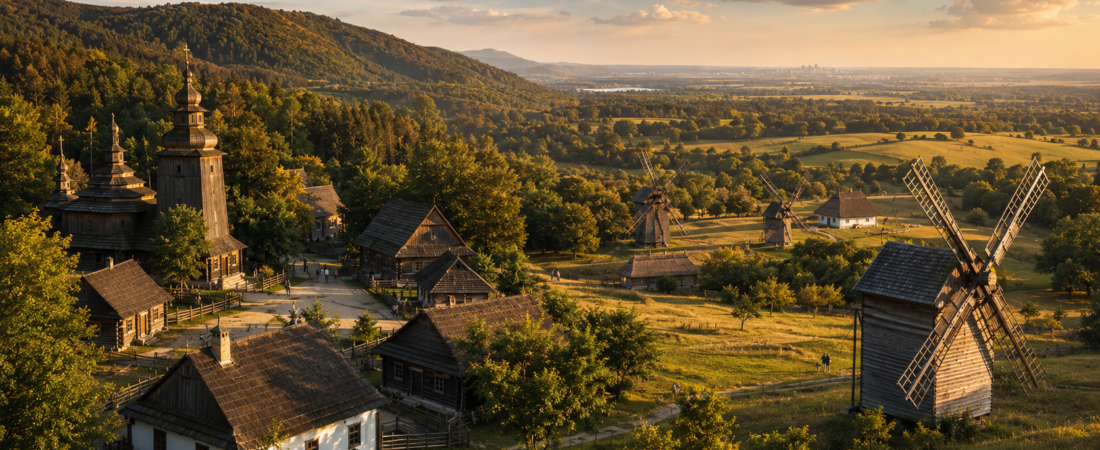
Pyrohiv contains about 300 monuments of folk architecture from the 16th to the 20th centuries. Its layout is regional at national scale: Polissia, Slobozhanshchyna and Poltavshchyna, the Carpathians, Naddniprianshchyna, Podillia and southern Ukraine each form part of the architectural-landscape complex. The windmill zone gives the park a strong visual marker, but the site’s real hierarchy comes from its regional sequencing: Ukraine is broken into landscape-cultural zones rather than into one local borderland story.
Architectural language, visual identity and history
Sanok’s architecture is rooted in Carpathian wooden construction from the 17th to the 20th centuries. The park includes cottages, farm buildings, churches, mills, workshops and other rural structures tied to upland and foothill communities. The Galician Market Square adds a small-town layer from the turn of the 19th and 20th centuries, representing the multiethnic culture of a Subcarpathian town rather than a purely peasant landscape.
Pyrohiv’s architectural scope is wider. Its buildings represent Ukrainian rural architecture across Polissia, Slobozhanshchyna, Poltavshchyna, the Carpathians, Naddniprianshchyna, Podillia and the South. The official museum site identifies the oldest architectural exhibit as a house from Samary, Volyn region, dated 1587. Houses, storehouses, wells and farm complexes are arranged to reproduce the material setting of historical Ukrainian villages.
Sanok was founded in 1958 as a post-war rescue project for the material culture of southeastern Poland, especially after wartime destruction, post-war displacement and the loss of many Rusyn village communities from the Bieszczady, Beskid Niski and neighbouring foothills. The first objects opened to visitors in 1966. The museum’s early development under Aleksander Rybicki combined field acquisition, documentation, disassembly, relocation and conservation practice.
Pyrohiv was founded in 1969 and opened to visitors in 1976. Its institutional logic was national: to preserve, research and present folk architecture and everyday life from all historical-ethnographic regions of Ukraine. In 2008, a presidential decree granted it national status as the National Museum of Folk Architecture and Life of Ukraine.
Collection corpus and research depth
The buildings are only one layer of each museum’s corpus. Sanok has a dense Carpathian-borderland research base: more than 31,000 collection items, an archive of over 170,000 catalogue units, almost 80,000 photographs, a specialist library of 21,000 volumes, and long-running scholarly publications including Materiały Budownictwa Ludowego w Sanoku and Acta Scansenologica. Its holdings include folk, urban, sacred, manor and Judaica material, as well as furniture, tools, machines, glass, copperware, clocks, paintings, icons, clothing and liturgical objects.
Pyrohiv’s corpus is broader and national in scope. Kyiv’s official city guide describes about 100,000 household items in the museum’s collections, including clothing, furniture, fabrics and tools. The museum’s current official site also lists active research outputs on regional material culture, including work on Polissia, Podillia stoneworking and wooden gingerbread boards and moulds. Sanok reads as a deep archive of the Polish-Ukrainian Carpathian borderland. Pyrohiv reads as a national material record of Ukrainian rural culture.
Everyday life and craft interpretation
Sanok interprets everyday life through interiors, exhibitions and controlled access to historic buildings. Its permanent exhibitions include Carpathian icons, the Bogdański family, folk costume and childhood. The official site also lists museum lessons, demonstrations of old customs, fairs, flea markets, concerts and events. The interpretation is strong when guided: interiors can only be entered with a guide, so the visitor’s access to domestic space depends on tour structure rather than free movement through houses.
Pyrohiv gives everyday life a more performative public layer. The museum presents houses, farmsteads, wells and regional village ensembles, but it also runs seasonal ethnographic fairs, folk festivals and a creative workshop where visitors can make folk-art objects. Its ticket page lists standard excursions, foreign-language excursions and a separately priced interactive tour. Pyrohiv therefore relies less on interiors alone and more on the combination of architecture, landscape, festival calendar and craft activity.
Heritage status, conservation and site management
Sanok is a Polish public cultural institution with a statutory museum role: documentation, protection, research, education, exhibitions, conservation, digitisation and public access to the cultural heritage of southeastern Poland. Its own history page shows an unusually strong conservation culture for an open-air museum: scientific principles were defined early, methods for moving and conserving buildings were developed, and the museum kept its own building teams and specialist practice.
Pyrohiv is administered as a national Ukrainian heritage institution under the National Academy of Sciences framework. Its 2008 national-status decree explicitly links that status to the museum’s role in preserving, researching and popularising folk culture from all historical-ethnographic regions of Ukraine. Its scale gives it national symbolic weight, but the same scale makes conservation harder: hundreds of wooden buildings, large open grounds and war-era public-infrastructure pressures raise the burden of maintenance, security and fire prevention.
Fire risk is relevant to both sites. Sanok suffered a serious fire in 1994 that destroyed 15 objects and 1,324 exhibits. Pyrohiv has also faced fire damage in the 2000s, including a reported 2006 arson-related incident. The comparison should not present Pyrohiv as uniquely vulnerable; wooden open-air museums are structurally exposed to fire, weather, theft and maintenance backlog.
Visitor experience: education and interpretation
Sanok gives a more curated, guide-dependent experience. The official site lists over 180 objects, permanent and temporary exhibitions, museum lessons, old-custom demonstrations and guided tours in Polish or foreign languages. Adult admission is listed at PLN 32, reduced admission at PLN 20, and Mondays are free. Guided tours cost PLN 140 in Polish and PLN 190 in a foreign language.
Pyrohiv gives a more expansive, park-like experience. Adult admission is listed at 200 UAH, with reduced tickets for school pupils, students, pensioners and people with disabilities in groups II and III. Standard excursions, foreign-language excursions and interactive tours are priced separately; the interactive tour is not included in the basic ticket. Free-entry categories include people with group I disabilities, combatants and war veterans, preschool children, museum workers and several other groups.
Sanok is stronger for concentrated regional learning. Pyrohiv is stronger for regional breadth and seasonal cultural programming. Sanok’s weakness is language and access dependency: detailed interpretation is strongest with a guide, and the English-facing material is limited. Pyrohiv’s weakness is self-guided international accessibility: the current official website is primarily Ukrainian, and detailed practical information for non-Ukrainian visitors is less accessible without translation.
Accessibility and inclusion
Sanok is reachable through Sanok town, with the ethnographic park entrance at 3 Rybickiego Street. Its visiting regulations warn that the site has slopes, descents, steps, thresholds and small doorways, especially difficult after rain. The regulations also mention that visitors can request help from a designated coordinator at the ticket office or security staff, but they do not provide a full wheelchair-accessibility specification.
Pyrohiv publishes clearer transport information. The museum states that it is on Kyiv’s southern edge, among the green oak woods of the old Holosiiv forest, and can be reached by car, trolleybus 11, minibus 496 and bus 57, with a 15-minute walk from the stop at the turn to the museum. It also has a “barrier-free” section, including inclusive visits and accessibility-themed programming. This shows an active accessibility agenda, but the public material still does not give enough detail on path surfaces, gradients, wheelchair routes or accessible interior entry.
Neither site should be described as fully accessible without qualification. Both are large outdoor museums with historic wooden buildings, uneven terrain and thresholds. Pyrohiv communicates accessibility more explicitly. Sanok gives more practical warnings about terrain.
Social openness, safety and LGBTQ+ inclusiveness
For ordinary visitors, the main published safety issues are site management, fire prevention, historic-building protection, terrain, steps, thresholds and visitor conduct.
Neither museum publishes an explicit LGBTQ+ inclusion policy in the material reviewed. Both operate as public heritage institutions, publish visitor rules, offer family and educational programming, and list social concessions or free-entry categories for selected groups. The legal context is weak in both countries by wider European standards. ILGA-Europe’s 2026 Rainbow Map ranks 49 European countries on legal and policy protections for LGBTI people. Poland scores 22%; Ukraine scores 19%. This does not prove visitor-level risk at Sanok or Pyrohiv, and it does not justify calling either museum unsafe. It does mean that “social openness” should not be overstated: both museums sit in national contexts with limited LGBTQ+ legal protection compared with much of Western and Northern Europe.
Final takeaway
Sanok is the stronger museum for a focused Carpathian-borderland reading of place. Its value lies in geographic precision: buildings, communities, settlement forms and collections are tied to southeastern Poland and the Polish-Ukrainian-Rusyn cultural frontier. The Galician Market Square and the oil-industry sector widen the story without breaking the regional frame.
Pyrohiv is the stronger museum for national spatial breadth. Its value lies in scale: Ukrainian rural architecture is arranged as a territorial-cultural sequence across historical regions. The visitor sees Ukraine as a set of regional building traditions, domestic economies, landscapes and seasonal practices rather than as one village type.