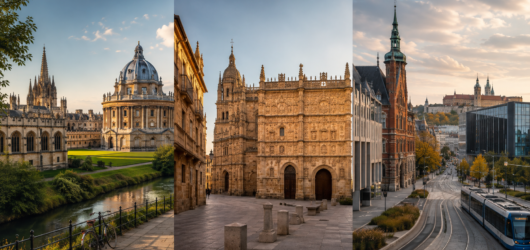
Snapshot
These museums all display machines, scientific instruments and transport technology. Their buildings and locations shape the visit as much as their collections do. The Deutsches Museum occupies an island in central Munich. The Science Museum stands among the museums and universities of South Kensington. Chicago’s Griffin Museum of Science and Industry fills the former Palace of Fine Arts in Jackson Park.
| Criterion | Deutsches Museum, Munich | Science Museum, London | Griffin Museum, Chicago |
|---|---|---|---|
| Urban position | Island campus in the Isar, close to the city centre | Street-facing museum within the South Kensington cultural district | Freestanding palace in Jackson Park on Chicago’s South Side |
| How it began | Founded in 1903; Museum Island building opened in 1925 | Developed from the Great Exhibition and South Kensington Museum; formally named in 1909 | Opened in 1933 after Julius Rosenwald’s visit to the Deutsches Museum |
| Building type | Purpose-built reinforced-concrete museum ensemble | Purpose-built national museum expanded and refitted in stages | Adapted 1893 Palace of Fine Arts with later purpose-built exhibit spaces |
| What visitors mainly see | Original objects, working models, demonstrations and reconstructed processes | National collections, large historical objects and specialised interactive galleries | Large machines, walk-through settings, tours and hands-on experiments |
| General admission | Paid | Free; some attractions are ticketed | Paid; free days and concessions apply, while some tours cost extra |
| Work now | About half of the exhibition building is open during renovation; full reopening is planned for 2028 | Most galleries remain open while individual areas are rebuilt | Work on the South Portico is expected to reopen the historic park-facing entrance in 2027 |
Munich’s published 20,000 m² covers only the part of Museum Island currently open. London and Chicago do not publish a site-area figure on the same basis. The collection totals also cover different things. The Deutsches Museum reports over 125,000 objects and about 7,000 exhibits on view across its five sites. The Science Museum Group’s 7.3 million items belong to the whole group, not the London museum alone. The published figures cannot support a reliable size or collection ranking. [1] [2] [18]
Setting and buildings
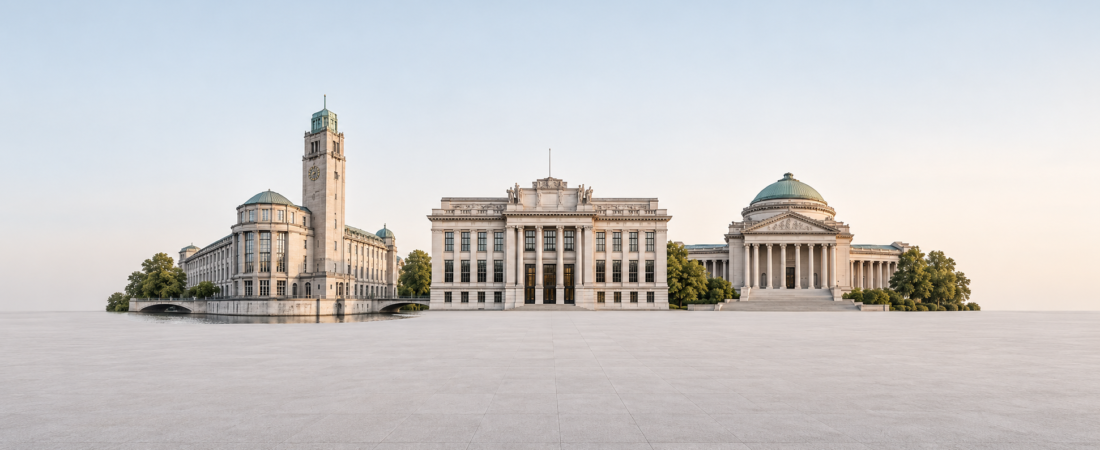
The Deutsches Museum has a campus of its own on an island in central Munich. Bridges cross the Isar to the exhibition building, library and congress hall. Gabriel von Seidl designed the exhibition building, whose foundation stone was laid in 1906. One of Munich’s early large reinforced-concrete structures, it stands on over 1,500 piles driven into the island ground. The building opened in 1925, the library in 1932 and the congress hall in 1935. The river and museum tower make the site easy to recognise from the surrounding city. [3]
The Science Museum opens directly onto Exhibition Road. The Victoria and Albert Museum is opposite, Imperial College is beside it, and the Natural History Museum is immediately to the south. Visitors can walk between these institutions without leaving the district. Behind the formal stone frontage, galleries and extensions added over many decades create a less regular interior than Munich’s island buildings or Chicago’s symmetrical palace.
Griffin MSI stands alone in Jackson Park. Charles B. Atwood’s Palace of Fine Arts was built for the World’s Columbian Exposition of 1893 as a symmetrical cross beneath a central dome. Its steel-and-brick structure was unusually durable because it protected valuable art, although the temporary outer surface later deteriorated. During conversion to a permanent museum in the late 1920s, builders recreated the classical exterior with 28,000 tons of Indiana limestone. Art Moderne interiors and later additions now accommodate exhibits such as the U-505 submarine, which the original art palace was never designed to hold. [4]
Visitors cross a bridge in Munich, enter from a museum-lined street in London and approach across a park in Chicago. Chicago’s original south entrance faced the Columbian Basin, but the museum later directed ordinary visitors to the north side, where cars and buses were easier to handle. The South Portico project will add an accessible entrance, café and terrace on the Jackson Park side. The work will change how visitors enter the museum and use the park-facing side of the building. [5]
Origins and museum model
Oskar von Miller founded the Deutsches Museum in 1903 around “popular education and popular amusement”. He wanted visitors to understand machines through working models, experiments and demonstrations. The museum also brought exhibitions, a library and a congress hall onto one site. Its name claimed importance for Germany, although it collected objects from other countries from the beginning. [6]
The Science Museum developed gradually. Its origins lie in the Great Exhibition of 1851 and the South Kensington Museum, established in 1857. Scientific collections moved to separate buildings on Exhibition Road in 1862, and the name Science Museum was formally adopted in 1909. It grew from a government-backed system for teaching science, industry, art and design rather than from one founder’s plan. [7]
Munich directly influenced Chicago. Julius Rosenwald visited the Deutsches Museum in 1911 and saw children using an interactive exhibit. He returned with plans for a similar museum in Chicago and pledged $3 million in 1926. The Coal Mine, the first exhibit to open in 1933, took visitors through a reconstructed mine instead of presenting objects in cases. Chicago adopted Munich’s teaching method and developed it through guided tours and large walk-through exhibits. [8]
The founding histories still shape what visitors see. Munich continues to demonstrate how machines and technical systems work. London places historical objects beside galleries on medicine, communication, engineering and current research. Chicago organises much of the visit around submarines, aircraft, storms and reconstructed industrial settings.
Collections and interpretation
The Deutsches Museum’s renewed galleries still place objects beside models and demonstrations that show how they work. Bridges and Hydraulic Engineering combines original material, models, dioramas and a walkable suspension bridge. Image Script Codes connects printing and paper with digital information and cryptology. Musical Instruments moves from Renaissance instruments to synthesisers while explaining acoustics and manufacture. Daily demonstrations cover model railways, flight simulation, chemistry and other subjects. Screens add information, while machinery and staff demonstrations remain central to the visit. [1] [9]
London uses historical objects to tell a broad history of science and technology. Making the Modern World arranges large machines along a central route and uses smaller objects to connect invention with work and everyday life. Puffing Billy, built in 1813–14 and recognised by the museum as the oldest surviving steam locomotive, remains one of its main exhibits. The Space gallery, opened in September 2025, places the Apollo 10 command module near the Soyuz capsule that returned Tim Peake to Earth. Science City, Information Age and the Medicine galleries cover institutions, bodies, commerce and social change as well as inventions. [10]
London’s permanent object galleries are free, but some hands-on areas require tickets. Wonderlab contains over 50 interactive exhibits and live demonstrations, and Power Up is also ticketed. Other permanent galleries include smaller interactive displays. Visitors can see much of the collection without paying, but the two largest interactive areas are not included in free admission. [11]
Chicago organises many of its best-known exhibits around large objects and walk-through settings. The U-505 is preserved in a purpose-built hall below ground. The Henry Crown Space Center combines the Apollo 8 command module and Mercury capsule Aurora 7 with a flight-proven SpaceX Dragon and objects associated with Mae Jemison. In Science Storms, visitors can manipulate a 40-foot tornado, lightning and waves. The Coal Mine takes them through a reconstructed industrial setting on a guided tour. [12]
Each museum covers both historical and current science. Munich uses live demonstrations throughout the museum. London separates many free object galleries from ticketed interactive areas. Chicago builds the visit around large objects and reconstructed settings. These are differences in presentation, not collection quality.
Movement and visitor experience
Today’s visit to the Deutsches Museum covers only part of the main building. Twenty renewed permanent exhibitions occupy about 20,000 m². Astronomy, Computer Science, the Mine, Marine Navigation, the Planetarium and other former departments remain closed during the second phase of construction. Some objects have moved into the reopened galleries, but older guides describe areas that visitors cannot currently enter. A temporary glass entrance beside Cornelius Bridge will remain in use until the main courtyard entrance returns in 2028. [13]
Within the open half, subjects are spread over several levels rather than arranged in one chronological route. Scheduled demonstrations draw visitors to particular galleries at set times. The museum’s app provides a map, self-guided tours and audio in several languages. Live events are mainly in German, while the digital guide is available in eight languages. [9] [19]
In London, galleries and paid attractions are spread over several floors. The relocated Space gallery sits deep inside Level 0. There is no single route through the whole museum, so visitors can concentrate on steam power, medicine or communications. Free admission also makes a short return visit practical. Chicago’s central rotunda and long wings provide a simpler starting point.
Chicago’s central rotunda helps visitors understand the building when they arrive. From there, the submarine, Coal Mine, space centre and Giant Dome Theater act as major stops in different parts of the museum. Several require timed or additional tickets, so visitors need to decide in advance which tours they want.
Access and public use
General admission creates the biggest practical difference. The Science Museum is free and recorded 2,640,417 visits in 2025. Wonderlab, Power Up and the IMAX cinema cost extra, but visitors can enter the building and see the permanent object galleries without payment. This makes both short visits and full days possible. [14]
The Deutsches Museum charges admission, with most daily demonstrations included after entry. Griffin MSI also charges general admission and sells additional tickets for the Coal Mine, U-505 onboard tour, dome films and selected exhibitions. Chicago offers Illinois Resident Free Days, free general admission for registered Illinois school and homeschool groups, Museums for All and other concessions. In Munich, visitors pay to enter. In London, they pay only for selected attractions. In Chicago, they may pay for both admission and special experiences. [1] [15]
Only London has a current site-level attendance figure. Munich is operating with much of its main building closed, and Chicago has not published an equivalent 2025 total. The available figures cannot support a three-way attendance ranking.
Renewal and conservation
Munich has the largest renovation programme. The first construction phase began in 2015 and reopened in July 2022. The second half of the exhibition building is scheduled to reopen in 2028. Workers are repairing the structure and replacing services and safety systems while curators rebuild the exhibitions. Some familiar departments have closed, and objects have moved into newly organised galleries. The project must preserve an old building and collection while changing a display system that influenced other science museums. [13]
London renovates one part of the museum at a time. Since 2014 it has opened new or rebuilt galleries on communications, mathematics, medicine, technicians, engineering and energy, followed by Space in 2025. Tomorrow: The Bennett Gallery is planned for early 2027, with Ages of Invention expected later in the decade. Most of the museum remains open, but the finished galleries differ in age and design. [16]
Chicago’s museum was a conversion from the start. Builders removed the failing fair-era exterior of the Palace of Fine Arts, rebuilt it in limestone and fitted the building for science and industry. Later projects altered it again for large exhibits. Moving U-505 indoors in 2004 protected the submarine from weather. The South Portico project makes smaller changes to a protected landmark. Repairs, step-free access and a glass enclosure will make the historic entrance usable again. WBEZ reported a budget of $22 million and completion expected in 2027. [4] [5] [20]
Each project responds to a different building. Munich is rebuilding a museum whose structure, services and displays aged together. London replaces galleries one at a time while the museum stays open. Chicago continues to adapt a former art palace. These works already affect the visit and cannot be treated as background information.
Public role and history
The Deutsches Museum presented science and technology as national achievements in a large public building. Its history also includes political compromise. The museum records that Nazi officials entered its committees, Hitler sponsored a vehicle hall, and the library hosted propaganda exhibitions including The Eternal Jew. War then damaged much of the complex, which was rebuilt after 1945. These periods form part of the museum’s history alongside its scientific collections. [3] [6]
The Science Museum is part of Britain’s national collection and South Kensington’s group of museums and universities. Because admission is free, visitors can enter from Exhibition Road without buying a ticket. Its neighbours also matter: the Victoria and Albert Museum, Natural History Museum and Imperial College make science part of a district devoted to museums, education and research.
Griffin MSI occupies a surviving world’s-fair building on Chicago’s South Side and depends heavily on private donations. Rosenwald declined to have the museum named after himself. A $125 million gift announced in 2019 led to the adoption of the Kenneth C. Griffin name in 2024. The current name therefore departs from Rosenwald’s preference. The South Portico project will also change which side of the building most visitors see first by reopening the entrance facing Jackson Park, the basin and the nearby Obama Presidential Center. [4] [5] [17]
Conclusion
Munich directly influenced Chicago, while London followed a separate path. Rosenwald borrowed the Deutsches Museum’s use of working and interactive exhibits, then developed larger walk-through displays inside a world’s-fair palace. London grew from the Great Exhibition and South Kensington Museum, combining a national collection with free entry and galleries rebuilt at different times.
Visitors who want live demonstrations will find them most consistently in Munich, although only the renewed half of the main building is open. London is the easiest museum to revisit without paying, but some interactive attractions cost extra. Chicago gives the greatest space to complete machines and walk-through exhibits, inside a building whose original Jackson Park entrance is being restored.