
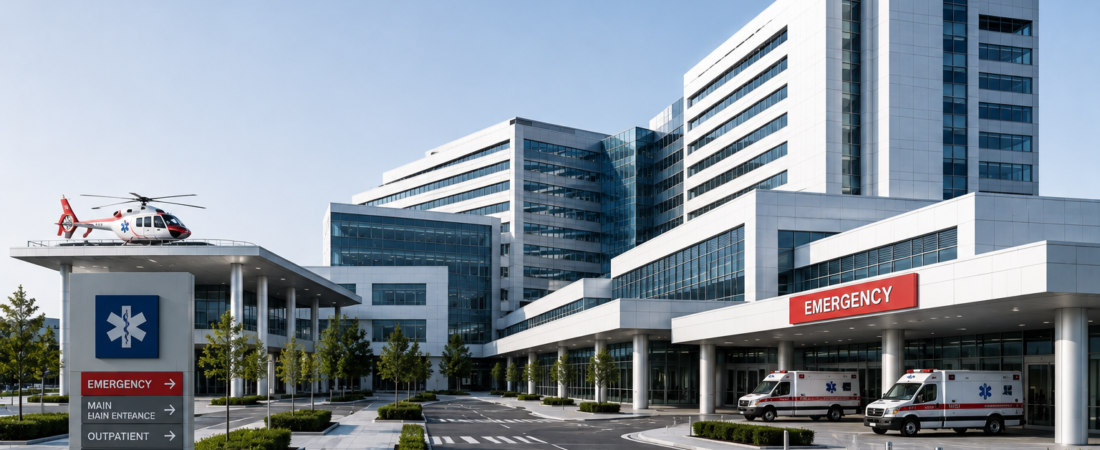
Three Mega-Hospitals as Place Cases
All three are large teaching hospitals, but they occupy different positions in their cities and health systems. Etlik is a planned public campus delivered through a public-private partnership. Chris Hani Baragwanath grew over eight decades within Soweto. Amrita Faridabad is a new nonprofit private university hospital on Faridabad’s urban edge. Governance, location, architecture, interior planning, movement, and community role expose differences that bed rankings miss.
Snapshot comparison
| Feature | Ankara Etlik | Chris Hani Baragwanath | Amrita Faridabad |
|---|---|---|---|
| Place and setting | Varlık/Etlik area of Ankara; large campus within the capital’s urban fabric | Diepkloof, Soweto, Johannesburg; long-established campus within a dense metropolitan community | Sector 88, Faridabad; 52.6-hectare health and education campus on the Delhi NCR urban edge |
| Governance | Public Ministry of Health hospital; campus delivered through a PPP concession | Public academic hospital of the Gauteng Department of Health | Nonprofit private hospital under Mata Amritanandamayi Math; linked to Amrita Vishwa Vidyapeetham |
| Formation | Opened in 2022 as a coordinated integrated health campus | Opened as a military hospital in 1942; transferred to South African government ownership in 1948; expanded incrementally | Inaugurated in 2022; medical school opened for the 2023–24 academic year |
| Capacity | 4,050-bed stated capacity | Often described as about 3,200 beds; a 2022 provincial presentation recorded 2,888 approved and 2,680 usable beds | 2,600-plus-bed stated capacity, including 534 critical-care beds |
| Site area | 102.2 hectares | 70.0 hectares | 52.6 hectares |
| Reported floor area | 1,145,129 m² enclosed floor area | 233,795 m² total building surface area | About 929,000 m² planned total built-up area |
| Published workforce | 10,000 total employees (current Ministry-verified profile) | About 6,760 staff (2022 parliamentary report) | Current institutional profile: team of 800 doctors and healthcare professionals; 2022 opening plan projected about 10,000 staff at full operation |
| Architectural type | Central diagnostic-and-treatment core with six main specialist towers; separate rehabilitation, psychiatric, radiotherapy, parking, and support buildings | Brick pavilion wards form the historic base; later maternity, eye, specialist, prefabricated, and newer buildings produce a mixed low-rise campus | 14-floor clinical tower for the main medical and patient areas; seven-floor research block and separate education and support buildings |
| Interior planning and wayfinding | Shared operating, emergency, imaging, laboratory, and treatment functions in the core; specialist outpatient and inpatient areas in the towers | Interior layouts vary by building and period; recent projects redesign individual services, including the expanded burns unit | Large clinical departments stacked in the tower; standardized wayfinding family with 11 indoor and 8 outdoor sign types |
| Academic role | Training and research hospital within Turkey’s public health system | Major Wits University teaching and research platform | Teaching hospital attached to Amrita School of Medicine, Faridabad |
| Access pattern | Four campus entrances, dedicated ambulance circulation, bus connections, and metro-to-bus transfers | Regional and local road access across a large campus serving Soweto and a wider referral network | Road-based regional access supplemented by an operational rooftop helipad for critical transfers |
| Central place issue | Fitting a very large planned campus into an established urban district | Maintaining and adapting a historically layered public campus under intense service demand | Establishing a durable community and public-service role on the metropolitan edge |
Three hospitals, three urban institutions
Ankara Etlik City Hospital, Chris Hani Baragwanath Academic Hospital, and Amrita Hospital Faridabad combine specialist clinical services, education, research, and large physical footprints. Each serves a metropolitan or regional catchment, but each developed under different historical, urban, and institutional conditions.
Etlik consolidates specialist hospitals around shared diagnostic and treatment infrastructure in Ankara. Chris Hani Baragwanath began as a military hospital, became a civilian and academic institution, and expanded as Soweto grew around it. Amrita extends a nonprofit healthcare and university system into North India through a campus combining care, education, research, and outreach.
Bed totals alone obscure these distinctions. Published numbers may describe planned capacity, approved beds, usable beds, or ultimate campus capacity. Etlik’s Ministry of Health profile states 4,050 beds. Amrita’s current hospital site states more than 2,600 beds. Chris Hani Baragwanath is commonly described as a roughly 3,200-bed campus, while a 2022 Gauteng presentation recorded 2,888 approved beds and 2,680 usable beds at that time. The operational meaning of ‘capacity’ therefore differs across the three institutions.
Location and physical setting
Etlik occupies 102.2 hectares in Ankara’s Varlık/Etlik area. The official address places it in Varlık, Yenimahalle, while the hospital name and institutional description use Etlik. The campus is not a remote medical enclave: it sits within the capital’s established urban fabric and connects to metropolitan roads and public transport. Its 1,145,129 m² of enclosed floor area exceeds its site area because clinical, parking, and support functions are built on multiple levels.
Chris Hani Baragwanath occupies 70.0 hectares in Diepkloof, Soweto. The campus predates the surrounding metropolitan form. What began on Johannesburg’s periphery became embedded in a dense urban community as Soweto expanded. A 2022 parliamentary report records 233,795 m² of building surface area across the campus. Its dispersed footprint differs from the vertical concentration of the two newer hospitals. The hospital serves nearby communities, a wider referral network, and Wits University’s teaching programme.
Amrita Hospital stands in Sector 88, Faridabad, on a 52.6-hectare health and education campus within a planned metropolitan extension. The 2022 opening plan reported about 929,000 m² of total built-up area, led by a 14-floor clinical tower and associated research and teaching buildings. Road access supports a wide regional catchment, while the rooftop helipad extends critical-transfer capability beyond ordinary surface access.
Origins and spatial development
Etlik was developed through Turkey’s city-hospital programme and a long-term public-private partnership. It opened in September 2022 as one coordinated project. The campus links the general, neuro-orthopaedic, chest and cardiovascular, children’s, obstetrics and gynaecology, and oncology hospitals to common diagnostic and treatment functions. Rehabilitation, psychiatric, observation, radiotherapy, administrative, conference, parking, research, and technical facilities complete the complex.
Chris Hani Baragwanath opened as the Imperial Military Hospital on 23 September 1942, initially with 480 beds. The South African government purchased it from the British government in 1948, and the transfer of services from Johannesburg General Hospital helped establish its civilian role. Maternity, intensive care, specialist services, academic programmes, and later facilities were added over decades. Successive additions produced a layered campus with complex circulation and maintenance requirements.
Amrita Hospital was inaugurated on 24 August 2022. Its clinical, research, and education components were conceived as parts of one institutional campus, although they entered operation in stages. Amrita School of Medicine Faridabad opened for the 2023–24 academic year with 150 MBBS places. A nursing college, allied-health education, simulation facilities, and a dedicated research block extend the campus beyond the role of a standalone private hospital.
Architecture and campus form
Etlik’s project design, developed by Studio Altieri and NKY Architects, places six main specialist towers around a central diagnostic-and-treatment core. The core concentrates shared operating, emergency, imaging, laboratory, and treatment functions. Outpatient clinics, inpatient wards, and service areas are organized within the towers. Separate rehabilitation, psychiatric, radiotherapy, administration, conference, parking, research, and technical buildings extend the complex across the site. Together, the buildings form a centralized campus of linked hospitals.
Chris Hani Baragwanath began with solid brick pavilion wards built for the wartime hospital. Those low-rise wards still define much of the historic plan. Maternity and eye hospitals, prefabricated accommodation, specialist buildings, administrative and laboratory blocks, and later clinical additions created a mixed campus. A 2022 parliamentary report counted 429 structures. Different building generations remain visible across the site.
Amrita concentrates its main medical facilities and patient areas in a 14-floor clinical tower. A seven-floor research block, medical college, nursing and allied-health facilities, simulation centre, and support buildings occupy the wider 52.6-hectare campus. Project documentation identifies M/s PPAL as architect. Clinical care is vertically concentrated; education and research occupy separate campus buildings.
Interior design and clinical planning
Etlik’s interior organization follows the core-and-tower architecture. Shared operating theatres, emergency care, imaging, laboratories, pharmacy, sterilization, chemotherapy, and endoscopy occupy the central core, while the towers contain specialty-specific outpatient, inpatient, and support areas. The plan separates specialty destinations from shared treatment areas. In December 2025, a university-led mural and colour project altered interior spaces in the oncology hospital’s Integrated and Preventive Cancer Center; it was a local intervention, not a campus-wide palette. Published project material does not provide a finish schedule, patient-room typologies, lighting or acoustic criteria, or evaluated wayfinding results.
Chris Hani Baragwanath has no single campus-wide interior scheme. Ward and departmental interiors belong to different construction and refurbishment periods. A 2003 Gauteng plan documented renovated pavilion wards alongside spaces requiring major work, including low, dark maternity passages and a delivery-room layout that compromised privacy; those observations describe conditions in 2003, not a current survey. The 2024 burns-unit expansion shows the present pattern of targeted redesign: 12 specialist ICU beds, a dedicated operating theatre, recovery room, outpatient facility, and separate physiotherapy, speech-therapy, and occupational-therapy rooms were added within one service line.
Amrita’s published interior information covers clinical zoning and navigation. The 14-floor tower contains the main patient and medical areas, including adult and paediatric outpatient departments, a dedicated mother-and-child floor, 534 critical-care beds, and 64 networked modular operating theatres. Its wayfinding program used 11 standardized indoor sign types and 8 outdoor types; more than 11,000 signs were produced for the campus. The HVAC case study documents pressure-independent control for fan-coil and air-handling systems. Public sources do not establish a single material palette or comparable measures for daylight, acoustics, privacy, or patient satisfaction.
Workforce
Workforce figures are published on different bases, so their labels and dates matter. A current Ministry-verified HealthTürkiye profile lists 10,000 total employees at Etlik. A June 2022 South African parliamentary report records about 6,760 staff at Chris Hani Baragwanath; the underlying February 2022 provincial staffing table counted 6,255 filled posts out of 7,218 approved posts.
Amrita does not publish a current total headcount. Its current institutional profile describes a team of 800 doctors and healthcare professionals. Before opening in 2022, the university projected about 2,000 direct employees initially and around 10,000 staff, including more than 800 doctors, once the campus became fully operational. The 10,000 figure is a plan, not a verified current workforce total.
Access, movement, and wayfinding
Etlik’s official transport guidance combines buses with transfers from Ankara’s metro network. The hospital can be reached from İvedik Metro station by ring bus or taxi, and direct or connecting bus routes serve the campus from central Ankara, the intercity bus terminal, the high-speed rail station, and the airport corridor. Inside the site, separate ambulance circulation and multiple entrances distribute flows. Campus size makes accurate destination information essential.
Chris Hani Baragwanath serves nearby Soweto residents as well as a much wider referral geography. The provincial campus plan shows a network of specialist and support destinations distributed across the site. Movement is therefore inseparable from departmental organization: patients, staff, students, ambulances, supplies, and visitors do not all share the same route or destination. Current public information does not provide a comparable campus-wide wayfinding standard, so a direct quality ranking against the two newer hospitals would be unreliable.
Amrita is primarily reached by road. Its rooftop helipad, approved for daytime visual-flight operations, supports critical patient transfers and connects with emergency, intensive-care, operating-theatre, cardiac, neuroscience, and transplant services. This capability strengthens regional emergency reach but does not replace everyday public access. For most patients, the quality of surface transport, arrival areas, pedestrian routes, and internal navigation remains more consequential than air access.
Clinical, educational, and research functions
Etlik combines broad tertiary and specialist care with public-sector training and research. Its Clinical Research Center meets good manufacturing practice standards, and the campus includes hybrid treatment areas, radiotherapy, chronic wound care, rehabilitation, and specialized emergency facilities. The linked hospital model enables the same campus to serve routine referrals, highly specialized treatment, and professional education.
Chris Hani Baragwanath is a core Wits University clinical platform and a major Gauteng referral institution. Its 2022 provincial service profile covers a wide range of medical, surgical, maternal, child, psychiatric, diagnostic, rehabilitation, and allied-health services. More recent initiatives include patient-record digitization, an expanded burns service, paediatric triage improvements, and continued university research. Teaching and research take place within daily public service across the campus.
Amrita combines tertiary and quaternary care with a university medical campus. The institution reports centres for cardiac sciences, cancer care, neurosciences, transplantation, nephrology and urology, diabetes and metabolism, liver disease, robotic surgery, orthopaedics, pulmonary medicine, rehabilitation, imaging, and molecular diagnostics. The medical school, simulation centre, research block, nursing college, and allied-health programmes make education and research visible parts of the campus plan.
Patient environment and daily use
Patient journeys follow three different patterns. At Etlik, users move among specialist towers and a shared treatment core. At Chris Hani Baragwanath, users cross a dispersed campus built and altered over eight decades. At Amrita, users depend on vertical circulation inside the clinical tower and surface routes to education and research buildings. Each pattern changes the importance of signage, transfers, staff orientation, and family support.
Comparable post-occupancy measures for waiting, noise, daylight, privacy, navigation, and satisfaction are not available across all three hospitals. Etlik’s official description cites privacy, safety, outdoor walking areas, and separated clinical flows. Baragwanath’s published priorities address maintenance, service expansion, triage, and digitization. Amrita’s materials document critical-care technology, integrated operating theatres, controlled indoor climate, and a large wayfinding system. The evidence supports description of the designed environment, not a comfort ranking.
Community relationship and social character
Etlik is a national public-health investment with a metropolitan role. Its creation consolidated specialist services that had previously been distributed among older Ankara hospitals. This increases the importance of citywide transport, referral coordination, and continuity for populations accustomed to the former institutions. It is a state institution built to provide specialist public care from one site.
Chris Hani Baragwanath has the deepest local historical relationship. Its civilian development was tied to segregated healthcare under apartheid, and its later identity became inseparable from Soweto and from Chris Hani’s name. The hospital is an employer, teaching centre, referral institution, and everyday public service. Its local legitimacy rests on daily service and its long association with Soweto.
Amrita’s community role combines nonprofit ownership, regional referral care, university education, and organized outreach. Institutional programmes have included health awareness, school activities, and local medical initiatives in and around Faridabad. The campus also states a commitment to subsidized or free care for economically disadvantaged patients. Because the institution is recent, its long-term relationship with surrounding neighbourhoods will depend on how access, affordability, education, employment, and outreach develop together.
Environmental performance and resilience
Etlik’s official profile identifies on-site energy production and outdoor recreation areas, while its emergency circulation separates ambulances and trauma access from ordinary movement. The PPP structure also assigns long-term maintenance responsibilities within the concession model. Publicly available figures do not provide a complete, comparable account of energy use, water performance, or post-occupancy environmental results.
At Chris Hani Baragwanath, keeping the historic campus operating depends on maintenance. Gauteng’s planning documents allocate programmes for occupational health and safety, refurbishment, security infrastructure, landscaping, and preventive maintenance. The 500-bed pandemic-era facility remained under-used in 2025, and the province planned to repurpose it.
Amrita describes the Faridabad campus as a low-carbon green-building project with wastewater treatment and reuse systems. Its zero-wastewater policy includes efficient fixtures, leak management, rainwater harvesting, and treatment for reuse. The operational helipad supports emergency transfer and disaster response. Available evidence does not show whether the campus has a lower total environmental impact than Etlik or Baragwanath.
Distinctive place identities
Etlik concentrates specialist public care on one Ankara campus. Distinct hospital blocks share diagnostic, treatment, and support infrastructure. Its identity is tied to state-led consolidation.
Chris Hani Baragwanath is inseparable from Soweto. Eight decades of additions made it both a public hospital and a physical record of changing demand, policy, and academic medicine. Its identity rests on continued service, not architectural coherence.
Amrita extends a nonprofit healthcare and university system into Faridabad’s urban edge. Its clinical tower, teaching facilities, research buildings, and charitable programmes were planned together. Its local identity will depend on who can reach and use those services over time.
Sources
Ankara Etlik City Hospital — Introduction
Ankara Etlik City Hospital — Transportation Information
Türkiye Ministry of Health — Etlik City Hospital opening
European Bank for Reconstruction and Development — Ankara Etlik Hospital PPP Project
HealthTürkiye — Ankara Etlik City Hospital workforce profile
Studio Altieri — Etlik Integrated Health Campus Hospital
Ankara Etlik Hospital Project Company — Environmental and Social Impact Assessment
Ankara Yıldırım Beyazıt University — Etlik City Hospital mural and colour project
Gauteng Department of Health — Chris Hani Baragwanath Academic Hospital presentation, 2022
Parliament of South Africa — Gauteng Provincial Week report, 2022
University of the Witwatersrand — The making of a hospital
Gauteng Provincial Treasury — Department of Health Strategic Plan 2003–04
University of the Witwatersrand — New wing in Bara burns unit
South African Government — Gauteng patient-file digitisation
South African Government — Gauteng Health 2023/24 performance report debate
Gauteng Department of Health — Annual Performance Plan 2024–25
Gauteng Provincial Government — State of Ethics Report 2025
Amrita Hospital Faridabad — Hospital profile
Amrita Hospital Faridabad — About Us and current team figure
Amrita Vishwa Vidyapeetham — Pre-opening campus and workforce plan
Amrita Vishwa Vidyapeetham — Faridabad hospital inauguration
Amrita Vishwa Vidyapeetham — School of Medicine Faridabad
FlowCon — Amrita Hospital project and HVAC case study
VersionAbsolute — Amrita Hospital wayfinding and sign design
Cosign — Amrita Hospital signage system