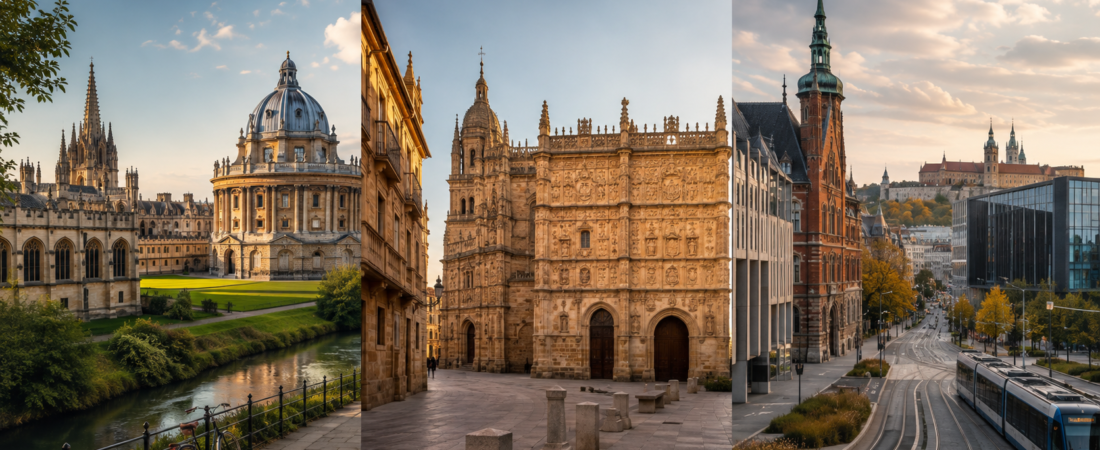
Salamanca is the most compact university city; Oxford provides the strongest college-centred community; Jagiellonian covers the largest part of its host city and creates the longest faculty-dependent journeys. Institutional structure affects daily movement, housing, public access and inclusion. The three universities share long histories and protected buildings, and they produce three distinct experiences of place.
| Measure | Oxford | Salamanca | Jagiellonian |
|---|---|---|---|
| Foundation | Teaching recorded by 1096; no single foundation date | Founded by royal charter in 1218 | Founded in 1364; renewed in 1400 |
| Main urban form | Colleges, departments and libraries spread across central Oxford | Historic university quarter plus newer city campuses and regional sites | Old Town buildings, a western central belt, Ruczaj science campus and medical sites |
| Institutional form | Central university plus 43 collegiate bodies: 36 colleges, three societies and four permanent private halls | Public university organised through faculties, schools and central services | Public university with 16 faculties, including three in Collegium Medicum |
| Approximate scale | More than 26,000 students in 2025 | About 25,500 degree students in recent official planning material | More than 36,000 students in the current university profile |
| Housing pattern | College rooms, university graduate housing and a costly private market | University residences, colegios mayores and shared flats across a compact city | University dormitories and private flats distributed across Kraków |
| Daily movement | Walking and cycling dominate central trips; buses connect outer sites | Most central destinations are walkable; buses serve outer campuses | Walking in the centre; trams and buses are important for Ruczaj and medical sites |
| Heritage status | Many protected buildings; Oxford itself is not a UNESCO World Heritage property | University buildings form a defining part of the UNESCO-listed Old City | Historic university buildings lie within UNESCO-listed central Kraków |
| Public access | Four free museums, public parks and controlled entry to many colleges | Ticketed historic rooms, exhibitions, libraries and cultural venues | Collegium Maius museum, botanical and specialist collections, events and courtyards |
Location and physical setting
Salamanca has the most compact setting. Its ceremonial buildings, Plaza Mayor, cathedrals, libraries and many student streets sit within a short walk. Oxford also works at pedestrian scale in its centre. Its academic buildings form a wider chain from the historic core through the Science Area and Radcliffe Observatory Quarter to Headington. Jagiellonian has the greatest city-wide separation: the Old Town, the western central belt, Ruczaj and Prokocim function as distinct clusters.
Oxford’s rivers, meadows and low floodplain bring greenery close to dense academic streets. Salamanca’s plateau position and Villamayor sandstone give the centre a consistent appearance and expose it to summer heat and winter cold. Planty softens Kraków’s Old Town, and the outer Jagiellonian campuses occupy ordinary residential districts. Salamanca leads for daily convenience, Oxford for landscape variety and Jagiellonian for access to a large urban region.
Origins and historical development
Their histories explain their layouts today. Oxford grew incrementally from teaching recorded in 1096 and acquired independent halls, colleges and properties over centuries. That history explains its fragmented ownership and lack of a single founding precinct. Salamanca began through royal foundation in 1218 and developed an academic quarter whose sixteenth-century buildings still define the institution. Jagiellonian began in 1364, was renewed in 1400 and retained Collegium Maius as its historic centre.
Oxford added libraries, museums, laboratories and medical sites around its college system. Salamanca preserved one dominant ceremonial centre and placed larger modern faculties elsewhere in the city and region. Jagiellonian created the largest gap in scale and distance by developing major science facilities at Ruczaj and consolidating medicine at Prokocim. Oxford has kept its college-based organisation most continuously, Salamanca has kept the strongest single historic image, and Jagiellonian has the clearest division between old and new university areas.
Institutional structure and spatial organisation
Oxford is organised in a unique way among the three. Its central university controls departments, libraries and museums, and 43 collegiate bodies control their own accommodation, dining, teaching and welfare spaces. Salamanca has the most centralised structure: faculties, schools and common services sit within one public university. Jagiellonian is also a public university, with 16 faculties and a separate Collegium Medicum grouping its three medical faculties.
Oxford students move through overlapping systems of college, department, library and city, with access rules that vary by owner. Salamanca students use a more consistent university administration across 26 teaching centres, including sites beyond Salamanca itself. Jagiellonian students usually identify with one principal cluster because humanities, sciences and medicine occupy separate parts of Kraków. Oxford offers the strongest small-community structure. Salamanca is the easiest organisation to understand. Jagiellonian is organised most strongly around faculty location.
Architecture, heritage and public realm
Oxford has the greatest architectural variety. Medieval college courts, the classical Radcliffe Camera, Victorian museums and contemporary laboratories place several periods within one walking route. Jagiellonian comes second, with Collegium Maius, the neo-Gothic Collegium Novum, interwar buildings and large modern structures at Ruczaj. Salamanca concentrates on a narrower historic range in its centre, where Villamayor sandstone links the Escuelas Mayores, Escuelas Menores, Hospital del Estudio and neighbouring civic and religious buildings.
Patio de Escuelas is the most open university forecourt and forms part of Salamanca’s normal walking route. Oxford’s quadrangles provide more varied internal spaces, with gates, opening hours and charges controlling entry. The Collegium Maius courtyard opens Jagiellonian’s history directly to visitors, and Planty connects its old buildings to Kraków’s pedestrian network. Oxford leads for variety, Salamanca for an open city-centre setting and Jagiellonian for the visible jump from medieval rooms to a modern campus.
Relationship with the host city and region
Salamanca has the most visible dependence on its university. Degree students and short-course language learners occupy a large share of its compact centre, rental market and everyday cultural life. UNESCO identifies continued university use as part of the Old City’s value. Oxford reports the largest economic figures: its 2021–22 study estimated a £16.9 billion UK impact and 90,400 supported jobs. Oxford also shows the greatest local friction through housing pressure, visitor congestion and restricted college land. The figures describe the university’s scale across the UK.
Jagiellonian operates within a much larger city that contains several major universities. Its Old Town buildings strengthen Kraków’s cultural and visitor economy; Ruczaj and Prokocim connect research and medicine to residential districts across the city. Salamanca has the strongest university-town relationship, Oxford the largest reported economic figures and greatest housing pressure, and Jagiellonian the widest relationship with its host city and region.
Scale, land use and functional geography
Oxford mixes the greatest number of uses within small central sites. A single college can contain bedrooms, dining, study, worship, administration and recreation. Salamanca separates uses between the historic quarter, Miguel de Unamuno, other city sites and regional campuses. Jagiellonian creates the largest distances: ceremonial and humanities uses in the centre, science at Ruczaj, and clinical teaching at Prokocim.
Oxford gives housed undergraduates the shortest link between home and college life, with longer trips to some science and medical sites. Salamanca keeps the main city-centre and humanities experience compact and distributes specialist teaching beyond it. At Jagiellonian, faculty address determines sensible housing and transport choices. Oxford puts the most activities together on the same sites, Salamanca has the simplest order of main and secondary sites, and Jagiellonian groups specialist subjects most strongly.
Transport, walkability and physical accessibility
Salamanca provides the easiest central walking environment. Its main historic destinations, shops and many rentals fit within a short route. Oxford follows closely for central trips and has the strongest cycling culture; university guidance places many routine destinations within a 20-minute walk or a five-to-ten-minute cycle. Jagiellonian requires the most public-transport use because Ruczaj and Prokocim sit well beyond the Old Town. Czerwone Maki gives the science campus a strong tram and bus connection.
Step-free access is more complicated. All three historic centres contain steps, thresholds, uneven paving and protected fabric. Jagiellonian’s and Salamanca’s newer campuses generally provide simpler level access than their historic buildings. Oxford supplies the most extensive public building-by-building Access Guide. Salamanca’s Disability and NEAE Unit offers equipment, interpretation and exam support. Jagiellonian combines an Accessibility Centre with building descriptions and navigation tools. Complete step-free access is unavailable across the three historic estates. Each relevant faculty and residence requires individual checking.
Student life, housing, affordability, LGBTQ+ openness and inclusion
Oxford provides the strongest built-in undergraduate community and the greatest housing pressure. College rooms, dining halls, common rooms and welfare teams place social life inside the institution. All colleges house first-year undergraduates and provide at least one further year. Graduates depend more heavily on university and private housing. Salamanca places more student life in shared flats, residences, cafés and public streets. Jagiellonian offers the widest large-city social life, and faculty location makes neighbourhood choice more important. Salamanca integrates students most directly into the host city; Oxford gives undergraduates the strongest residential institution; Jagiellonian gives students the widest choice of urban settings.
Oxford has the broadest LGBTQ+ support network: a university society, Rainbow Peers, counselling resources, central policy and college-level welfare. Salamanca has the clearest dedicated university unit, a recognised-name procedure, anti-discrimination support, Iguales USAL and an active 2026 Pride programme. Jagiellonian has equal-treatment officers, formal protection covering sexual orientation and the student-led TęczUJ organisation. This comparison covers published policies and services. Oxford offers the broadest network, Salamanca the most explicit specialist unit, and Jagiellonian a smaller combination of university and student support.
Environmental quality, neurodiversity and sensory conditions
Oxford has the best access to large, quiet green spaces near the academic centre and the greatest flood exposure. University Parks, college gardens and river meadows provide relief from busy bus corridors, bells, visitors and cycling conflict. Salamanca’s pedestrian centre reduces traffic pressure and introduces other sensory demands: hard reflective stone, night-time activity, strong summer sun, limited shade in large squares and cold exposed winters. Jagiellonian varies most by site. Planty and Collegium Maius offer sheltered central spaces; Ruczaj brings open grounds, long exposed walks and large interiors; Kraków traffic and winter air quality affect the wider city experience.
Each university describes neurodivergent support in its own way. Oxford publishes the broadest central set of neurodiversity and counselling resources, and adjustments operate through university and college services. Salamanca’s Disability and NEAE Unit most clearly names specific educational needs and can provide a separate exam room, equipment and tailored support. Jagiellonian combines individual educational adjustments with detailed access descriptions and the NawigUJ navigation system. Information about predictable quiet rooms, lighting, acoustics and sensory conditions is scarce at all three.
Public access, cultural institutions and visitor experience
Oxford offers the widest free cultural collection, Salamanca the shortest university heritage route and Jagiellonian the strongest single university museum. Oxford’s Ashmolean, Museum of Natural History, Pitt Rivers Museum, History of Science Museum and Weston Library support repeated public visits. Salamanca links the Escuelas Mayores, Escuelas Menores, Patio de Escuelas, Historical Library and cathedrals in one short walk. Jagiellonian concentrates its public story in Collegium Maius, supported by the Botanical Garden, Pharmacy Museum and specialist collections.
Entry is simplest at Oxford’s free museums and most fragmented at its colleges, where hours, charges and closures vary. Salamanca gives visitors the easiest route, with ticketing or guided access for some active historic rooms. Its Historical Library occupies the upper cloister of the Escuelas Mayores; the earlier draft’s Convent of San Esteban location was false. Jagiellonian gives Collegium Maius a clear museum function, and the rest of its cultural network requires separate planning. Oxford leads for breadth, Salamanca for ease of navigation and Jagiellonian for a focused account of university history.
Distinctive place identity and final takeaway
Daily life is organised around the college at Oxford, the university city at Salamanca and the faculty’s part of Kraków at Jagiellonian. Oxford’s college model is socially strong, architecturally varied and administratively fragmented. Salamanca is compact and closely tied to public streets and squares. Jagiellonian is well served by culture and public transport and has the greatest variation in journey length and campus character.
Oxford ranks first for college-centred community, architectural variety, free museum breadth, central green space and published access information. Salamanca ranks first for walkability, connection with city streets and public life, and the clarity of its dedicated LGBTQ+ unit. Jagiellonian ranks first for the range from a medieval centre to purpose-built science and medical campuses and for access to a large city. These are judgements about the places. Academic quality is outside the scope.
Oxford suits a student who values a small residential community. Salamanca suits a student who values a compact, public and walkable university city. Jagiellonian suits a student who values Kraków’s scale and accepts faculty-dependent travel. In every case, the faculty address, housing offer and building access matter more than the university’s familiar historic image.
Sources and evidence notes
All factual checks were completed to 8 August 2026. Source links are collected here to keep the report readable. Student totals use the most recent comparable public figures available from each institution. Definitions and reporting dates differ, so the figures indicate approximate scale and are unsuitable for ranking.
University of Oxford — history — Teaching from 1096, growth after 1167 and the development of the collegiate university.
University of Oxford — facts and figures — Current student totals, international profile and economic-impact figures.
University of Oxford — how the university is run — Current composition of colleges, societies and permanent private halls.
University of Oxford — estate — Central estate, protected buildings and principal sites.
University of Oxford — Access Guide — Building-level physical access information.
University of Oxford — inclusive student life — Equality, harassment policy and the division of support between the university and colleges.
University of Oxford — Rainbow Peers — LGBTQ+ peer support within the university welfare system.
University of Oxford — neurodiversity resources — Counselling and self-support resources.
University of Oxford — sustainability — The 2035 net-zero and nature-positive targets, revalidated in 2026.
University of Oxford — what to see — Museums, libraries, gardens and visitor information.
University of Oxford — visiting colleges — College-specific opening and ticket arrangements.
Oxford City Council — flooding — Current flood-risk guidance for Oxford.
University of Salamanca — history — Foundation in 1218 and principal periods of development.
University of Salamanca — centres and degrees — Teaching centres and distribution across Salamanca, Zamora, Ávila, Béjar and Villamayor.
University of Salamanca — Historical Library — Correct location and public/research role of the library in Escuelas Mayores.
UNESCO — Old City of Salamanca — World Heritage boundaries, university buildings, architectural significance and conservation framework.
University of Salamanca — disability and NEAE support — Educational adjustments, sign-language interpretation, equipment and exam support.
University of Salamanca — LGBTQ+ diversity unit — Student support, recognised-name procedure and university/community activity.
University of Salamanca — 2026 diversity commitment — Current institutional activity and Pride programme.
University of Salamanca — Green Office — Environmental policy, waste, energy, mobility and green-space work.
Jagiellonian University — history — Foundation, renewal, faculties, broad student scale and development of the Ruczaj campus.
Jagiellonian University — current profile — Current university-wide headline figure of more than 36,000 students.
Jagiellonian University — organisational units — Current faculty structure and 2026–27 admissions organisation.
Jagiellonian University Collegium Medicum — 2025–26 statistics — Current medical-college student and doctoral-candidate totals.
Jagiellonian University — physical accessibility — Accessibility Centre, building descriptions, sign-language interpretation and navigation support.
Jagiellonian University — equal treatment at Collegium Medicum — Equal-treatment remit, including sexual orientation and disability.
UNESCO — Historic Centre of Kraków — World Heritage context and the university’s place in Kraków’s historic centre.
Kraków Public Transport Authority — network maps — Current tram, bus, night and suburban transport maps.
Kraków transport operator — reduced-mobility access — Current low-floor fleet and passenger-access information.