Scope and current status
Café Central in Vienna and New York Café in Budapest are late nineteenth-century coffeehouses associated with literary culture, elaborate historic interiors, table service, regional food, and live music. Their present institutional settings differ, but the contrast should not be exaggerated into a distinction between an authentic civic institution and a purely commercial tourist attraction. Both are professionally managed heritage hospitality venues whose histories form an important part of their contemporary branding.
A current comparison requires one major qualification: Café Central has been closed since 16 March 2026 for a comprehensive renovation of Palais Ferstel. Reopening is scheduled for autumn 2026. Descriptions of its menu, service, atmosphere, and accessibility below therefore refer principally to conditions immediately before the closure. The nearby DECENTRAL pop-up is a separate temporary operation.
Institutional identity
Café Central opened in 1876 inside Palais Ferstel, a building originally constructed for the Austrian National Bank and Vienna Stock Exchange. It is not part of a hotel, but neither is it an independent owner-operated café: it is operated by Palais Events, part of the VERKEHRSBUERO hospitality group.
New York Café opened in 1894 on the ground floor of the New York Palace. The palace was commissioned by the New York Life Insurance Company as its European headquarters. Since the building’s conversion into a luxury hotel in 2006, the café has functioned as one of the principal public dining spaces of what is now the Anantara New York Palace Budapest Hotel. The café’s own website identifies it as a member of the Hungarian Eventrend Group.
The most defensible distinction is therefore institutional: Café Central is a café-restaurant in a historic commercial building, whereas New York Café operates within a luxury hotel complex. Both nevertheless admit customers who are not hotel guests.
Location and urban setting
Café Central is located at Herrengasse 14 in Vienna’s Innere Stadt. Its principal entrance is on the corner of Herrengasse and Strauchgasse, not in a quiet pedestrian courtyard. The Arkadenhof is an internal arcaded courtyard within Palais Ferstel. The café is close to Freyung and the Hofburg, with Herrengasse underground station nearby.
New York Café is at Erzsébet körút 9-11 in Budapest’s seventh district. It stands on the Grand Boulevard close to Blaha Lujza tér, which provides metro, tram, and bus connections. It is not at the Oktogon-Andrássy Avenue intersection, although Oktogon and the State Opera remain accessible from it.
Both establishments therefore occupy central and highly accessible urban locations. Café Central sits within Vienna’s historic administrative and palace quarter, while New York Café faces one of Pest’s major nineteenth-century boulevards.
History and continuity
Palais Ferstel was built between 1856 and 1860 to designs by Heinrich von Ferstel. Gustav and Hermann Pach opened Café Central in 1876 in premises previously associated with the stock exchange. By the turn of the twentieth century, it had become an important meeting place for writers, intellectuals, journalists, and chess players.
The café was remodelled in 1925 and reopened as a café-restaurant in 1926. It closed in 1943 and remained out of operation for approximately four decades. A provisional Café Central reopened in another part of the complex around 1982; in 1986 it moved into the restored columned hall associated with its present form.
New York Café opened on 23 October 1894 in the New York Life building. It rapidly became associated with Budapest’s writers, editors, journalists, and artists. Accounts differ concerning the extent of the building’s wartime damage, but they agree that the café declined, was nationalized, and was temporarily repurposed after the Second World War.
The establishment reopened in 1954 as Hungária Café and Restaurant. Hungary’s National Archive dates the restoration of the New York name to 1990, although some secondary accounts give 1989. The building was sold to private investors in 2001 and underwent a major reconstruction before reopening in 2006 as a luxury hotel containing the restored café.
Neither establishment has an uninterrupted history. Café Central experienced a particularly long closure after 1943; New York Café survived part of the socialist period under a different name and function before another closure and reconstruction.
Architecture and spatial experience
Palais Ferstel is a historicist building inspired by Venetian and Florentine Trecento architecture. Its arcades, stone columns, vaulted spaces, and glass-covered passage reflect its original combination of banking, stock-exchange, commercial, and social functions. Since the café changed locations within the building and underwent repeated reconstruction, its present interior should not be described simply as an untouched survival of 1876.
New York Palace was designed by a team led by Alajos Hauszmann. Anantara describes it as an eclectic combination of Renaissance, Baroque, and Art Nouveau influences; the café is also commonly classified as Italian or Neo-Renaissance. Its interior contains marble columns, ceiling paintings, gilded ornament, chandeliers, and sculptural decoration.
New York Café is more densely decorated, while Café Central’s columned hall is comparatively restrained. These are defensible visual observations.
Food, drink, and service
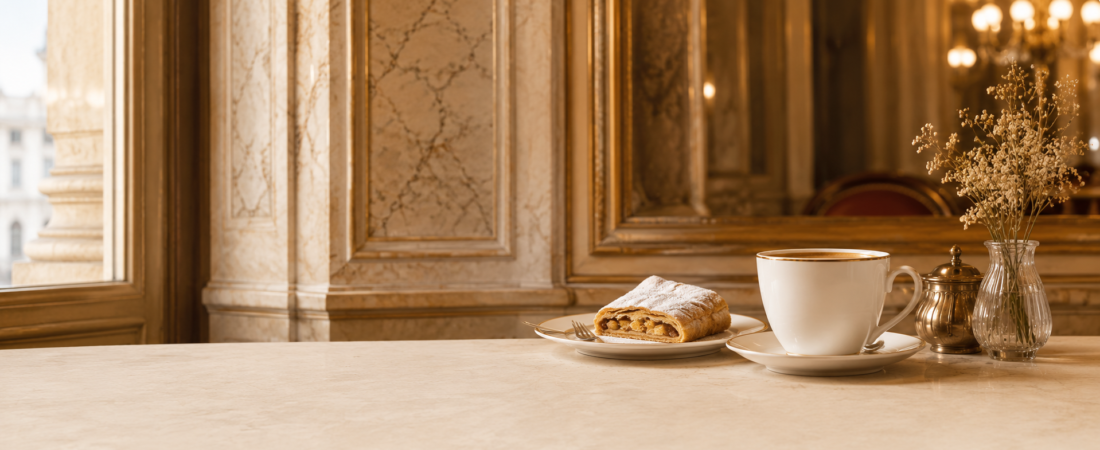
Immediately before its 2026 closure, Café Central offered breakfast, Viennese coffee preparations, pastries, and restaurant dishes such as Wiener schnitzel, goulash soup, and Kaiserschmarrn. Its January 2026 menu identified vegetarian and vegan dishes. Live piano music was advertised daily in the late afternoon and evening.
New York Café’s current menu combines Hungarian and international food. It includes goulash, Hungarian breakfast items, contemporary restaurant dishes, cakes, vegan and gluten-free desserts, and coffee drinks decorated with edible gold. A 15 percent service charge is added to the bill.
New York Café currently opens at 7:00. Reservations are available for dinner after 18:00; daytime customers are seated in order of arrival, and some tables remain available for evening walk-ins. It therefore has a structured restaurant system, but dinner reservations are not mandatory.
The tradition of lingering over one drink is well documented in accounts of Viennese coffeehouse culture. Stefan Zweig described the Viennese coffeehouse generally as a democratic club in which customers could remain for hours and read newspapers.
Literary and cultural roles
Café Central’s historical patrons included Peter Altenberg, Alfred Polgar, Arthur Schnitzler, Stefan Zweig, Sigmund Freud, Adolf Loos, and Leon Trotsky. Chess was also an important part of its social life, leading to its association with the idea of a chess school or chess university. These associations made it one of Vienna’s best-known literary coffeehouses.
New York Café played a comparable role in Budapest. Writers, journalists, newspaper editors, artists, and theatrical figures worked or met there, and it was closely connected with the city’s literary press. Its importance was not merely decorative: the café provided professional and social infrastructure for cultural production.
Viennese coffeehouse culture was entered in Austria’s national inventory of intangible cultural heritage in 2011 under the Austrian UNESCO Commission.
The contemporary cultural distinction between the two cafés is less absolute than it first appears. Café Central continues to market its connection with Vienna’s literary tradition, while New York Café and the hotel report hosting literature lessons and events for Hungarian readers and writers.
Tourism, atmosphere, and present-day identity
Both cafés have become tourist destinations as well as restaurants. Their architecture, literary associations, central locations, and extensive promotion make them attractions in their own right. Queues have been widely reported at both venues.
The most beautiful café in the world is best described as New York Café’s slogan or a frequently repeated promotional epithet.
The evidence supports a difference in presentation: New York Café is explicitly integrated into the experience of a five-star hotel, while Café Central presents itself as a Viennese café-restaurant within Palais Ferstel. Both combine historic preservation, commercial hospitality, cultural memory, and tourism.
Social inclusion and accessibility
General histories state that women were no longer formally banned from Viennese coffeehouses from 1856. Café Central separately claims to have been the first Viennese café where women could visit without a male companion, using its glass-covered courtyard as a space treated partly like an outdoor café.
Before its 2026 closure, Café Central’s official information described an assisted barrier-free entrance in Herrengasse and an accessible toilet on the second floor, reached with staff assistance. This supersedes an older TripAdvisor answer stating that no accessible toilet existed. The arrangements should be checked again after the renovation.
New York Café is commonly labelled wheelchair accessible by travel platforms, but this alone does not verify the complete route from the street, table clearances, or the availability and location of accessible toilets. Direct confirmation from the venue is required. No reliable comparative evidence was found concerning hearing support, quiet areas, sensory accommodations, or accessible signage at either café.
Conclusion
Café Central and New York Café are comparable as nineteenth-century coffeehouses whose architectural settings and literary histories have been incorporated into contemporary hospitality businesses. Both serve regional and international food, use live music and historic interiors as part of the experience, and attract visitors interested in cultural heritage.
Their clearest difference is institutional rather than moral. Café Central is a café-restaurant within Palais Ferstel and is not attached to a hotel; New York Café is a public café within the Anantara New York Palace hotel complex. New York’s interior is more elaborately decorated, while Café Central’s columned hall is visually more restrained.
Sources
Sources were selected according to function: official venue material for current operations, menus, and accessibility; archival or journalistic sources for historical chronology; and the Austrian UNESCO Commission for heritage status. Official venue descriptions are treated as first-party sources and not as independent evidence of reputation, authenticity, or visitor composition. All web sources were accessed on 18 July 2026.
• Café Central – Official website, renovation notice, history, directions, operator, and accessibility information. Open source
• Café Central pre-closure menu – Menu dated 28 January 2026. Open source
• ORF Vienna – Account of Café Central’s twentieth-century reopening and move into the present hall. Open source
• Anantara New York Palace Budapest – History – Official account of the building’s commission, architecture, café, and 2006 reopening. Open source
• Anantara New York Palace Budapest – Contact – Address, coordinates, and transport information. Open source
• New York Café – Official café website, hours, reservation policy, and operator information. Open source
• New York Café current menu – Current food, drink, dietary, price, and service-charge information. Open source
• Hungarian National Archive – Historical account of New York Palace and the café’s postwar chronology. Open source
• Austrian UNESCO Commission – National inventory entry for Viennese coffeehouse culture. Open source
• Anantara sustainability and community programming – First-party description of literature lessons and cultural events. Open source