Comparison at a glance
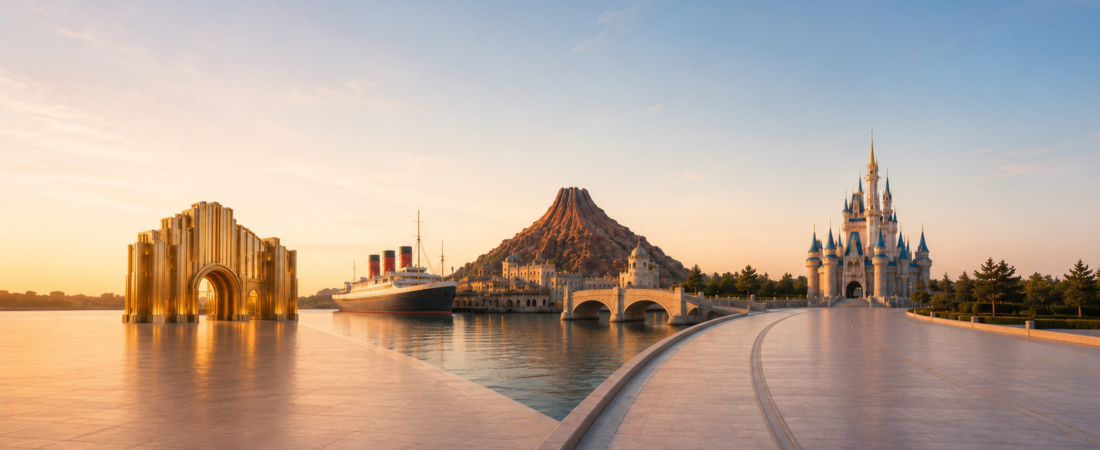
Warner Bros. World Abu Dhabi, Tokyo DisneySea and Magic Kingdom all use familiar entertainment properties to construct immersive environments. Warner Bros. World places a compact, climate-controlled collection of cartoon and superhero worlds inside one building. Tokyo DisneySea uses water, topography and elaborate architecture to create an exploratory park organized around eight maritime-themed ports. Magic Kingdom uses a highly legible central icon and hub-and-spoke plan to organize a broad, multigenerational Disney fantasy.
The clearest overall distinction is therefore not simply Warner versus Disney. Warner offers the strongest protection from weather and the most controlled atmosphere; DisneySea offers the richest integration of architecture, landscape and movement; and Magic Kingdom offers the most immediately understandable plan and the most culturally familiar collection of Disney experiences. Accessibility is substantial at all three, but the services and eligibility rules differ.
| Criterion | Warner Bros. World Abu Dhabi | Tokyo DisneySea | Magic Kingdom |
|---|---|---|---|
| Core identity | Warner Bros. cartoons, superheroes and studio nostalgia | Maritime exploration, myths and Disney fantasy | Classic Disney fantasy, Americana and nostalgia |
| Spatial model | Indoor central plaza with portals to five other lands | Interconnected ports organized around water and a central volcano | Main Street entrance leading to a castle-centered hub |
| Strongest quality | Total climate control and sharply controlled moods | Architectural, landscape and spatial richness | Legibility, iconic imagery and multigenerational familiarity |
| Main design limitation | Limited natural landscape and little visible local cultural expression | Complex routes and substantial weather exposure | Heavy crowds, exposed outdoor circulation and current construction disruption |
| Family/thrill balance | Family-heavy, with several technologically distinctive thrill rides | Broad balance, with a somewhat more mature atmosphere than a castle park | Strongest emphasis on young children and mixed-age family groups |
| LGBT context | Restrictive national law; no park-specific LGBT program identified | Same-sex relations and LGBT events legal | Strongest visible Disney Pride signaling; same-sex couples can legally marry and receive federal recognition |
Identity and sense of place
All three parks depend on intellectual property. Warner Bros. World is the most explicitly franchise-led. Its six lands are Warner Bros. Plaza, Bedrock, Dynamite Gulch, Cartoon Junction, Gotham City and Metropolis. The Plaza is one of the six—not a hub plus six additional lands—and opens through portals into the other five environments. Its art-deco Hollywood imagery provides a common entrance language before the park separates into prehistoric comedy, stylized desert animation and DC superhero cities. The official park currently presents more than 30 rides and experiences in one climate-controlled environment.
Tokyo DisneySea is more concept-led. The official resort describes it as the only Disney park themed to the myths and legends of the sea. Its eight ports are Mediterranean Harbor, American Waterfront, Port Discovery, Lost River Delta, Fantasy Springs, Arabian Coast, Mermaid Lagoon and Mysterious Island. Each uses a different period, geography or fantasy world, but water, travel and discovery provide a stronger unifying idea than the shared brand alone. Fantasy Springs has broadened that formula by introducing environments based on Frozen, Tangled and Peter Pan, yet springs, waterways and journey narratives still connect it to the park-wide theme.
Magic Kingdom is the most archetypal and immediately recognizable. Main Street, U.S.A. leads to Cinderella Castle, around which Adventureland, Frontierland, Liberty Square, Fantasyland and Tomorrowland are arranged. Its identity combines idealized American history, European-derived fairy tale imagery, adventure fiction and retro-futurism. This variety makes the park less conceptually unified than DisneySea, but the castle, Disney characters and repeated storybook conventions provide a powerful common identity.
In comparative terms, DisneySea has the strongest single conceptual framework, Magic Kingdom the clearest symbolic identity, and Warner the most direct translation of separate screen franchises into physical environments.
Spatial organization, circulation and transitions
Warner Bros. World is the easiest of the three to understand at a glance. Guests enter Warner Bros. Plaza and choose portals to the five surrounding lands. The indoor enclosure reduces the need to navigate around large bodies of water or extensive outdoor topography. It also allows transitions to be made through controlled thresholds: light, sound, color and ceiling treatments can change rapidly between the bright cartoon areas and the darker atmosphere of Gotham City. This clarity does not prove that the park is free of bottlenecks, but the compact central organization lowers the cognitive burden of navigation.
DisneySea makes circulation part of the experience. Mediterranean Harbor serves as the principal gateway, while Mount Prometheus, waterways, bridges and Hotel MiraCosta act as major orientation elements. The plan supports exploration through multiple connected routes rather than a single set of spokes. The DisneySea Transit Steamer Line and DisneySea Electric Railway add scenic transport, although they should be understood as attractions with operational schedules rather than guaranteed shortcuts. The result is the most varied movement experience of the three parks, but also the one most likely to require a map or app on a first visit.
Magic Kingdom offers the clearest large-scale orientation. Main Street establishes a direct entrance axis, Cinderella Castle announces the center, and paths distribute guests toward the surrounding lands. That legibility is currently qualified by major change. The Rivers of America, Tom Sawyer Island and the Liberty Square Riverboat closed on 7 July 2025 for the Piston Peak expansion. The Walt Disney World Railroad is currently operating on a modified Main Street-to-Fantasyland route that excludes Frontierland, rather than circling the entire park.
Magic Kingdom therefore has the simplest organizing diagram, Warner the most compact plan, and DisneySea the most rewarding but complex circulation. Warner uses abrupt theatrical portals, DisneySea relies on landscape and architecture to stage gradual discoveries, and Magic Kingdom uses paths, gateways and the central castle to signal changes between lands.
Architecture, landscape and immersion
Warner Bros. World treats architecture primarily as an interior set. The exterior is a large gold-toned enclosure, while the interior shifts among art deco Hollywood, cartoon towns, prehistoric rockwork and superhero cityscapes. Full enclosure gives designers precise control over light and atmosphere: Gotham can remain nocturnal while Cartoon Junction appears perpetually bright. This produces consistent show conditions throughout the day, but the experience depends more heavily on fabricated surfaces and scenic lighting than the two outdoor parks.
DisneySea integrates architecture, constructed topography, water and planting most completely. Mediterranean Harbor combines Southern European streets, waterways and a Renaissance-style fortress. American Waterfront contrasts turn-of-the-century New York with Cape Cod. Mysterious Island uses volcanic rockwork and industrial fantasy to house Captain Nemo’s world, while Mermaid Lagoon shifts into an enclosed undersea environment. Hotel MiraCosta is physically integrated into the park frontage; Oriental Land describes it as being inside the park, with part of its first floor shared with Tokyo DisneySea.
Magic Kingdom also offers substantial architectural variety, but its environments work through familiar archetypes: an American main street, a colonial civic district, a frontier, a fairy tale kingdom, an adventure landscape and a retro-future. Forced perspective, planting, music and hidden service infrastructure support the illusion. Its utilidors were part of the original construction, with the park built above them because of Florida’s high water table; they were not constructed after Hurricane Floyd.
On architectural and landscape integration, DisneySea is the strongest. Warner produces the most consistent atmospheric control, especially through lighting, but offers the least engagement with natural conditions. Magic Kingdom lies between them: it has real outdoor landscape and a strong symbolic composition, but its transitions and individual lands are less consistently unified by one physical theme than DisneySea’s ports.
Weather protection, seating and physical comfort
Warner Bros. World has a decisive advantage in extreme weather. The entire attraction is climate-controlled, protecting circulation, queues, dining and entertainment from Abu Dhabi heat, direct sun, rain and airborne dust. The experience is therefore the most predictable throughout the year. Indoor operation does not by itself prove that seating is abundant, but it eliminates the need to seek shade between lands.
Tokyo DisneySea and Magic Kingdom both require weather planning. DisneySea has indoor relief in Mermaid Lagoon, restaurants, shops and numerous attractions, but its harbors, bridges and major promenades remain exposed. Tokyo summers can be hot and humid, and rain can disrupt outdoor entertainment and transport. Magic Kingdom likewise combines air-conditioned attractions and restaurants with long outdoor routes, exposed plazas and weather-sensitive rides. Florida heat, humidity and thunderstorms make midday breaks particularly important.
For year-round thermal comfort, Warner is clearly first. Between the outdoor parks, the better experience depends on season and daily conditions rather than an inherent design victory.
Attractions, audience and social experience
Warner Bros. World has a family-heavy identity without being exclusively a children’s park. Cartoon Junction and Bedrock provide gentle rides and recognizable characters, while Fast and Furry-ous, Scarecrow Scare Raid and Batman: Knight Flight broaden the offer for thrill-oriented visitors. Knight Flight is a robotic-arm dark ride combining motion and media, not a conventional Batman roller coaster.
DisneySea provides the broadest balance between atmosphere, family rides and adult-oriented thrills. Magic Kingdom is the most explicitly oriented toward multigenerational family groups and young children. Its strength is not ride intensity but breadth of recognizable stories, character encounters, parades and attractions that mixed-age parties can experience together.
For preschool and classic-character appeal, Magic Kingdom has the clearest advantage. DisneySea offers the strongest adult/family balance and the most sophisticated atmosphere. Warner is especially compelling for families whose interests center on DC, Looney Tunes, Scooby-Doo or Hanna-Barbera, and for groups that value indoor comfort over landscape scale.
Accessibility, neurodivergence and LGBT inclusion
Disability and neurodivergence
All three parks publish disability-access information, but their systems are not interchangeable.
Tokyo Disney Resort provides information for guests with mobility, visual, hearing, developmental, intellectual and mental disabilities. Its Disability Access Service allows an eligible guest and party to wait outside the physical queue until a designated time. The official policy explicitly says that the service does not shorten the wait, and documentation is required. Tokyo DisneySea also has accessible and multi-function restrooms, tactile resources and attraction-specific boarding rules.
Warner publishes information for People of Determination and currently offers eligible visitors and one companion admission benefits plus a complimentary priority-access product for selected attractions; safety and boarding restrictions still apply. Warner Bros. World and other Yas parks also received IBCCES Certified Autism Center designation in May 2025 after staff training and sensory-accessibility work. The designation gives the park a formal neurodivergence credential alongside its practical companion and priority-access benefits.
Walt Disney World publishes the most extensive neurodivergence-specific planning toolkit of the three, including sensory and queue-preparation guidance. Its current Disability Access Service is narrower than a general disability fast pass: it is intended for guests who, because of a developmental disability such as autism or a similar condition, cannot wait in a conventional queue for an extended period. Companion restrooms and some manual-flush toilets can help with caregiver and sensory needs.
LGBT visitors
Warner Bros. World Abu Dhabi: No park-specific LGBT inclusion program or public Pride initiative was identified in the official material reviewed. More importantly, the park operates under UAE law. Current U.S. government travel guidance states that consensual same-sex relations and cross-dressing remain illegal, although the U.S. Embassy is not aware of recent arrests or prosecutions for consensual same-sex relations or cross-dressing.
Tokyo DisneySea: No dedicated DisneySea Pride program or park-specific LGBT policy was identified in the official pages reviewed. The national legal context is nevertheless markedly different from the UAE: current U.S. government guidance states that Japanese law places no restrictions on same-sex sexual relations or the organization of gay and lesbian events. This does not mean that every visitor will experience the same degree of social openness, or that the park makes LGBT identity especially visible. It means that LGBT visitors do not face the same criminal-law issue for same-sex relationships or LGBT events. Tokyo DisneySea is therefore best characterized as legally low-risk and institutionally neutral rather than overtly Pride-oriented.
Magic Kingdom: Walt Disney World operates in a jurisdiction where same-sex couples can legally marry and receive federal recognition. Disney has also made Pride visibility part of its public consumer activity through Pride merchandise and official Pride Month food offerings, including items sold at Magic Kingdom. That is evidence of explicit brand-level recognition, though it should not be exaggerated into a dedicated Magic Kingdom Pride festival or a guarantee about every interpersonal experience. Walt Disney World’s gender-neutral companion restrooms are also relevant for some visitors, although they are designed primarily around accessibility and caregiver needs.
For an LGBT traveler, Warner Bros. World presents the clearest legal caution. Tokyo DisneySea offers a legally permissive but relatively low-visibility environment. Magic Kingdom provides the strongest explicit corporate Pride signaling of the three.
Crowds, queue systems, dining and facilities
The latest comparable attendance figures are the 2024 TEA Global Experience Index figures: approximately 17.836 million visits for Magic Kingdom, 12.441 million for Tokyo DisneySea and 1.575 million for Warner Bros. World. These figures should be attributed to the TEA index, which uses operator data where available and professional estimates where necessary; they are not park-by-park attendance figures published by Disney. Annual attendance also cannot establish guest density by itself because park area, operating hours, seasonality and capacity differ.
The figures nevertheless indicate different operating scales. Magic Kingdom handles the greatest annual volume and commonly concentrates crowds around its hub, parades and nighttime entertainment. DisneySea also experiences high demand, especially for major attractions and Fantasy Springs. Warner’s lower annual attendance does not guarantee short waits on every date, but it operates on a smaller scale.
Tokyo DisneySea currently uses paid Disney Premier Access and the free 40th Anniversary Priority Pass; the latter is scheduled to end after 31 August 2026. Magic Kingdom uses Lightning Lane Multi Pass, Single Pass and Premier Pass. Warner sells a Flash Pass for priority access to selected rides.
All three provide restaurants, restrooms, first aid and family services, but food examples should be current and accurately named. At DisneySea, Restaurant Sakura—not S.S. Columbia Dining Room—is the clearest Japanese-dining example. The Tangled-themed Fantasy Springs restaurant is The Snuggly Duckling, while Vulcania Restaurant serves Chinese dishes. Magic Kingdom’s Be Our Guest Restaurant and Cinderella’s Royal Table are restaurants and themed dining experiences, not attractions. Dining quality remains subjective unless supported by a defined survey or review method.
Relationship to local culture and climate
Warner Bros. World responds strongly to Abu Dhabi’s climate but only weakly to its local culture. Enclosure and air-conditioning are fundamental design decisions, while the represented places—Hollywood, Gotham, Metropolis, Bedrock and an animated American Southwest—come from Western screen properties. This makes Warner the clearest example of climatic adaptation without substantial cultural localization in the visible themed environment.
DisneySea presents global and fictional ports rather than Japanese architecture. Its localization is more evident in operations, language, food, service conventions and the expectations of its domestic audience than in the literal scenery. The claim that the sea theme was chosen specifically because of Japan’s maritime tradition should be used only with a direct design-history source. Oriental Land documents extensive Japanese-American negotiation and describes the completed park as a unique sea-themed project, but that does not by itself prove a single cultural cause. The park cost ¥335 billion to construct; it was a new park, not merely a Disney “expansion.”
Magic Kingdom is geographically in Florida but visually rooted in idealized Americana and Disney fantasy. Florida conditions affect landscaping, drainage, operations and weather planning, but the visible narrative is not primarily Floridian. The park’s utilidors and elevated guest level date to original construction and should not be attributed to later hurricanes.
Impact on local economy
The parks influence their local economies in different ways across markedly different geographic scales. Warner Bros. World forms part of Yas Island’s wider tourism strategy, supporting Abu Dhabi’s economic diversification by attracting visitors whose spending extends to hotels, restaurants, retail, transport and other island attractions. Its role is primarily catalytic: it helps strengthen Yas Island as an integrated destination, although the park’s individual contribution is not publicly separated from Miral’s broader portfolio. Tokyo DisneySea operates within the mature Maihama tourism cluster in Urayasu, where it supports substantial direct employment and continuing demand for resort hotels, rail services, shops, restaurants and local suppliers. Its principal contribution is sustaining and renewing an established visitor economy through continued investment and repeat domestic tourism. Magic Kingdom has the broadest regional reach because its attendance feeds the much larger Walt Disney World network and supports hospitality, construction, transportation and supplier activity throughout Central Florida. Disney reports a major statewide economic contribution for Walt Disney World, but that total covers the entire resort rather than Magic Kingdom alone. Magic Kingdom therefore probably creates the largest regional spillover, DisneySea the most concentrated local employment ecosystem, and Warner the clearest contribution to long-term destination development and economic diversification.
Overall assessment: which park is best for whom?
For architectural and spatial immersion: Tokyo DisneySea is the strongest choice. Its ports, water, constructed topography, planting and integrated hotel create the richest continuous environment. Its disadvantage is more complicated navigation and greater exposure to weather.
For reliable physical comfort: Warner Bros. World is the strongest. Full climate control is a decisive benefit in extreme heat, and the compact plan is easy to understand. Its tradeoff is a smaller-scale, more visibly fabricated environment with limited natural or local-cultural integration.
For young children and classic Disney familiarity: Magic Kingdom is the strongest. Its castle-centered plan, broad character recognition and large selection of mixed-age attractions make it the most immediately accessible family fantasy. Its tradeoffs are heavy demand, outdoor heat and rain, and current construction-related changes.
For thrill-seeking adults: DisneySea offers the best overall combination of atmospheric sophistication and major thrill attractions, although individual attraction closures must be checked. Warner provides distinctive indoor thrills but a more family-weighted overall mix. Magic Kingdom has several major thrill rides but remains the most child-centered of the three.
For LGBT visitors: Magic Kingdom offers the strongest explicit Pride visibility at operator level, while Tokyo DisneySea combines a low-key park environment with a national legal framework that does not restrict same-sex relations or LGBT events. Warner Bros. World requires substantially greater caution because of UAE law, including restrictions relevant to same-sex relations, gender expression and passport sex markers. For some LGBT travelers, that legal distinction will outweigh differences in rides, architecture or climate comfort.
No park is universally “best.” DisneySea is the strongest designed environment, Warner is the strongest climate-controlled environment, and Magic Kingdom is the strongest classic family icon. The appropriate choice depends on whether the visitor prioritizes immersive design, weather protection, family familiarity, attraction mix, accessibility needs or LGBT safety and visibility.
Evidence note
This comparison distinguishes official facts from interpretation. Counts, current closures, access systems and legal statements are documented in the Sources section at the end of the report. Judgments such as “strongest immersion” or “most familiar” are comparative assessments based on the documented design characteristics, not objective measurements of emotion or quality. Current attraction availability, product names, offers and travel law should be checked again close to the date of travel.
Sources
All citations and supporting links are consolidated below. Accessed 21 July 2026.
- 1. Warner Bros. World Abu Dhabi — official park overview . Warner Bros. World Abu Dhabi.
- 2. Warner Bros. Plaza — official land description . Warner Bros. World Abu Dhabi.
- 3. Batman: Knight Flight — official attraction page . Warner Bros. World Abu Dhabi.
- 4. People of Determination offer and accessibility information . Warner Bros. World Abu Dhabi.
- 5. The Flash Pass — official priority-access information . Warner Bros. World Abu Dhabi.
- 6. Yas Theme Parks Certified Autism Center designation . Miral Destinations.
- 7. Tokyo DisneySea overview and eight themed ports . Tokyo Disney Resort.
- 8. Tokyo DisneySea attractions . Tokyo Disney Resort.
- 9. Barrier-free services at Tokyo Disney Resort . Tokyo Disney Resort.
- 10. Disability Access Service and separate-wait services . Tokyo Disney Resort.
- 11. Disney Premier Access . Tokyo Disney Resort.
- 12. Tokyo Disney Resort 40th Anniversary Priority Pass . Tokyo Disney Resort.
- 13. Facility overview, including Tokyo DisneySea Hotel MiraCosta . Oriental Land Co., Ltd..
- 14. Tokyo DisneySea project history and construction cost . Oriental Land Co., Ltd..
- 15. OLC Group employee data . Oriental Land Co., Ltd..
- 16. Magic Kingdom Park — official overview . Walt Disney World Resort.
- 17. Piston Peak National Park and Frontierland expansion . Disney Parks Blog.
- 18. Walt Disney World Railroad — current modified route . Walt Disney World Resort.
- 19. Utilidors . D23: The Official Disney Fan Club.
- 20. Services for guests who are neurodivergent . Walt Disney World Resort.
- 21. Disability Access Service . Walt Disney World Resort.
- 22. Lightning Lane passes . Walt Disney World Resort.
- 23. Disney Eats: Pride Month Foodie Guide 2024 . Disney Parks Blog.
- 24. United Arab Emirates international travel information . U.S. Department of State.
- 25. Japan travel advisory and information for LGBT travelers . U.S. Department of State.
- 26. Federal marriage benefits for same-sex couples nationwide . U.S. Department of Justice.
- 27. TEA Global Experience Index 2024 . Themed Entertainment Association.
- 28. Miral overview and Abu Dhabi economic-diversification role . Miral.
- 29. Walt Disney World economic impact in Florida . The Walt Disney Company.