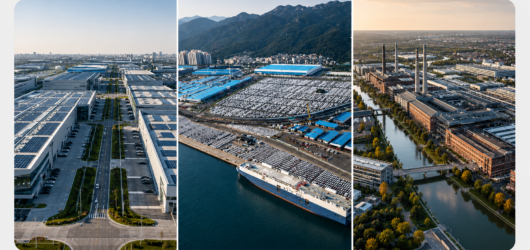
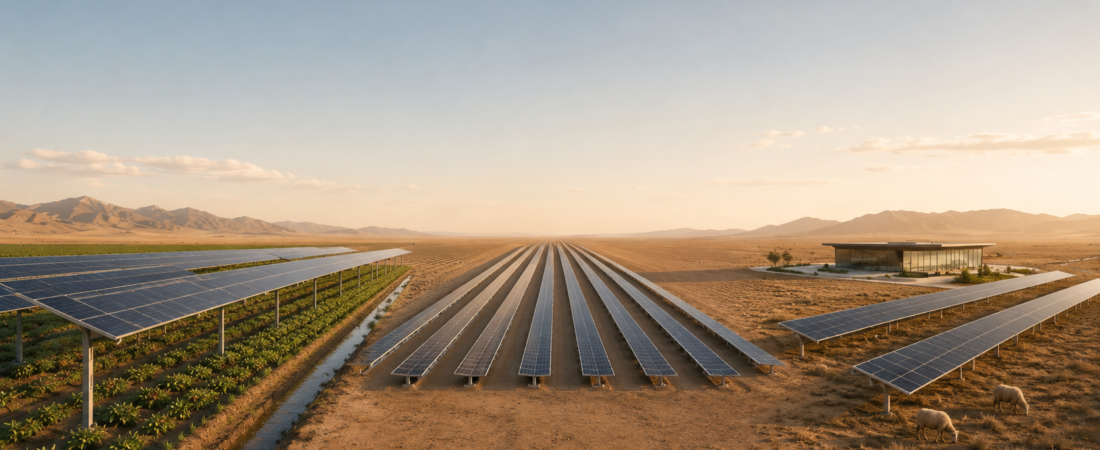
Ningxia Baofeng, Al Dhafra and Karapınar each cover about 20 square kilometres. Ningxia grows crops beneath raised panels and uses planting to control sand. Al Dhafra is a large fenced solar plant built to supply Abu Dhabi’s power system. Karapınar connects a solar field in Konya with a module factory and research centre in Ankara. Its control building also provides space for meetings and arranged visits. The report focuses on how the projects use land, affect the environment, create work and present themselves to visitors. Evidence was checked through 4 August 2026.
| Measure | Ningxia Baofeng | Al Dhafra | Karapınar |
|---|---|---|---|
| How it was developed | Land treatment followed by solar construction and commercial crops | Solar plant owned by four energy companies under a 30-year contract with EWEC | Government solar tender tied to Turkish module manufacturing and research |
| Location | Yellow River irrigation region east of Yinchuan, beside the Mu Us sandy lands | Level desert site at Al Bihouth, about 35 kilometres south of Abu Dhabi city | Semi-arid farming and grazing area in the Konya Closed Basin |
| Site area | About 20 km² | 21.18 km² construction area | About 20 km² |
| Operating scale | Approximately 1 GW; more than four million modules; separate DC and AC ratings unavailable | 2.1 GWp DC; 1.5 GW AC; about four million modules | 1.348 GWdc; 1.0 GWac; 3,376,890 modules in the lender design |
| Layout | Raised tracking rows with crops, irrigation channels and farm access | Continuous rows of bifacial panels with electrical equipment and maintenance roads | Long tracker rows and a central control building inside the solar site |
| Other land use | Goji, alfalfa and other vegetation across parts of the solar field and treated land | No documented productive use beneath the panels | Sheep grazing beneath panels at an incompletely documented scale |
| Jobs and local benefit | Recurring farm work alongside electricity production | Construction jobs and electricity supply; permanent local workforce unpublished | Solar generation in Konya linked to manufacturing and research in Ankara; sheep grazing on site |
| Access | Arranged government and media visits; routine opening unconfirmed | Visitor centre used for arranged visits; standard admission unconfirmed | Control building, meeting rooms and roof terrace used for arranged visits |
Project sources use their own definitions of area and capacity. Ningxia’s separate DC and AC ratings are unavailable. The report therefore keeps the original figures and avoids calculated rankings.
Regional setting and development model
Ningxia Baofeng lies east of Yinchuan, near the southwestern edge of the Mu Us sandy lands and within Ningxia’s long-established Yellow River irrigation system. The area has a dry continental climate, strong wind erosion and extensive irrigated farming. This report covers the 1 GW solar site outside Yinchuan where crops grow beneath the panels. Baofeng’s separate 1 GW solar and sand-control project at Majiatan is another development.
Baofeng began treating desertified land in 2013–14. The company levelled selected ground, planted alfalfa and extended irrigation. It later installed raised solar panels above areas used for goji and other crops. Company and government reports link the project to land restoration, farm work and poverty reduction. Baofeng has published little about the site’s contracts and financing. The company also produces coal chemicals.
Al Dhafra stands at Al Bihouth, about 35 kilometres south of Abu Dhabi city. The site is close to the capital and existing 400 kV power lines. TAQA owns 40%. Masdar, EDF power solutions and Jinko Power each own 20%. EWEC buys all the electricity through a 30-year agreement. Financing closed in December 2020, full operation began in June 2023, and a US$870.75 million green bond refinanced the plant in January 2026. The agreed tariff was 1.32 US cents per kWh.
Karapınar stands on a high semi-arid plain in Central Anatolia’s Konya Closed Basin. The district contains farms and grazing land and has long faced wind erosion and falling groundwater levels. Türkiye’s first large solar YEKA tender awarded the Kalyon–Hanwha consortium a 1,000 MWe connection in 2017 at 6.99 US cents per kWh. The 15-year agreement required domestic module production, research and technology transfer. The solar plant is in Konya Province. The module factory and research centre are in Ankara.
Layout and land use
Ningxia’s raised tracking rows leave working space beneath and between the modules. Irrigation channels, planted strips, farm paths and maintenance routes break up the rows of panels. More than four million older modules cover the site. The crop fields and access routes use space that a solar-only site could fill with equipment.
Goji is the most visible crop at Ningxia. Workers prune, fertilise and harvest among the panels. Alfalfa and other vegetation also grow across the wider treated land. Published descriptions give several crop-area figures, so no single total is reliable.
Solar equipment fills almost all of Al Dhafra. Approximately four million bifacial modules sit on 33,000 single-axis trackers within a 21.18 km² construction area. Substations, cables, maintenance roads and cleaning routes run through the panel rows. Arranged visitors mainly see long, uninterrupted rows and the roads used by maintenance crews and cleaning robots.
Karapınar also uses long rows of single-axis trackers. Its central control building is the main landmark inside the solar field. Kalyon reports that the nearby G24 project will add 522 MWp on 6,435,050 m², using 794,448 panels, with completion planned for December 2026. This project will add another large solar field and new grid equipment nearby.
Environmental effects and climate risks
At Ningxia, solar panels and planted ground share the same site. Reuters observed workers tending goji beside and beneath the modules in September 2025. Shade changes light and soil moisture, and planted ground helps slow moving sand. Recent peer-reviewed studies found small areas with their own shade and moisture conditions around the tracking arrays. They also recorded vegetation recovery and changes in plant diversity.
Company and government reports state that vegetation cover rose from below 30% to 85.1% and that evaporation fell by as much as 70%. Independent research has not confirmed those figures across the whole site. A full assessment would need records for crop area, soil condition, irrigation efficiency, fertilizer and pesticide use, groundwater and the amount of Yellow River water diverted to the project.
Al Dhafra uses plant-powered robots to clean the panels without water. This removes the regular water demand created by washing. Project publications give detailed figures for modules, output, ownership and finance. They give little information about the original habitat, wildlife movement, soil disturbance, drainage after heavy rain, biodiversity monitoring or restoration after closure.
UK Export Finance classified Karapınar as Category A because the project could cause significant environmental, social and human-rights harm. Its review covered water, wastewater, land purchases, lost livelihoods, working conditions, community safety, biodiversity and climate risk. It identified possible effects on the Karapınar Plain Key Biodiversity Area and required plans to manage those risks. Little post-construction monitoring has been published.
The Karapınar site occupies land used for farming, grazing and erosion control. A 2026 peer-reviewed study based on ten households and interviews with other local groups documents sheep grazing beneath the panels. The study describes possible benefits for herders and water conservation. Long-term rules for access, fencing, liability, water provision and grazing remain unclear.
Each site faces a separate set of climate risks. Ningxia depends on continued irrigation and crop care. Al Dhafra uses tracking equipment and robotic cleaning to manage heat and dust. Karapınar operates in a basin with severe water pressure and has a formal climate-risk plan. The operators have not published comparable records for heat waves, sandstorms, hail, snow, flooding or long droughts.
Work and local benefits
Ningxia creates recurring work after construction. Goji pruning, fertilising, harvesting, irrigation, weed control and panel cleaning require workers throughout the year. Chinese government and company reports claim roughly 80,000–100,000 work occasions each year and average additional household income above RMB40,000 for participating farmers. The employment figure appears to count individual shifts or visits. Published sources give no details on wages, contracts, gender, place of residence or net crop profits.
Farm work keeps local workers involved after the solar plant is built. The income earned by households depends on irrigation and processing costs, crop prices and employment terms. Recent reporting confirms continued cultivation. No independent study has checked the income and poverty-reduction figures.
Masdar reports 4,500 jobs at Al Dhafra’s construction peak. Published information gives no breakdown by nationality, residence, skill, wage or contract condition. The permanent operating headcount is also unpublished. Automation and robotic cleaning point to a small long-term workforce. The plant’s main long-term benefit is large-scale electricity supply at a low contracted tariff. The sources give no comparable account of benefits to nearby communities.
Karapınar creates work in several places. The solar field is in Konya Province, the module factory and research centre are in Ankara, and UK export-credit support paid for British electrical equipment linked to more than 100 UK jobs. Permanent employment in Karapınar district is unpublished. Sheep grazing can provide forage for local herders and control vegetation beneath the panels. Its value depends on clear, lasting access rules.
Ningxia keeps farm work on the site. Al Dhafra mainly contributes electricity to Abu Dhabi’s power system. Karapınar connects the solar field to factory and research jobs elsewhere. Construction job totals reveal little about the benefits that remain in nearby communities.
Access and public presentation
All three sites are controlled electrical installations. Access is limited to arranged visits. Most people encounter them through aerial photographs, company videos and a few designated viewing areas. None has confirmed routine admission for independent visitors.
Ningxia lies roughly 50 kilometres east of central Yinchuan. Early descriptions proposed viewing platforms, farm tourism and visitor facilities. Recent evidence confirms arranged tours for government groups and journalists. At ground level, crops, irrigation, workers and raised panels show clearly how farming and electricity generation share the land.
Al Dhafra has a visitor centre for arranged tours. Company materials emphasise capacity, tariff, module count, construction speed and aerial scale. Visitors see the working plant and its long rows of panels. The centre gives little attention to desert ecology or earlier land conditions.
Karapınar is the only site with a building designed partly for visitors. The 2,778 m² control building includes operating rooms, meeting rooms and event space. A roof terrace gives a 360-degree view across the panels. Its reflective double-layer stainless-steel façade reduces direct solar heat and makes the building easy to recognise. Conferences, workshops and arranged visits present Türkiye’s solar manufacturing programme.
Ningxia is presented through crops growing among panels. Al Dhafra is presented through aerial views of its size. Karapınar is presented through its control building and roof terrace. Each choice directs attention to one part of the project.
What makes each place distinctive
Ningxia Baofeng is a solar farm that is also cultivated. Panels stand above crops, irrigation channels and working fields. The main unanswered question is whether the gains for vegetation and household income justify the project’s use of Yellow River water.
Al Dhafra is a very large solar power plant near Abu Dhabi. A long-term electricity contract, closely packed tracker rows and robotic cleaning shape how it works. Its owners publish detailed engineering and financial information. They publish little about ecological change or nearby communities.
Karapınar is a solar field linked to Turkish module manufacturing and research. The control building makes that national programme visible on the site. Sheep grazing connects the plant to local rural life. The extent and future of that access remain unclear.
Ningxia combines solar power with crops and sand control. Al Dhafra devotes almost the whole site to electricity generation. Karapınar ties a solar field to manufacturing, research and arranged public visits. The unresolved questions concern water use and household income in Ningxia, ecology and nearby communities at Al Dhafra, and long-term grazing rights at Karapınar.
Sources and evidence notes
1. Reuters, China enlists solar panels in war to halt desert sands — 23 September 2025 on-site reporting; confirms the operating Ningxia facility, active goji cultivation, Baofeng’s coal-chemical background and the separate Majiatan project.
2. China Daily Ningxia, Baofeng agriculture–solar desertification-control case — Institutional source for the 1 GW label, 30,000 mu footprint, Yellow River irrigation, vegetation, evaporation, employment and income claims.
3. Dialogue Earth, With coal off the menu, can China export its renewables model? — Independent reporting that attributes module, crop-area and ecological claims to Baofeng and related institutions.
4. Solar-tracking photovoltaic systems create divergent microhabitats — Peer-reviewed site research at the Baofeng photovoltaic facility on light, microhabitats and vegetation recovery.
5. Solar-tracking PV shifts species composition and improves plant diversity — Peer-reviewed site research on plant diversity, microhabitats and water redistribution at Baofeng.
6. State Grid Ningxia 2024 new-energy generation and export figures — Regional grid context: 61.3 TWh generated, 40.2 TWh consumed within Ningxia and 21.1 TWh exported; not plant-specific data.
7. Masdar, Al Dhafra Solar PV quick facts — Institutional source for ownership, location, financial close, operating date, bifacial technology and tariff.
8. Dhafrah PV2 Energy Company, solar project — Project-company source for 2.1 GWp DC, 1.5 GW AC, 4.7 TWh, 21.18 km², four million modules, 33,000 trackers and the 30-year PPA.
9. EWEC, US$870.75 million Al Dhafra green bond — 16 January 2026 primary source for refinancing, current ownership and waterless plant-powered cleaning robots.
10. Masdar, Al Dhafra inauguration — Institutional source for location, tariff, footprint and the stated 4,500 construction jobs at peak.
11. pv magazine, A closer look at Al Dhafra — Independent trade-journal visit confirming the visitor centre and hosted site access; not evidence of routine public opening.
12. Middle East Council on Global Affairs, responsible GCC solar development — Regional analysis of biodiversity and monitoring needs in arid solar landscapes; not evidence of a specific Al Dhafra impact.
13. Türkiye EPDK, Karapınar YEKA tender record — Regulatory source for the 2017 competition, 1,000 MW connection and 6.99 US-cent bid.
14. Türkiye Ministry of Energy, first solar YEKA competition — Government source for the Kalyon–Hanwha award and the 2017 procurement context.
15. UK Export Finance, Category A Karapınar assessment — Primary lender record for 1,348 MWdc, 1,000 MWac, 3,376,890 panels, 2.3 TWh expected output and environmental and social risks.
16. UK Export Finance, £217 million Turkish solar support — Export-credit and UK supply-chain context; the separate Category A page records a £189.8 million principal support value.
17. Kalyon Energy portfolio — Developer source for the operating Karapınar plant, approximately 20 km² and 3.5 million modules, current generation claim and G24 projections.
18. Kalyon Energy ownership — Company source for the 50% Kalyon İnşaat and 50% International Energy Holding ownership structure since August 2022.
19. Between Panels and Pastures — Peer-reviewed 2026 Karapınar study using longitudinal engagement with ten households, stakeholder interviews and quantitative material; detailed results were not fully open-access during review.
20. Bilgin Architects, Kalyon Karapınar central control building — Architect’s project listing for the control building and its interpretive role; design evidence rather than proof of routine public programming.
21. IPCC, Climate Change and Land — Desertification — Authoritative regional context for Karapınar’s semi-arid climate and desertification history; not a project-impact assessment.