Executive summary
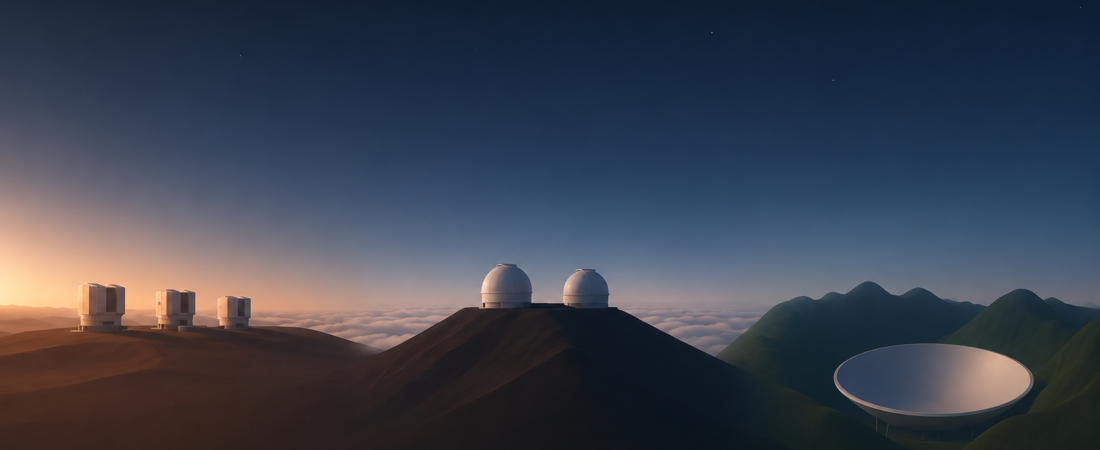
Paranal Observatory, W. M. Keck Observatory, and the Five-hundred-meter Aperture Spherical Radio Telescope (FAST) are all leading astronomical facilities, but they are not equivalent kinds of place. Paranal is a multi-telescope optical and infrared campus in Chile’s Atacama Desert. Keck is a two-telescope facility within the shared observatory precinct and culturally significant landscape of Maunakea in Hawaiʻi. FAST is a radio facility built into a karst depression in Guizhou, China, surrounded by a regulated radio-quiet landscape and now being extended by a distributed core array.
Their physical forms follow the signals they observe. Optical and infrared astronomy at Paranal and Keck benefits from dark skies, low atmospheric water vapour, stable air and careful thermal control. FAST depends primarily on protection from terrestrial radio-frequency interference and on mitigation of interference from satellites. These requirements produce different operational geographies: a residential desert campus, a high-altitude shared summit precinct, and a protected electromagnetic basin.
Their institutional and social settings also differ. Paranal is operated by the European Southern Observatory (ESO), an intergovernmental organisation with an established international proposal system and formal host-state provisions for Chile. Keck is governed and operated through the California Association for Research in Astronomy (CARA) on behalf of the California Institute of Technology and the University of California, with observing shares held by partners including NASA and the University of Hawaiʻi. FAST is a Chinese Academy of Sciences facility that has accepted international proposals since 2021, although its current allocation data and community-impact evidence are less fully documented in publicly accessible English-language sources.
The comparison is therefore most useful when it asks how astronomy reorganises land, infrastructure, access and governance. Paranal’s defining condition is desert isolation combined with a highly serviced scientific campus. Keck’s is the coexistence of frontline astronomy with Native Hawaiian cultural claims, environmental stewardship and an ongoing transfer of land-management authority. FAST’s is the construction of a radio-quiet territory around an unusually land-dependent instrument, together with resettlement, tourism development and a new multi-antenna extension.
Scope and method
This comparison is current to 31 July 2026. “Place” refers here to the operational facility, its supporting infrastructure, its immediate protected landscape, and the governance and community relationships that enable or constrain its continued use.
The units are not perfectly symmetrical. Paranal is an observatory campus containing several telescope systems; Keck is one observatory within a larger summit precinct; and FAST began as a single dominant instrument but is now being expanded through the FAST Core Array. The comparison therefore does not rank the three facilities by scientific performance. It examines how their observing requirements shape built form, operations, access and relations with the surrounding territory.
Atmospheric figures are included only as contextual evidence. Measurements from different instruments, periods and definitions are not treated as directly interchangeable. Social and community evidence is also uneven: Maunakea has an extensive public record in English, while the accessible records for Paranal and FAST are more institution-led. Absence of comparable documentation is not evidence that conflict or community effects are absent.
Regional context and physical setting
| Site | Approximate elevation | Facility and landscape | Observing domain |
|---|---|---|---|
| Paranal | 2,635 m | Multi-telescope campus on Cerro Paranal, about 120 km south of Antofagasta and 12 km inland from the Pacific | Optical and infrared |
| Keck | 4,145 m | Two telescope domes near the summit of Maunakea, within a shared astronomy precinct | Optical and infrared |
| FAST | 1,110 m | Active 500 m spherical reflector in the Dawodang karst depression, with a protected radio-quiet zone and a core array under construction | Radio |
Paranal occupies an exceptionally dry and sparsely populated part of Chile’s Antofagasta Region. ESO’s scientific site page gives the general Cerro Paranal location as approximately 24°40′S, 70°25′W; the individual telescope coordinates differ slightly. The nearest major transport node is Antofagasta. Staff and authorised scientific visitors use organised logistics, while public visitors travel under a separate, controlled access regime. ESO’s site information gives the elevation, distance from the coast and detailed environmental data.
Keck’s two domes stand near the summit of Maunakea at approximately 13,600 ft, or 4,145 m. Operations are distributed across the summit facility, the Hale Pōhaku mid-level complex and Keck’s headquarters in Waimea. Road access above the Maunakea Visitor Information Station requires a suitable four-wheel-drive vehicle and is subject to weather, altitude and stewardship restrictions. Keck is physically distinct from the other summit observatories but depends on shared roads, services and land-management arrangements.
FAST lies in the Dawodang depression near Kedu Town in Pingtang County, Guizhou. Its geometry and surrounding terrain are integral to the reflector and help shield it from terrestrial radio emissions. Access to the scientific core is controlled, and the use of radio-emitting electronics is restricted.
Environmental fit and observing conditions
Paranal has the most centralised and current public environmental-monitoring record of the three. ESO reports a long-term photometric-plus-clear fraction of about 77% for 2014–2024 and a usable-time fraction of about 90%. These terms must not be confused: “photometric” denotes the strictest transparency category, while the larger 77% figure combines photometric and clear conditions. ESO’s broader site summary separately estimates the strictly photometric fraction at about 30%.
Maunakea’s altitude places Keck above a large fraction of the atmosphere and often above lower cloud layers. The site is widely recognised for low water vapour, low thermal background and excellent optical and infrared image quality. However, Keck does not publish a single current climatological summary directly comparable with Paranal’s monitoring pages.
Seeing and optical sky brightness are not meaningful measures of FAST’s site quality. Its principal environmental requirement is electromagnetic compatibility.
Telescope architecture and built form
Paranal’s main optical platform is an ensemble. The Very Large Telescope consists of four 8.2 m Unit Telescopes; the Very Large Telescope Interferometer also uses four movable 1.8 m Auxiliary Telescopes. The site additionally includes the VISTA and VST survey telescopes. The telescope platform, control building, technical spaces, Residencia and staff camp form a deliberately separated but integrated campus. Access to telescope buildings is restricted during observations to limit light, heat and safety risks, and most VLT observations are operated from a separate control building.
Paranal is also changing. Construction has begun for the southern array of the Cherenkov Telescope Array Observatory, and new instrumentation such as MOONS and 4MOST is altering the scientific and logistical programme. Describing Paranal only as the four VLT Unit Telescopes therefore understates its current scale and continuing development.
Keck has a more concentrated form: two large domes containing segmented 10 m primary mirrors, connected to common support functions and surrounded by other independently operated observatories. Its instrument suite supports visible and infrared imaging, spectroscopy, adaptive-optics work and precision radial-velocity measurements.
By primary-aperture diameter, each Keck telescope (10 m) is larger than each of Paranal’s four VLT Unit Telescopes (8.2 m), although Paranal has four large optical units to Keck’s two. FAST operates at a different physical scale: its reflector is approximately 500 m across, with a 300 m illuminated aperture used for an observation. These figures compare physical size, not equivalent scientific performance across optical, infrared and radio wavelengths. Cables and actuators deform part of FAST’s spherical surface into the required shape, while a cable-driven feed cabin and a secondary positioning platform place the receiver system at the focus. The landscape and telescope are consequently more tightly coupled than at the two optical sites.
The facilities also entered service at different times. Paranal’s first VLT Unit Telescope achieved first light in May 1998, and the fourth followed in September 2000. Keck I began scientific observations in May 1993, while Keck II achieved first light in October 1996. FAST was built between March 2011 and September 2016 and entered formal operation in January 2020.
FAST can no longer be described only as a single, non-modular dish. Construction of the FAST Core Array began in September 2024. The project proposes 24 additional 40 m antennas within approximately 5 km of FAST, allowing the main dish to work as part of an interferometric array and greatly improving angular resolution. This extension changes both the science architecture and the spatial footprint of the observatory. CAS’s construction announcement describes the project as a planned extension of FAST.
Operations and scientific access
Paranal functions as a residential observatory campus. ESO coordinates transport and accommodation for authorised staff and visiting astronomers, and the Residencia, camp, control rooms and technical buildings support multi-day shifts. Rooms and offices follow blackout rules after sunset. Service-mode observing is especially important: ESO staff execute queued observations when the required conditions occur, reducing the dependence of a programme on the weather during a specific assigned night.
ESO currently has 16 Member States, with Chile as host state and Australia as a strategic partner. Proposals may be submitted by any group or individual, although institutional status affects some priorities and funding arrangements. Chilean scientists compete normally and also have access to host-state provisions for scientifically meritorious proposals, up to the fractions established by the ESO–Chile agreements.
Keck is governed and operated through CARA on behalf of Caltech and the University of California. It is not an open-skies observatory in the ESO sense: most time is distributed through partner institutions. NASA joined as a one-sixth partner, and its competitive call is open to researchers principally affiliated with U.S. institutions. The University of Hawaiʻi also receives observing time under the site arrangements. Keck’s existing sublease expires in 2033. Act 53, enacted in May 2026, authorises the Mauna Kea Stewardship and Oversight Authority (MKSOA) to extend existing leases and subleases by up to ten years, but such an extension is not automatic.
FAST entered formal operations in 2020 and opened to international proposals in March 2021. CAS reported in December 2025 that it had approved 27 applications from researchers in 14 countries since the international opening. This demonstrates real international use, but it does not by itself show what share of annual observing time is international, how acceptance rates compare across user groups, or how the allocation is distributed by instrument and programme type. Those questions require current observing-call and allocation data. CAS’s 2025 report supports the 27-application figure.
Land, community and legitimacy
Maunakea and Keck
Maunakea is a place of profound cultural, genealogical and spiritual importance to Native Hawaiians. Astronomy on the mountain has also been shaped by decades of criticism concerning state and University of Hawaiʻi management, cumulative development, environmental care and the treatment of cultural practice.
Hawaiʻi’s Act 255, adopted in 2022, created MKSOA. Act 53, enacted in May 2026, revised the timetable by extending the transition period through 1 December 2029, while providing for specified land and permit transfers and continuity of existing University of Hawaiʻi rules during the transition. It also authorises MKSOA to extend existing observatory leases and subleases by up to ten years. The legislation and current stewardship programmes combine cultural knowledge, environmental care, public access, astronomy and decommissioning within one management framework.
In June 2025, the Office of Hawaiian Affairs withdrew two Maunakea lawsuits and stated that it would pursue accountability and Native Hawaiian leadership through collaborative stewardship. The withdrawal did not erase the underlying history or establish consensus; OHA explicitly referred to longstanding concerns about mismanagement, environmental cleanup and cultural protection.
Decommissioning is already altering the summit. Two smaller facilities were removed in 2024, and in July 2026 the University of Hawaiʻi announced that UKIRT science operations would end in September as another decommissioning process begins. Keck is not currently scheduled for removal, but these projects demonstrate that observatory retirement and site restoration are active parts of Maunakea governance. The July 2026 UKIRT announcement provides the current context.
Paranal and Chile
The public institutional record for Paranal emphasises Chile’s role as host state, guaranteed access for Chilean astronomy, employment, procurement, training and joint development funds. The Chilean government donated the Paranal summit and surrounding land to ESO in 1988, and the later ESO–Chile agreement formalised scientific and labour provisions.
A recent industrial-development dispute shows that Paranal’s isolation is politically maintained, not naturally guaranteed. In 2024 a proposed green-hydrogen and ammonia complex, known as INNA, was submitted for a location close enough to raise concerns about dust, light pollution and atmospheric turbulence. ESO, Chilean astronomers, public authorities and other supporters opposed the location. The developer cancelled the project in February 2026. The episode exposed Paranal’s vulnerability to regional industrial development and the need for active dark-sky protection. ESO’s cancellation announcement records the outcome, while also reflecting ESO’s institutional position.
FAST, resettlement and regional development
FAST altered settlement and land use around the Dawodang basin. The available figures require careful chronology. A 2025 Xinhua retrospective states that Pingtang County launched a relocation programme in 2007 involving 6,653 rural residents from Kedu and Tangbian townships. Contemporary reporting in 2016 cited a planned relocation of approximately 9,110 people living within 5 km of the telescope to establish the radio-quiet environment. These figures may refer to different phases, boundaries or administrative counts; they should not be presented as competing estimates of a single clearly defined cohort.
The public record also contains allegations of forced demolition, inadequate compensation and unlawful detention. WIRED reported that as many as 500 families were said to be pursuing claims against Pingtang County, citing earlier Agence France-Presse reporting. These allegations are significant, but accessible independent follow-up on the cases and on long-term household outcomes is limited.
The relocation was accompanied by the development of astronomy tourism around Kedu and Pingtang. State reporting presents new tourism employment and infrastructure as benefits for relocated residents. Independent evidence is insufficient to determine how evenly those benefits were distributed, whether they replaced earlier livelihoods, or how affected residents assessed the process over time. The defensible conclusion is that FAST reorganised both electromagnetic regulation and settlement around the telescope; the quality of consent, compensation and long-term social outcomes remains incompletely documented. Xinhua’s 2025 retrospective and WIRED’s investigation represent contrasting parts of the record.
Environmental risk and resilience
Paranal’s continuing operation depends on protection from artificial light, dust and nearby industrial turbulence as well as adaptation to natural hazards. ESO’s site data include seismic design parameters for an operating-basis earthquake and a maximum likely earthquake, while more recent research has examined warming trends, seasonal moisture changes and unusual atmospheric effects such as those following the Hunga Tonga–Hunga Haʻapai eruption. The INNA dispute demonstrates that land-use policy may be as important as engineering in protecting site quality.
Keck’s immediate risks include severe summit weather, altitude exposure, road closures, invasive-species transfer and the ecological effects of visitor and operational traffic. Its longer-term resilience is institutional: continued operation beyond the present 2033 sublease depends on an extension or successor authorisation under MKSOA, as well as compliance with a governance system that gives cultural and environmental stewardship a more central role.
FAST’s environmental and engineering risks are closely linked. Local electronics, actuator systems and visitor devices must meet stringent electromagnetic requirements; satellites create interference beyond the reach of local regulation; and the active reflector, feed-support system and new array require specialised maintenance in a remote basin. The Core Array may improve scientific capability while also extending construction, maintenance and radio-quiet requirements across more of the surrounding landscape.
Public access and interpretation
Paranal offers free scheduled daytime tours, virtual guided visits and, since March 2026, a limited programme of public night tours associated with selected national and regional events. Research operations remain separated from public circulation, and ordinary daytime visitors arrange their own transport.
Keck’s summit visitor gallery is normally open daily during limited daytime hours, and the broader Maunakea Visitor Information Station provides interpretation below the summit. Physical access is constrained by altitude, health risks, road conditions and the need to protect cultural and ecological resources. Public presence is therefore both more visible and more contested than at an enclosed institutional campus.
FAST has the clearest physical division between tourism infrastructure and the scientific core. Public observation and science-popularisation facilities have been developed around Pingtang and Kedu, while electronics bans, checkpoints and advance permission protect the telescope itself. This arrangement makes FAST simultaneously a major tourist symbol and the most electromagnetically restricted working site in the comparison.
Conclusion
| Dimension | Paranal | Keck | FAST |
|---|---|---|---|
| Primary site requirement | Dark, dry and stable optical/IR conditions | High-altitude optical/IR conditions within a shared summit landscape | Protection from terrestrial RFI and mitigation of satellite interference |
| Built form | Residential multi-telescope campus | Two large domes within a multi-observatory precinct | Land-integrated active dish plus a core array under construction |
| Scientific access | International proposal system with host-state provisions | Primarily partner-allocated time, including a competitive NASA share | National facility with international proposals since 2021 |
| Central land and community issue | Protection of the observing environment and fuller accounting of regional relationships | Native Hawaiian cultural claims, stewardship, management transfer and future land authorisation | Resettlement, radio-quiet regulation, tourism development and limited independent outcome evidence |
| Current trajectory | New instruments and CTAO construction; active defence against nearby industry | Revised governance transition through 2029; existing sublease expires in 2033, with extension authority vested in MKSOA | Expansion from a single dish toward a distributed interferometric complex |
The strongest distinction among the three is the kind of environment each institution must sustain: Paranal protects an optical and infrared atmosphere, Keck operates within a high-altitude cultural and ecological commons, and FAST constructs and regulates an electromagnetic landscape. Each place demonstrates that astronomical observation is produced not by a telescope alone, but by an entire system of land, infrastructure, labour, governance and public legitimacy.