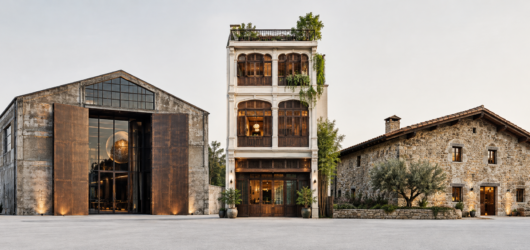
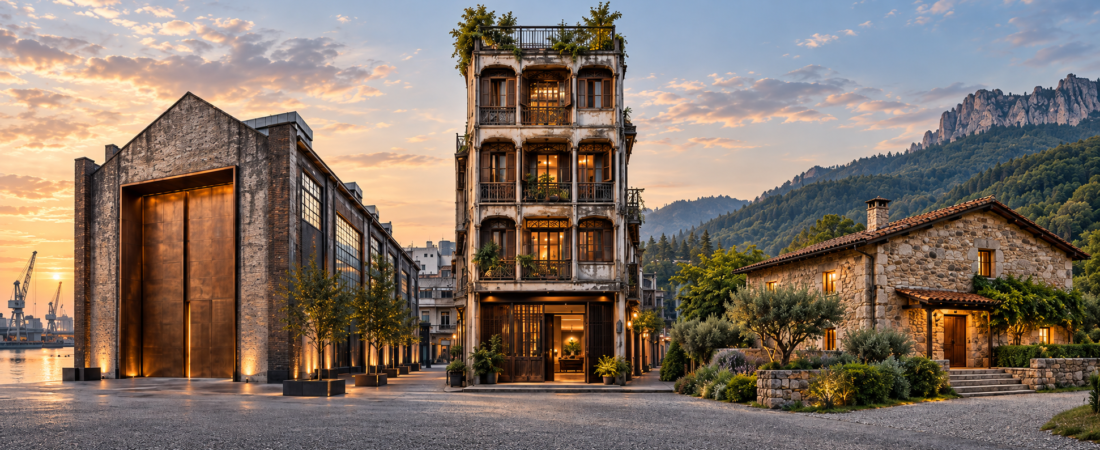
Snapshot
A restaurant’s setting affects the whole visit: the approach, the room, the sounds around the table and the time guests spend there. Alchemist, POTONG and Asador Etxebarri offer useful comparisons because they occupy buildings with very different proportions and histories.
| Criterion | Alchemist, Copenhagen | POTONG, Bangkok | Asador Etxebarri, Axpe |
|---|---|---|---|
| Location | Refshaleøen, Copenhagen’s former shipyard district | Vanich 1, in Bangkok’s Chinatown | Atxondo valley, Bizkaia |
| Building | Former industrial and theatre workshop | Five-storey family shophouse | Eighteenth-century stone farmhouse |
| Restaurant opened | Current premises in 2019 | September 2021 | Around 1990; published dates vary |
| Scale reported | About 50 diners per service, 2024 | 28 seats announced in June 2026 | About 50 diners at one lunch service, 2025 |
These figures describe different dates and measures: seats at POTONG and diners per service at the other two restaurants. They indicate the size of the operation, rather than an exact capacity ranking. [1][4][6][8][9]
Buildings and their reuse
Alchemist occupies a large warehouse previously used by the Royal Danish Theatre for set construction. Studio Duncalf’s conversion used its height and depth to fit several rooms and a projection dome. Most of the interior that guests encounter was created for the restaurant. The old workshop supplied the space needed for this extensive installation. [1][2]
POTONG’s building belonged to Chef Pichaya “Pam” Soontornyanakij’s family, who lived there and produced Chinese herbal medicine for four generations. The restaurant dates the shophouse to around 1910. Its conversion retained old woodwork and decorated partitions while introducing kitchens, dining rooms and bars. The family’s former workplace became a new business under the same name. [3][4]
A further renovation in May–June 2026 included the kitchen and cellar. The restaurant announced 28 seats across two dining levels and a reopening date of 16 June. Earlier reviews remain useful accounts of the building, but their descriptions of kitchen size, furniture and circulation cannot all be treated as current. [4][8]
Etxebarri occupies a restored stone farmhouse in Axpe, at the foot of Anboto. Bittor Arginzoniz established the restaurant around 1990 and lives nearby. The building accommodates a specialised grill kitchen within the scale of the village. Stone, timber, linen, ceramics and flowers give the guest rooms a relatively restrained appearance. [6][9]
Arrival and movement
At Alchemist, large bronze doors mark the entrance in an otherwise industrial setting. Staff admit guests into smaller spaces before leading them to the main dining room. Lounges and transitional rooms divide the visit into stages. Once inside, there is little visual contact with the waterfront; guests depend on the restaurant’s lighting and guidance to understand where to go. [1][2]
POTONG is reached through Chinatown’s narrow commercial streets. Inside, dining rooms occupy two levels, with Opium Bar and the rooftop above. A 2024 review describes steep connecting stairs, while the restaurant’s building account records a lift installed during the conversion. The available descriptions do not establish a complete accessible route through every guest space. [3][5]
Etxebarri’s approach takes guests through the Atxondo valley to Axpe. A 2025 report describes taxis arriving before lunch, aperitifs at the bar and diners climbing upstairs to eat. Some stayed on the terrace well into the evening. The visit involves relatively little movement once lunch begins. [6]
Quietness and conversation
Quietness needs its own assessment. A small room can be noisy, and a rural address says little about sound at a full table. The relevant questions are whether music or effects compete with speech, whether noise travels between spaces, and how often service interrupts conversation. The sources reviewed contain no comparable sound measurements or systematic tests of how easily guests can hear one another.
At Alchemist, electronic music accompanies the meal. A first-person review describes the volume rising as projected scenes change. Sound is an active part of the experience, and the cues may distract guests seeking long stretches of undisturbed conversation. This establishes interruptions, rather than continuous loudness. [1][10]
At POTONG, published accounts describe the rooms and narrated courses but provide little dependable information about indoor noise after the 2026 renovation. Quietness remains unconfirmed. Fewer seats alone do not establish better acoustics, and activity on the street does not establish how much noise reaches the tables. [3][5][8]
At Etxebarri, the 2025 on-site report describes a quiet working routine and an unhurried lunch. It does not separately assess dining-room noise, music or speech clarity. There is some support for a calm atmosphere, but insufficient evidence to call it the quietest dining room or guarantee easy conversation during a full service. [6]
Presentation and the pace of the meal
Alchemist’s dome carries images that change with the courses. Darkness removes a stable view of the surroundings, and the restaurant controls when guests look up, listen or move on. Some presentations address pollution, animal welfare and surveillance. This can make the meal demanding as well as entertaining: the subject of a course may require attention beyond its taste. [1][2]
POTONG gives more of the explanation at the table. Earlier menus used objects such as a booklet, an old lunchbox and a cabinet with drawers containing parts of a duck course. Guests opened and examined them while staff introduced the food. These are examples from earlier visits, rather than a description of every current course. [5]
Etxebarri’s single lunch service allows an extended stay without a scheduled second sitting. Much of the coordination happens in the kitchen, where Arginzoniz prepares embers and manages the grills. The report of guests remaining outside late in the day shows how far the visit can extend beyond eating. [6]
Food and local connections
Alchemist’s culinary subjects extend well beyond its immediate location. A course about marine pollution or surveillance can be understood without knowing Refshaleøen. Its strongest connection to the building is practical: the warehouse accommodates the equipment and rooms needed to present those ideas. [1][2]
POTONG draws on Chef Pam’s Thai-Chinese background and dishes she knew through her family. Reporting describes recipes from her mother reworked through different techniques and presentations. This gives the former family property a direct connection to the menu. The evidence supports a relationship through food traditions and memory; it does not establish that ingredients are mainly sourced within Chinatown. [5][7]
Etxebarri combines nearby production with ingredients brought from elsewhere. Arginzoniz makes mozzarella from his own buffalo milk and uses garden vegetables, while prawns arrive from Palamós and fish from other Spanish coastal towns. Different woods and carefully controlled embers govern how these products are cooked. Its local connection lies in the chef’s production and working practice as well as the origin of some ingredients. [6]
Sources
1. Rebecca Mead, “Can Your Stomach Handle a Meal at Alchemist?”, The New Yorker, 23 September 2024. On-site reporting on the rooms, service and meal.
2. “Alchemist restaurant Copenhagen by Studio Duncalf has digital ceiling to create immersive experiences for diners”, Leisure Opportunities. Architectural coverage of the warehouse conversion.
3. POTONG, About POTONG Building. The restaurant’s account of the family property, conversion, lift and floor uses.
4. POTONG, Journey. Official timeline, including the September 2021 opening and 2026 renovation.
5. Heiko Zwirner, “Sie brach ihr Studium ab, um in Bangkoks Chinatown zu kochen”, WELT, 4 March 2024. Visit and profile describing the neighbourhood, rooms and earlier menu.
6. Paz Álvarez, “Un día en Etxebarri, el gran favorito a coronarse como el mejor restaurante del mundo este año”, El País, 18 June 2025. On-site reporting on service, sourcing, the kitchen and village setting.
7. POTONG, Chef Pam’s Tasting Menu. The chef’s account of the menu’s relationship to her family and the building.
8. “Restaurant POTONG Announces its Latest Renovation and Newest Course Menu”, TRAVELINDEX announcement reproduced by Visit Bali, 9 June 2026. Restaurant-supplied information on reopening and seating. Its reference to an original opening in 2022 conflicts with POTONG’s official timeline; this article follows the September 2021 date in that timeline.
9. Basque Country Tourism, Asador Etxebarri. Building age, restoration and location.
10. My review of Alchemist in Copenhagen, Denmark, Eating Really Well. First-person account describing music becoming louder at scene changes; used as one visitor’s observation, not an acoustic measurement.