
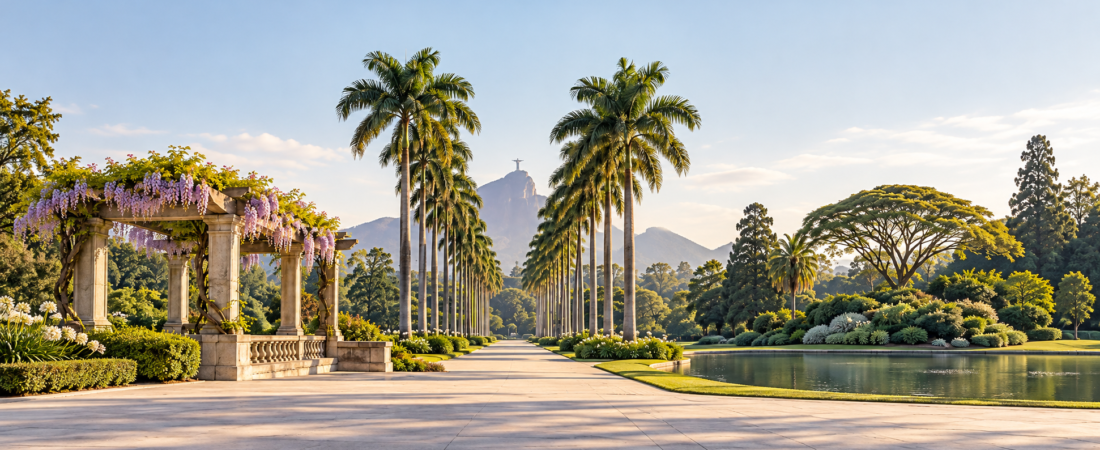
Snapshot
Duke Gardens combines a formal terrace garden with wooded paths on a university campus. Rio’s botanical garden has long palm avenues beneath forested mountains, with routes through tropical collections and historic monuments. Melbourne spreads around lakes and lawns within the city’s parklands. Duke suits a concentrated garden visit, Rio a botanical and historical walk, and Melbourne a longer outing combining collections with informal recreation.
| Feature | Duke Gardens | Rio Botanical Garden | Melbourne Gardens |
|---|---|---|---|
| Location | Duke University, Durham, USA | Jardim Botânico, Rio de Janeiro, Brazil | Birdwood Avenue, Melbourne, Australia |
| Public garden area | 55 acres, about 22 hectares [1] | 54 hectares of arboretum, reported in 2020 [2] | 38 hectares [3] |
| Origins | Began 1934; terraces dedicated 1939 [4] | Founded 1808 [5] | Established 1846 [6] |
| Admission | Free; parking currently US$2/hour [7] | R$40 for Brazilian residents; R$80 for foreign visitors; concessions available [8] | Free; some activities ticketed [3] |
| Grounds hours | 8 a.m. to sunset [7] | 8 a.m.–5 p.m.; Wednesday 11 a.m.–5 p.m. [9] | 7:30 a.m.–7:30 p.m.; closes 5:30 p.m. April–September [10] |
| Suggested time | 2–3 hours | 3–4 hours | 2½–4 hours |
Visit durations are editorial allowances for walking and stops. Individual routes can be shorter. Rio’s area figure is older institutional reporting, not a new measurement. Its Christmas and New Year closures and reduced holiday hours require separate checking. Duke’s main entrance and parking open at 9 a.m., later than the grounds. [2][7][9]
History and cultural identity
Duke’s garden developed through university philanthropy. Mary Duke Biddle supported the landscape in memory of her mother, Sarah P. Duke, and Ellen Biddle Shipman designed its terraces. Later designers added woodland and Asian landscapes. [4][11]
Rio began as a Portuguese royal acclimatization garden, testing economically useful plants transferred between territories. Its tropical planting therefore reflects colonial exchange as well as Brazilian flora. Nineteenth-century directors expanded its scientific and educational work. The garden belongs to the UNESCO-listed Carioca cultural landscape, which connects designed spaces with Rio’s mountains and coast. [5][12]
Melbourne was established on Kulin Nation land. Ferdinand von Mueller developed scientific collections, while William Guilfoyle reshaped the grounds into the curving paths, lawns and lakes that define much of the present landscape. The Aboriginal Heritage Walk introduces continuing First Peoples connections to plants and Country. Visitors can encounter that history alongside the garden’s colonial design and botanical collections. [3][6][13]
Urban setting and access
Duke’s campus location connects a garden visit with university buildings and pedestrian routes. The principal entrance at 420 Anderson Street passes through the Barnes Welcome Center; gates on Flowers Drive connect with West Campus. On-site parking is limited, with additional weekend provision. Campus, GoDurham and GoTriangle buses stop at or near garden entrances. Choosing an entrance affects the return walk through the grounds. [14][36]
Rio occupies the transition between the Jardim Botânico neighbourhood and the wooded mountain landscape. The surrounding streets remain part of a working residential and commercial district. Entrance conditions differ: Rua Jardim Botânico 920 opens on weekends and holidays, while Rua Pacheco Leão 915 requires an online ticket. The other listed entrances are Rua Jardim Botânico 1008 and Rua Pacheco Leão 101. Municipal buses serve the area, including connections from the metro. [12][15][37]
Melbourne is about two kilometres from the city centre, adjoining the Domain parklands. Ten gates allow visitors to enter and leave at different points. Trams on St Kilda Road stop approximately 650 metres from Observatory Gate, and Anzac Station provides rail access. This makes a garden walk easy to combine with the surrounding cultural precinct, although the distance from transport to a particular collection still needs planning. [3][10]
Landscape design and landmarks
At Duke, seven stone-walled terraces descend along a central axis from a wisteria pergola toward a pond. Stairs, fountains and planted levels give the slope a formal structure. Beyond this composition, woodland paths and water gardens break the visit into smaller scenes. The garden’s ravine creates changes of elevation and view within a relatively compact area. [11]
Rio’s imperial-palm avenues establish long sightlines and a repeated vertical rhythm. Lakes, fountains, bridges and mature trees interrupt and extend that geometry. The Fountain of the Muses and Frei Leandro Lake provide stopping points within a landscape assembled over successive administrations. The mountain setting connects these planted avenues with forest beyond the cultivated grounds. [2][5][12]
Melbourne’s main composition follows sweeping paths around lawns and irregular lakes. The Ornamental Lake gives visitors an open view across water; Fern Gully encloses a creek beneath dense planting. Guilfoyle’s Volcano occupies a high point, with drought-tolerant plants around a historic reservoir and views toward the city. Open ground, shaded gullies and elevated planting produce different walking conditions within the same garden. [13][16][17]
Botanical collections
Duke groups much of its planting geographically. The Blomquist Garden concentrates on Southeastern United States flora, while the Culberson Asiatic Arboretum presents eastern Asian plants. The Historic Gardens add seasonal ornamental displays. Visitors can move between regional woodland collections and formal horticulture without needing to cover a large institution. [1][18][19]
Rio combines native and introduced plants in the arboretum and specialist collections, including orchids, bromeliads, cacti and medicinal plants. Its self-guided routes cover palms, giant trees, threatened species and Brazilian environments. These routes make the botanical content more manageable than attempting to see every collection. Current access is incomplete: an official notice updated on 5 October 2026 lists the insectivorous-plant and fern greenhouses as temporarily closed. [2][20][21]
Melbourne reports more than 8,500 species and provides named collections including Australian Forest Walk, Southern China, cycads, oaks and dryland plants. Some collections occupy distinct areas; others are distributed through beds and lawns. Labels connect individual specimens with their botanical identity. Comparable current species counts are unavailable for all three gardens, so these figures cannot establish a defensible diversity ranking. [3][22]
Visitor experience and accessibility
At Duke, the terrace axis provides an immediate point of orientation, while the woodland areas reward a slower circuit. The accessible-route map is important: steps, loose gravel and gradients interrupt otherwise manageable walks. A seasonal mobility trolley runs subject to weather and volunteers, but passengers must board independently. No wheelchair rental is available. Shaded benches and named drinking-fountain locations help visitors plan rests. [11][23]
The Barnes Welcome Center supplies maps, staff assistance, accessible toilets and a café with courtyard seating. Other toilets are available in the Terrace Gardens and Asiatic Arboretum. Arrival facilities are consequently easier to use than some historic paths deeper inside the garden. [14]
Rio’s thematic walks provide a practical alternative to an unrestricted circuit. The palm and giant-tree routes each have an estimated duration of 90 minutes; the self-guided historical route is listed at 2½ hours. [20]
Visitors needing a wheelchair should contact Rio’s Visitor Center beforehand; vehicle drop-off for people with reduced mobility is permitted at Rua Jardim Botânico 1008. Detailed outdoor gradients and surfaces remain insufficiently documented for a comparison with Duke or Melbourne. The playground area has toilets and picnic tables. Current closures cover the play equipment and two restaurants in the garden; the picnic area remains open. Drinking-water points and covered resting places are not comprehensively identified in the visitor pages reviewed. [15][21][24][25]
In Melbourne, a visit can follow the lake and add selected collections rather than make a complete perimeter circuit. Fern Gully’s boardwalk is described as fully accessible, although its separate wellbeing spaces require walking. Guilfoyle’s Volcano also advertises mobility access. The garden publishes maps, accessible-toilet locations and guidance on gradients; wheelchairs can be booked through the Visitor Centre. [16][17][26]
Melbourne’s access guide identifies seating with backrests, pavilions for weather protection and maps at the gates. Cafés and toilets are mapped, allowing breaks to be planned around the walking route. Some details in the older access guide require reconfirmation. Its fuller documentation supports advance planning, without establishing that every historic path is equally easy. [26][27]
Public life and activities
Duke accommodates university use alongside public education, family programmes and horticultural activities. Outdoor classes, student gatherings and community events give it uses beyond sightseeing. Visitors can spend time in a selected garden area without following a guided itinerary. [28]
Rio offers paid historical walks and free Friday thematic walks, with admission arrangements checked separately. Eating is restricted to designated areas; the garden’s lawns and avenues should not be treated as unrestricted picnic grounds. The museum adds an indoor cultural visit, with a separate timetable and free ticket requirement. [8][9][15][20]
Melbourne combines informal lawn use with guided walks, children’s activities and seasonal events. Its published programme includes free 90-minute walks on most days and ClimateWatch walks that involve recording plants and wildlife. The Children’s Garden has its own opening schedule and winter closure. Families therefore need to check that attraction separately from the grounds. [3][10]
Crowding atmosphere and LGBTQ comfort
Duke reports more than 600,000 annual visitors, but that total does not describe conditions along individual paths. Cherry displays can draw people into a small area, making stopping and photography more difficult. Rio’s broad avenues and Melbourne’s lawns offer more room in some sections, yet neither site’s total area establishes that a visit will be quieter. [1][29]
Duke’s wooded slopes interrupt views between garden areas. Rio’s tall avenues and canopy frame longer walks. Melbourne repeatedly opens onto water and lawns before returning to denser planting. [5][11][13]
Duke has several nearby potential noise sources. Anderson Street and Flowers Drive border the grounds; the Durham Freeway and the railway beside West Main Street lie roughly 300–600 metres north of the northern garden edge. Duke University Hospital’s rooftop helipads are about 400–600 metres northwest of the nearest garden boundary. These are much closer than Raleigh–Durham International Airport, approximately 20 kilometres southeast. The map therefore identifies road traffic, trains and hospital helicopters as relevant exposures, even within a wooded campus setting. [38][41]
Rio’s Rua Jardim Botânico runs directly beside the eastern edge, while Rua Pacheco Leão follows the northern side. Avenida Borges de Medeiros lies farther east beside the lagoon. Two mapped helipads on its western shore are approximately 600–900 metres from the garden’s eastern boundary. The Corcovado railway is around two kilometres north, beyond wooded slopes, rather than alongside the arboretum. Santos Dumont Airport is approximately eight kilometres northeast. The nearby roads and lagoon helipads deserve more attention in assessing local noise exposure than the garden’s forest-backed appearance might suggest. [39][42]
Melbourne has Alexandra Avenue along its northern side, Anderson Street to the east and Birdwood Avenue to the south and west. CityLink’s surface sections are across the Yarra, roughly 150–300 metres from parts of the northern edge; the Richmond–Flinders Street railway corridor is about 400–700 metres away across the river and sports precinct. The Alfred Hospital helipad is approximately 1.4 kilometres south of the garden’s southern edge. Major airports are outside the immediate surroundings. Road traffic, trains, helicopters and events in the adjoining sports precinct are therefore potential interruptions to the garden atmosphere. [40][43]
Distances are rounded straight-line estimates from map scales, generally measured from the nearest garden boundary; airport distances are approximate regional separations. These locations establish potential exposure. Actual sound levels and aircraft overflight frequency depend on operations, routes, terrain and weather, which the maps do not establish. [38–40]
Garden-specific LGBTQ inclusion evidence exists at Duke and Melbourne. Duke advertised a Queer Ecology Family Picnic for September 2026; Melbourne’s October Design X Nature programme includes a Queer Ecologies discussion. These demonstrate programming, without measuring everyday treatment. No equivalent current Rio programme was identified in the reviewed material, which leaves an evidence gap rather than establishing exclusion. [30][31]
Broader conditions also require care. UK travel guidance describes substantial variation in attitudes across the United States. It notes legal recognition of same-sex marriage in Brazil and Australia, alongside reports of anti-LGBT discrimination or crime. National context and institutional events cannot establish a garden-level ranking of comfort or harassment risk. [32–34]
Seasonality and visiting conditions
Duke’s spring flowering can determine both the appeal and the pace of a visit. Cherry blossom timing varies annually, and the garden provides seasonal updates. A visit planned around a particular display should allow for its short flowering window and concentrated attendance. Woodland and evergreen collections remain available outside that peak. [18][19][29]
Melbourne’s collection pages identify different seasonal interests: Fern Gully is highlighted for spring and summer, while Guilfoyle’s Volcano has summer interest and flowering extending into autumn. Longer October–March opening hours create more scope for an evening walk. Open lawns and dryland beds offer less overhead shelter than the gully. [10][16][17]
Rio’s tall trees and tropical planting give the visit substantial interest beyond a single flowering season. Weather and maintenance can alter access: strong winds require particular caution beneath mature trees, and the garden publishes emergency procedures. Its normal Wednesday opening is later than on other days. In all three gardens, a route with shaded rests is more comfortable during heat than a continuous circuit through exposed areas. [2][9]
Safety maintenance and conservation
Duke’s documented slopes, steps and gravel are practical constraints for walking and mobility aids. Rio explicitly warns about falling branches, slippery moss near water, thorny or toxic plants and wildlife. Melbourne’s access information helps visitors avoid unsuitable gradients and surfaces. [9][23][26]
Maintenance affects what visitors actually reach. Rio’s current closure notice should take precedence over older descriptions of its playground and greenhouses. Its 2020 management report documents composting and horticultural maintenance, but those figures are historical evidence rather than a current performance assessment. [2][21]
Melbourne’s Landscape Succession Strategy plans changes to planting for projected conditions in 2090. Dryland collections make adaptation visible within the garden, while Fern Gully provides a sheltered growing environment and contributes to water management. Duke’s native-plant collection includes conservation work with regional flora. These programmes establish conservation activity; they do not supply a common measure for ranking upkeep or environmental outcomes. [16][18][22][35]
Comparative conclusion
Duke suits visitors who want formal terraces and regional woodland collections within a compact garden. Its limited area makes a focused visit practical, but terrain and route surfaces need attention. The new entrance facilities improve the start of the visit without removing those constraints.
Rio offers palm avenues, tropical collections and colonial botanical history within a mountain-backed urban landscape. A selected thematic route gives the visit a clear focus. Paid admission, uncertain outdoor-access detail and current facility closures require more preparation, particularly for families and visitors relying on step-free movement.
Melbourne supports a flexible outing through lakes, lawns and geographically varied collections. Transport connections, multiple entrances and detailed access information help visitors choose a manageable route. Its spread makes selection useful: a lake walk with one or two collections can be more rewarding than trying to cover everything in one visit.
Endnotes and sources
Visitor pages checked 8 October 2026; surrounding transport maps reviewed 9 October 2026. Institutional descriptions establish published provision and policy; they are not independent assessments of visitor satisfaction.
[34] UK Foreign Commonwealth and Development Office. Australia safety and security, LGBT travellers.