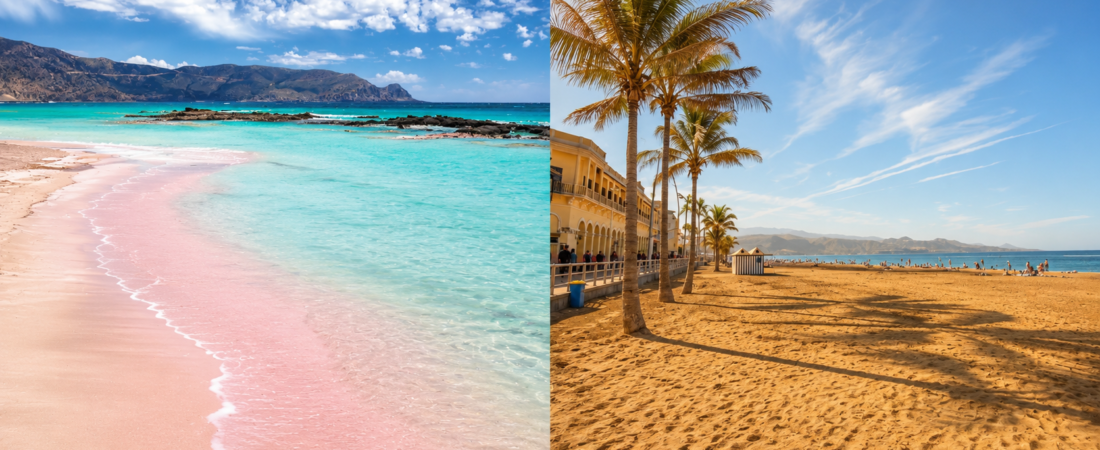
This report compares Playa de Las Canteras in Las Palmas de Gran Canaria with Elafonissi Beach in southwestern Crete. The two beaches are often praised, but they are not strong for the same reasons. Las Canteras is a large urban Atlantic beach protected in part by La Barra, a natural reef running parallel to much of the shore. Elafonissi is a remote Mediterranean sand and lagoon system known for pale sand, pink shell-fragment deposits and shallow turquoise water.
The framework uses seventeen criteria: location, beach material, sand colour, physical shape, water clarity, bathing comfort, visual character, accessibility, infrastructure, shade, social openness, crowd pressure, safety, ecological context, complementary features, satellite readability and uniqueness. The result separates functional beach quality from landscape distinctiveness.
Geographic reference
Playa de Las Canteras is located at approximately 28.1416° N, 15.4320° W. It follows the western seafront of Las Palmas de Gran Canaria. Its time zone is WET in winter and WEST in summer: UTC+0 in winter and UTC+1 in summer.
Elafonissi Beach is located at approximately 35.2718° N, 23.5412° E. It lies in southwestern Crete. Its time zone is EET in winter and EEST in summer: UTC+2 in winter and UTC+3 in summer. Elafonissi is two hours ahead of Las Canteras throughout the year.
Location and coastal setting
Las Canteras is embedded in the city. It runs along the western side of Las Palmas de Gran Canaria and is directly connected to hotels, residential streets, restaurants, public transport and the promenade. Its strongest geographic trait is the combination of urban frontage and partial natural protection. La Barra reduces wave energy over much of the beach and gives the bay a more controlled bathing character than a fully exposed Atlantic shore.
Elafonissi occupies a very different position. It lies at the southwestern edge of Crete, far from the island’s main urban centres. Arrival usually involves a long road approach through interior or coastal terrain. The beach reads as a peripheral landscape rather than a civic waterfront.
Las Canteras is stronger for urban integration and daily usability. Elafonissi is stronger for geographic separation and the feeling of reaching an edge.
Beach type and material
Las Canteras is primarily a golden-sand beach of volcanic Atlantic character. The sand is stable, walkable and suited to long stays. It behaves like durable city beach material: comfortable enough for bathing and walking, but not visually rare.
Elafonissi has a more distinctive material profile. Its pale sand is mixed with crushed shells and marine fragments, producing pink tones in some areas. The colour is not a uniform carpet of pink; it appears in concentrations that vary by light, erosion, wave action and visitor pressure.
On material distinctiveness, Elafonissi is clearly stronger. On stability and everyday practicality, Las Canteras has the advantage.
Sand colour and texture
Las Canteras offers warm golden sand. It gives the beach a pleasant Atlantic brightness, especially against the dark reef and blue water, but the colour itself is conventional in the context of European resort beaches.
Elafonissi is more memorable because its sand palette shifts from white and cream to pale rose. Sand colour changes the whole perception of the beach: it lightens the water, increases the sense of shallowness and gives the lagoon a softer appearance. The texture is generally finer and lighter underfoot, although protected areas should not be disturbed.
This criterion belongs to Elafonissi. Its sand is one of the main reasons the beach has a distinct identity.
Beach size and physical shape
Las Canteras has the stronger continuous form. It extends for roughly three kilometres in a long urban arc, allowing different zones to emerge along the same beach: calmer bathing sectors, surf-oriented areas, promenade segments, restaurant frontage and quieter stretches. This continuity gives it high functional capacity.
Elafonissi is not defined by one long, simple shoreline. Its appeal comes from fragmentation: shallow pools, sandbars, channels and the visual suggestion of an island separated from the mainland by water. This makes the beach more complex but less coherent as a single usable strip.
If the criterion is physical continuity and capacity, Las Canteras wins. If the criterion is irregular coastal morphology, Elafonissi is more interesting.
Water quality and visual clarity
Elafonissi has the stronger visual water profile. The combination of shallow Mediterranean water, pale substrate and lagoon geometry produces clear colour gradients, often from transparent shallows to turquoise and deeper blue. Its water is one of the main visual arguments for the beach.
Las Canteras also has clean and appealing water, but the Atlantic setting produces a different optical result. Movement, darker reef surfaces and greater wave energy reduce the polished lagoon effect. The water can be excellent for swimming and snorkelling, yet it is less visually delicate than Elafonissi.
This is a distinction between optical clarity and functional bathing quality. Elafonissi is stronger for visible water colour and transparency.
Sea conditions and bathing comfort
Las Canteras gains a major practical advantage from La Barra. The reef acts as a natural breakwater and creates calmer areas between the sand and the reef, especially around low tide. This improves bathing reliability and makes the beach less dependent on perfect weather.
Elafonissi is extremely shallow in many zones, which is favourable for children, weak swimmers and visitors who want warm, low-risk water. However, its openness means wind can quickly reduce comfort. A shallow lagoon can feel gentle in calm conditions and unpleasant when wind pushes sand, waves and crowd movement across the same space.
For repeated swimming, Las Canteras is stronger because its conditions are more structurally moderated. Elafonissi is better for shallow-water wading and visual bathing.
Visual beauty and landscape structure
Las Canteras has a strong urban-ocean composition. The promenade, city wall, long beach curve and open Atlantic horizon form an elegant civic seafront. Its beauty comes from balance: a functioning city placed against a usable beach.
Elafonissi has a more unusual landscape structure. The viewer sees sandbars, lagoon pools, shallow channels, low islands and changing water colour within a small area. It is less orderly than Las Canteras but more visually layered. The scene feels less like a beach front and more like a coastal system temporarily held together by sand and water.
For visual rarity and landscape memorability, Elafonissi is stronger.
Accessibility and entry effort
Las Canteras is almost frictionless. It can be reached by foot from much of central Las Palmas, by taxi, by bus or from nearby accommodation. The beach begins where the city ends. This makes spontaneous use possible.
Elafonissi requires deliberate travel. It is far from Chania and the main Cretan resort corridors. The road journey can be long, and the experience depends on season, traffic, parking arrangements and heat. Even where parking is available, the beach still feels like a destination reached through effort rather than an extension of ordinary movement.
There is no close contest here. Las Canteras is much stronger on accessibility.
Facilities and visitor infrastructure
Las Canteras has the infrastructure profile of a mature urban beach: promenade, restaurants, showers, toilets, lifeguard presence, access points, beach services and nearby shops. These services extend the usable day and make the beach suitable for families, older visitors, local residents and repeat use.
Elafonissi has lighter and more seasonal facilities. Basic services exist, but the place is not built around permanent urban support. That lower infrastructure helps protect the sense of remoteness, but it also limits comfort and resilience when visitor numbers rise.
Las Canteras is stronger for infrastructure. Elafonissi is stronger only if low development is treated as part of the desired experience.
Shade
Las Canteras has stronger shade support. While the beach itself remains exposed, the urban promenade behind it provides immediate retreat into cafés, restaurants and terraces. Parasols and loungers are widely available. This makes a long stay easier during bright midday hours.
Elafonissi is more exposed. Shade is limited mainly to rented umbrellas, and visitor reports frequently mention the need to bring personal sun protection or arrive early to secure coverage. Outside organised sectors, natural shade is almost absent.
For long midday stays, Las Canteras offers better thermal refuge. Elafonissi requires more preparation.
Social openness and gay friendliness
Las Canteras benefits from its location within Spain and the wider Gran Canaria social ecosystem, one of Europe’s strongest LGBT travel regions. Although the beach itself is not a specifically gay beach, the surrounding city environment provides stronger visible openness, easier social integration and greater identity comfort.
Elafonissi is safe for ordinary tourism but less socially defined. It functions primarily as a landscape destination rather than part of a visible social scene.
For explicit LGBT comfort and social openness, Las Canteras is slightly stronger.
Crowd pressure and anthropogenic noise
Las Canteras receives high visitor volume, but its length helps distribute people. Crowding exists, especially near popular sectors, yet the beach can absorb density because it has a long linear form and multiple access points. The drawback is persistent urban sound: promenade traffic, restaurants, voices, music and city movement.
Elafonissi has a different problem. Its surrounding landscape is quieter, but its famous lagoon sectors can become heavily compressed during peak periods. When many visitors concentrate around the same shallow pools and pink-sand areas, the sense of natural delicacy weakens quickly.
This criterion is conditional. Las Canteras manages volume better. Elafonissi offers stronger silence only outside peak crowd windows.
Safety and natural risks
Las Canteras is operationally safer. The reef reduces wave exposure in important sections, lifeguard and first-aid systems are part of the urban beach structure, and emergency access is close. Its risks are mainly Atlantic and urban: stronger currents outside La Barra, reef contact during tidal shifts, surf-related injuries, occasional jellyfish, sun exposure and petty theft in crowded areas.
Elafonissi is naturally gentle in the shallows, but its risk profile changes with exposure, heat, wind and distance from major services. Its risks are more environmental: prolonged UV exposure, heat stress, strong wind shifts, submerged rock, dune erosion and slower emergency response. Crete also has a background seismic risk because it lies near the Hellenic Arc, although this is a low-frequency risk for ordinary beach visitors. Volcanic risk is not a meaningful operational factor for either beach in normal travel planning.
For monitored, repeatable safety, Las Canteras is stronger. For calm wading in good conditions, Elafonissi remains comfortable but less operationally robust.
Ecological and protected-area context
Elafonissi has the stronger ecological claim. It forms part of a protected coastal environment with dunes, rare vegetation and sensitive habitats. The same traits that make it visually attractive also make it vulnerable: pink sand, dunes and shallow systems are easily damaged by excessive footfall and souvenir behaviour.
Las Canteras has marine ecological value because of La Barra and associated reef life. However, the beach is placed inside a dense city, and urban pressure is permanent. Its ecology is important but more constrained.
Elafonissi wins this criterion. Its ecological context is broader and more fragile, and protection is central to its identity rather than secondary to urban use.
Main POIs and complementary features
Las Canteras benefits from immediate urban depth. A visitor can combine the beach with Vegueta, Santa Catalina, restaurants, Poema del Mar, surfing sectors, walks to El Confital and the wider cultural life of Las Palmas. This makes the beach part of a larger day structure.
Elafonissi offers a narrower but more landscape-focused set of additions: lagoon walking, dune observation, nearby monasteries, mountain roads and other remote beaches in western Crete. These features support a scenic excursion rather than a layered urban itinerary.
Las Canteras is stronger for complementary features because it connects to more types of activity without requiring a new travel stage.
Curious facts and uniqueness
Las Canteras takes its name from “the quarries”, linked to historical extraction from La Barra, the reef-like formation that still protects the beach from Atlantic swell. This makes its identity unusually physical: the same feature shaped both the city’s history and the beach’s bathing conditions.
Elafonissi’s pink sand is not uniform decoration. It comes from shell and marine fragments, which is why the colour appears unevenly. The site also carries historical weight: in 1824, civilians were massacred there during the Cretan struggle against Ottoman rule.
Final assessment
Las Canteras and Elafonissi should not be forced into one simple hierarchy. Las Canteras is the stronger high-function beach. It is easier to reach, easier to use, better supported, safer in operational terms and more suitable for repeated visits. Its value lies in the rare efficiency of a large urban beach protected by a natural reef and supported by a mature city.
Elafonissi is the stronger high-distinction beach. It is more visually unusual, materially rarer and ecologically more fragile. Its value lies in colour, morphology, remoteness and the sense that the beach is not a fixed strip of sand but a changing coastal system.
Sources consulted
- Official Gran Canaria Tourism Board – baseline description of beach scale, urban context, and location: https://www.grancanaria.com/turismo/en/beaches/las-canteras/
- LPAmar (Las Palmas municipal beach authority) – official measurements (3,100m), quality certifications, environmental management: https://lpamar.laspalmasgc.es/las-playas/las-canteras/
- Living Las Canteras – detailed explanation of La Barra, calm water dynamics, marine biodiversity, and sports ecosystem: https://livinglascanteras.com/en/las-canteras-beach/
- Tur4All (accessible tourism platform) – accessibility profile, promenade structure, urban comfort: https://www.tur4all.com/resources/playa-de-las-canteras
- Wikipedia (geomorphology and environmental history) – La Barra geological composition, sedimentary structure, historical evolution: https://en.wikipedia.org/wiki/Playa_de_Las_Canteras
- Tripadvisor reviews
- https://www.cretanbeaches.com/en/sea-tourism/west-crete-beaches/elafonissi-beach
- CreteTravel – Natura 2000 status, dune ecology, rare flora, environmental restrictions: https://www.cretetravel.com/
- ILGA Europe / Spartacus Gay Guide / Spain tourism resources – for LGBT openness context in Gran Canaria and Spain.
- Greek tourism / travel advisories / local Crete tourism sources – for social neutrality and tourism safety context.
- European-Mediterranean Seismological Centre (EMSC) – seismic context for Crete / Hellenic Arc.