Comparison at a glance
Széchenyi, Friedrichsbad and Dōgo Onsen Honkan offer three kinds of bath visit. At Széchenyi, people move freely between medical baths, swimming pools, outdoor pools, saunas and places to eat or drink. At Friedrichsbad, they pass through a recommended order of hot-air rooms, steam rooms, pools and rest rooms. At Dōgo Honkan, the ticket determines whether the visit includes only a bath or also an upstairs tatami room, tea and a tour of the imperial rooms. This article compares where the baths stand, how people use them and what each one means to its city.
| What is compared | Széchenyi | Friedrichsbad | Dōgo Onsen Honkan |
|---|---|---|---|
| Urban setting | Freestanding bath complex in Budapest’s City Park | Monumental bath in Baden-Baden’s historic thermal quarter | Municipal bathhouse embedded in Dōgo Yunomachi |
| Baths and water | Indoor and outdoor thermal, swimming, activity, cooling and medical pools | Hot-air rooms, steam rooms, thermal pools and a cold bath visited in a recommended order | Water from eighteen sources blended to about 42°C for bathing |
| How a visit unfolds | Visitors choose freely among the open pools and other facilities | Visitors follow seventeen recommended stops | The ticket may include only bathing, or bathing with a communal or private rest room |
| What visitors wear | Mixed bathing in swimwear | Mixed bathing; textile-free five days and swimwear-only two days each week | Nude, sex-separated public bathing with washing before immersion |
| Basic 2026 admission | HUF 13,200 Monday–Thursday; higher on Fridays, weekends and peak dates | €39 on the current detailed price page | ¥700 for Kami-no-Yu downstairs |
| How long a visit lasts | A daily ticket permits a stay until closing | About three hours recommended; no fixed stay limit | Sixty minutes for the basic and second-floor courses; ninety minutes for selected private rooms |
| Wheelchair information | Official pages conflict, and they do not confirm a wheelchair route from the entrance into the water | The official site gives little detail about wheelchair use throughout the bath | Matsuyama lists many steps and handrails; the whole building is not step-free |
| Recent conservation work | Major repairs continue through 2027 while most of the bath stays open | The nineteenth-century bathing rooms remain in use within a World Heritage spa town | A six-year conservation project ended in December 2024 after the full bath reopened in July |
Where each bath sits in the city
The setting changes the visit before a bather reaches the door. Széchenyi stands alone in Budapest’s City Park, reached directly by the Millennium Underground and trolleybus. Friedrichsbad sits below Florentinerberg among Baden-Baden’s springs, Roman remains, hotels and other spa buildings. Dōgo Honkan opens onto the narrow streets, inns and shops of Dōgo Yunomachi. One is a park destination, one belongs to a formal spa quarter, and one stands at the center of a lived-in bath neighborhood.
Széchenyi brings most bathing and treatment options together inside one large complex. Friedrichsbad belongs to a larger group of springs, Roman remains, Caracalla Spa, hotels, gardens and cultural venues. Matsuyama spreads its public bathing among Honkan, Asuka-no-Yu and Tsubaki-no-Yu, all within walking distance. Honkan remains the best-known of the three because of its historic timber building, rooftop Shinrokaku and time drum.
The journey there follows the same pattern. Széchenyi draws people out of central Budapest and into the park. Friedrichsbad is approached through Baden-Baden’s historic center and spa quarter, with buses and a nearby garage. Dōgo Onsen Station connects the bath neighborhood to central Matsuyama; the tram ride from JR Matsuyama Station takes about twenty-five minutes. Of the three, Dōgo is the one most closely woven into the streets immediately around it.
Where the water comes from and how it is used
Széchenyi draws mineral water from Saint Stephen Well II, which began operating in 1938. Its water contains calcium, magnesium, bicarbonate, sodium, sulfate, fluoride and metaboric acid. Friedrichsbad receives sodium-chloride water from twelve Baden-Baden springs carried through three tunnels. The hottest source reaches 68.8°C, and the springs together produce about 800,000 liters a day. Dōgo combines water from eighteen sources, ranging from about 20°C to 55°C, to produce bathwater at about 42°C.
Széchenyi has outdoor thermal, swimming and activity pools as well as indoor thermal, cooling, immersion and medical pools. Its official pages group them inconsistently, so there is no reliable single total. Friedrichsbad offers four water baths, together with dry-air rooms at 54°C and 68°C, steam rooms at 45°C and 48°C, warm pools and an 18°C cold bath. Dōgo has fewer bathing rooms and keeps the water close to one onsen temperature. Széchenyi offers variety, Friedrichsbad leads bathers through changes in heat, and Dōgo centers the visit on a simple hot-water bath.
The official sites say much less about what happens to the water after it reaches the baths. Széchenyi lists temperatures and minerals but gives no current pool-by-pool figures for dilution, replacement, disinfection or the proportion of thermal water. Friedrichsbad describes its four pools as pure thermal water and says fresh water cools the hottest source water without extra energy. Dōgo says it reaches bathing temperature by mixing its sources, without reheating the water or adding ordinary water. These claims explain the basic methods, but the three baths do not publish enough information for a fair comparison of total water and energy use.
All three promote health or wellbeing, but their claims are not directly comparable. Széchenyi also provides medical treatments supported by Hungary’s health system. The official material confirms the mineral content of the water and the treatments offered. It does not show that an ordinary visit produces the same medical benefit at all three baths.
How the baths changed over time
Széchenyi grew from Vilmos Zsigmondy’s deep drilling in City Park and an Artesian Bath operating by 1881. The present building, designed by Győző Czigler, opened in 1913. New public-bathing wings and three outdoor pools followed in 1927. Later work brought mixed bathing, physiotherapy, filtration, water-circulation systems and new leisure services.
Friedrichsbad was built between 1869 and 1877 as Baden-Baden looked for new income when restrictions threatened its casino business. Carl Dernfeld placed the bath over and beside Roman remains after an older part of the city was cleared. Its rooms combine references to Roman baths, Irish hot-air treatment and nineteenth-century medical practice.
Dōgo’s spring tradition is much older than its present building. Legends, early writing and records of imperial visits show that people have associated the place with bathing for centuries. The familiar claim of a 3,000-year history should not be read as proof that the same bathhouse operated continuously for that entire period. Matsudaira Sadayuki reorganized the baths in 1636, dividing them by status, gender and purpose. Isaniwa Yukiya then led the rebuilding completed in 1894. The imperial Yūshinden and Tama-no-Yu wing opened in 1899, followed by the entrance and south wings in 1924.
Continued use has changed all three baths. Széchenyi has repeatedly added new pools, treatments and leisure services. Friedrichsbad still guides bathers through rooms created for a nineteenth-century bathing method. Dōgo keeps a timber bathhouse in public use even though its wings were built at different times. Repairs, new equipment and changing bathing customs have kept each one open.
Promotional slogans make all three histories sound simpler than they are. Széchenyi is often advertised as Europe’s largest bath complex. Friedrichsbad is described as Europe’s most modern bathhouse when it opened and as the site of Germany’s first fitness studio. Dōgo is promoted as Japan’s oldest onsen with 3,000 years of history. The more useful comparison rests on facts that can be checked: Széchenyi has an unusually wide range of pools and services; Friedrichsbad installed forty mechanical exercise devices in 1886; and Dōgo preserves old written traditions together with a nationally protected public bathhouse built in 1894.
How the buildings shape the visit
Széchenyi spreads its pools and services around a large outdoor courtyard. From outside, the main parts of the complex are easy to see across the pools. Inside, corridors connect smaller bathing rooms, saunas, changing areas and medical departments. Visitors decide where to go and how long to stay in each place.
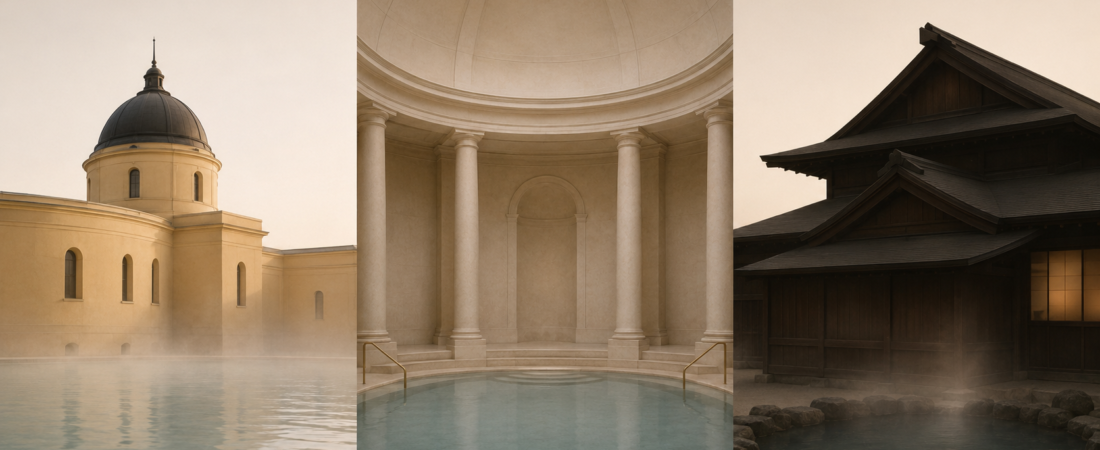
Friedrichsbad is much more controlled. Its symmetrical plan draws on the Roman Baths of Caracalla and Diocletian. Visitors move from one numbered room to the next and eventually reach a circular pool beneath a dome about 17.5 meters high. Corinthian columns, blind arches, old shower fittings and painted majolica give each room a distinct character. Although Friedrichsbad has fewer pools than Széchenyi, spending about three hours moving through its rooms makes the visit feel substantial.
Dōgo Honkan stacks the visit over several floors and four connected historic sections. The baths are on the ground floor; shared tatami halls and private rooms are upstairs. Stairs, changing floor levels, roofs and passages show where the sections built in 1894, 1899 and 1924 join one another. A basic ticket keeps the visitor downstairs. More expensive tickets add an upstairs rest, tea, a yukata, a private room or a tour of the Yūshinden imperial rooms.
The baths do not publish comparable figures for the floor area now open to visitors, so claims about which one is “largest” are unreliable. Széchenyi gives visitors the most freedom and the greatest number of activities at one time. Friedrichsbad asks everyone to follow the same numbered route. Dōgo uses ticket prices to decide how much of the building a visitor may enter.
What visitors wear and how they behave
Széchenyi requires swimwear and does not allow nude bathing. Burkinis and several other swimming garments are accepted, slippers are compulsory outside the water, and swimmers need a cap in the lap pool. Friedrichsbad is mixed-sex and nude on Monday, Tuesday, Thursday, Friday and Sunday. Wednesday and Saturday have required swimwear since July 2024. Dōgo’s public baths are nude and separated by sex; bathing suits are forbidden.
At Széchenyi, visitors may move freely among the open pools and combine medical treatment, swimming, outdoor soaking, saunas, food and conversation in one day. At Friedrichsbad, signs guide them through seventeen stops; quiet rooms, limits on electronic devices and the supply of towels and slippers support a visit of about three hours. At Dōgo, visitors wash before entering the bath, keep towels out of the water and leave after the sixty or ninety minutes allowed by their ticket.
Széchenyi’s outdoor pools support conversation, chess, exercise and sightseeing alongside weekday medical services. Premium rooms, a restaurant, a bar, beer-spa products and nighttime events turn part of the visit into paid entertainment. Friedrichsbad places strangers together without clothing and asks them to follow the same route, but the €39 price, minimum age of fourteen and three-hour recommendation make a casual visit less likely. Dōgo keeps the basic ground-floor bath inexpensive and charges more for a tatami room, tea, sweets or private rest.
Széchenyi combines Budapest’s municipal bathing tradition and publicly supported medical care with a large tourist business. Friedrichsbad helps define Baden-Baden as one of Europe’s historic spa towns. Dōgo Honkan is both a working municipal bath and a city landmark. Its Tokidaiko drum sounds at 6 a.m., noon and 6 p.m., so the daily life of the bath can be heard in the surrounding streets.
Prices, opening hours and who can enter
Széchenyi sells a day ticket, Friedrichsbad recommends about three hours, and Dōgo limits most tickets to sixty or ninety minutes. Széchenyi opens at 7 a.m. from Monday to Friday and at 8 a.m. on weekends; on Friday it stays open until 10 p.m. A standard daily ticket normally allows one entry and a stay until closing. In 2026, a locker ticket costs HUF 13,200 from Monday to Thursday, with higher prices on Fridays, weekends and peak dates. A more expensive online ticket includes faster entry.
Friedrichsbad opens every day from 9 a.m. to 10 p.m. and admits the last visitors three hours before closing. Its current detailed German price page lists admission at €39, including towels, slippers, washing products, lotion and tea. Part of the English site still shows the older price of €38. Visitors aged fourteen to seventeen need an accompanying adult, and younger children are not admitted.
Dōgo offers the cheapest and shortest basic visit. The downstairs Kami-no-Yu bath opens from 6 a.m. to 11 p.m., costs ¥700 and allows sixty minutes. Tickets that include a shared upstairs rest area also last sixty minutes; selected private-room tickets allow ninety minutes. Reservations are available for designated private rooms and Yūshinden tours. Ordinary bathers buy admission for the same day and may receive a number and wait when the bath is busy.
Friedrichsbad requires the least preparation because its price includes the main bathing items. Széchenyi visitors must bring or buy towels, swimwear, slippers and, when needed, a swimming cap; these items cannot be rented. Dōgo supplies shampoo, conditioner and body soap. Towels can be rented, and bathing garments that cover scars are sold for ¥500. Dōgo Honkan is a public bath, not a hotel, and has no overnight rooms.
Since August 2025, Széchenyi has admitted children under fourteen only for approved specialist medical treatment. Friedrichsbad’s two swimwear days give visitors an alternative to mixed nudity. Dōgo’s scar-covering garments offer privacy after surgery or injury. Dōgo’s English-language pages give no clear current answer about tattoos or access for gender-diverse visitors, an important gap in a bath divided into male and female areas.
Wheelchair access, noise and crowding
The official accessibility information varies greatly in detail. Széchenyi’s FAQ says the building is not fully accessible and tells wheelchair users to ask staff for help and a larger changing room. Its contact page goes further and says the bath is not wheelchair-accessible. Neither page confirms a continuous wheelchair route from the entrance to a pool, a lift or hoist into the water, tactile guidance, or help with changing. A wheelchair user should contact the bath before visiting because its own pages disagree.
Friedrichsbad’s garage connects directly to the operator’s thermal facilities, but the official site does not explain whether a wheelchair user can complete all seventeen stops. It also gives little detail about accessible changing rooms, entry into the pools or help for blind visitors. CARASANA publishes some accessibility information for the neighboring Caracalla Spa, but that information does not necessarily apply to Friedrichsbad. Visitors who need assistance should ask Friedrichsbad directly before booking.
Matsuyama gives the clearest description of physical barriers. Dōgo Honkan has steps at the entrance, on the way to the changing rooms and at the baths. Handrails are fitted on the descents into bathing rooms and pools, while the upstairs rest rooms require further climbing. Two accessible parking spaces stand beside Honkan. At the separate Ikoi-no-Ie facility next to Tsubaki-no-Yu, eligible disabled users and their companions can reserve private rooms. A wheelchair can reach the changing area there but cannot enter the bathing room.
Gay and lesbian visitors face no separate published admission rule at any of the three baths. The reviewed official pages do not describe any of them as LGBTQ+-friendly or publish an inclusion policy. The unresolved issue concerns gender identity: Széchenyi uses mixed-gender pools with swimwear, Friedrichsbad is mixed-gender on both nude and swimwear days, and Dōgo assigns nude bathers to male or female facilities without English guidance for transgender or non-binary visitors.
At Széchenyi, bathers encounter open sky, steam, conversation, swimmers, water jets, food service and crowds that change through the day. Its smaller indoor rooms are warmer, more humid and more enclosed. Friedrichsbad asks visitors to keep quiet and restricts electronic devices as they move between rooms with different temperatures. Dōgo packs washing, close contact with other bathers, running water and hard echoing surfaces into a short downstairs visit. More expensive tickets then lead to quieter tatami rooms, tea and yukata upstairs.
None of the baths publishes comparable figures for noise, crowding, lighting or waiting times. The descriptions above show the likely conditions, not how every visitor will experience them.
Repairs and modernization
All three baths are being preserved while people continue to use them. At Széchenyi, work planned for 2026–27 includes new water pipes, repairs to the entrance stairs, terraces and fountains, restoration of artificial stone, mixed-gender changing rooms and renovation of the former women’s thermal wing. The work is divided into stages so that most services can remain open.
Friedrichsbad is included in Baden-Baden’s part of the Great Spa Towns of Europe World Heritage property. Its dome, painted majolica and historic fittings remain part of the ordinary bath visit. Modern ticketing, bathing products, private baths and swimwear days have been added without removing the numbered Roman-Irish route through the old rooms.
Dōgo finished six years of repairs in December 2024, five months after the whole building reopened. Workers strengthened it against earthquakes, repaired roofs and plaster, replaced thermal-water pipes and other services, and kept original material where possible. They also added air conditioning, LED lighting and modern amenities to the timber building, which is protected as an Important Cultural Property. Parts of the bath remained open during most of the work.
Széchenyi is improving pipes, changing rooms and paid visitor services, but its wheelchair information is still contradictory. Friedrichsbad introduced swimwear days but still gives no detailed account of an accessible path through the bath. Dōgo improved earthquake safety and comfort while openly listing the many steps that remain. Preserving a working bath does not automatically make it easy for everyone to use.
Which experience each bath offers
Széchenyi is a large Budapest meeting place where medical bathing, swimming, outdoor soaking, conversation, food, premium services and events happen side by side. Its grand buildings and open-air pools turn a day at the bath into a visit to City Park.
Friedrichsbad offers a quieter and more prescribed experience. Nudity, silence, changing temperatures and numbered rooms guide visitors toward the domed central pool and then to rest. The bath makes Baden-Baden’s nineteenth-century spa history something visitors still perform, not only something they view.
Dōgo Honkan combines an inexpensive municipal bath with the ceremony of its upstairs rooms, imperial suite and time drum. The old timber building remains part of everyday neighborhood life, surrounded by other baths, inns, shops and a tram stop.
Széchenyi offers the greatest choice and the most freedom to shape a full day. Friedrichsbad offers the most carefully directed visit, with every room and temperature forming part of one three-hour route. Dōgo connects a short, affordable public bath most closely to a historic building and the streets around it.
Limits of the available information
This article compares Széchenyi Thermal Bath, Friedrichsbad and Dōgo Onsen Honkan. Nearby baths, transport and streets appear only when they help explain the setting or offer a documented alternative for disabled visitors. Prices, hours and visitor rules were checked on 2 August 2026.
The official sources are strongest on prices, opening hours, temperatures, visitor instructions and building history. They also contain advertising claims, contradictions and superlatives that cannot always be verified. UNESCO and city records give firmer information about heritage status and conservation work. Independent research is scarce on who uses each bath, what disabled visitors experience, the environmental costs and the medical results of an ordinary visit.
Prices remain in local currencies because exchange rates alone would not show what they mean to local visitors. The article gives no single pool total for Széchenyi because its own pages group the pools differently. The accessibility section separates barriers confirmed by official pages from details the baths simply do not publish. Descriptions of sound, heat and crowding come from the buildings and visitor instructions because the baths provide no comparable measurements.