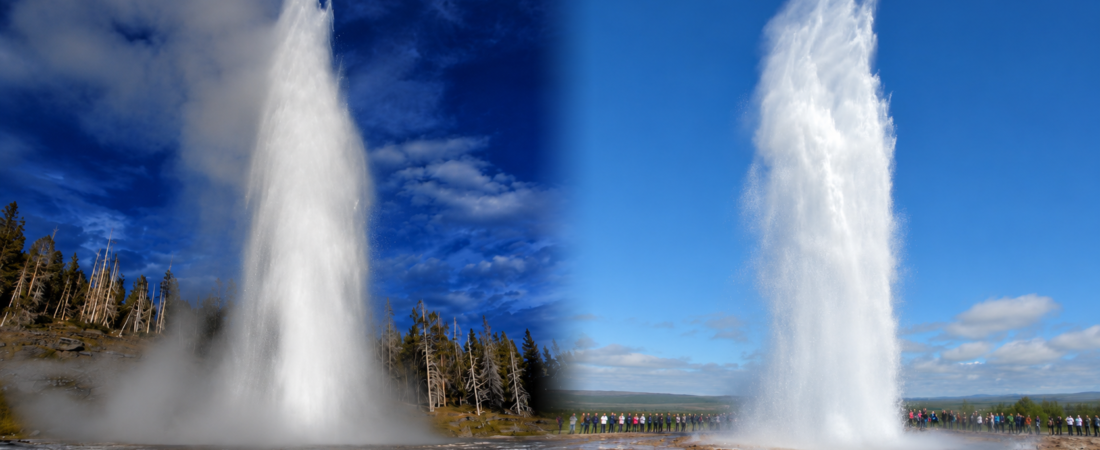
Grand Geyser in Yellowstone and Strokkur in Iceland are both frequently observed geysers, but they offer different settings and viewing experiences. Grand is part of the extensive Upper Geyser Basin and produces comparatively long, tall, multiburst eruptions. Strokkur occupies a compact visitor site within the Haukadalur hydrothermal field and erupts far more frequently. The comparison therefore involves not only two vents but also two geological settings, access systems, management regimes, and cultural contexts.
Quick facts
| Feature | Grand Geyser | Strokkur |
|---|---|---|
| Location | Upper Geyser Basin, Yellowstone National Park, United States | Geysir Area, Haukadalur, southwest Iceland |
| Geyser form | Fountain geyser erupting from a pool | Pool geyser with a sinter-lined central conduit |
| Reported height | Sometimes about 200 ft (60 m) | Official visitor information gives up to about 30 m (98 ft) |
| Eruption form | Average duration 9–12 minutes; usually 1–4 bursts | One or more short fountains in an eruption sequence |
| Published recurrence | NPS table: 6 hr 30 min ±60 min, using behavior data last updated in November 2020 | Usually several minutes; the precise pattern changed in October 2024 |
| Modern recorded name | Named Grand Geyser by the 1871 Hayden survey | Named Strokkur by Sveinn Pálsson in 1793 |
| Protected area | Yellowstone National Park | Geysir Natural Monument, 1.2 km² |
Geographic and geothermal setting
Grand Geyser lies in Yellowstone’s Upper Geyser Basin, within the Firehole River drainage. Heat from the Yellowstone volcanic system drives the basin’s hydrothermal activity. The National Park Service says magma beneath Yellowstone may be as close as 3–8 miles (5–13 km) to the surface, while rain and snow provide groundwater that descends through fractured rock before returning as heated water and steam. Rhyolitic rock supplies silica, which is deposited at the surface as sinter and also helps seal parts of the underground plumbing.
Glaciation also influenced the basin. NPS interpretation identifies volcanic rocks and ice-water contact deposits in the Upper Geyser Basin and explains that deposits beneath Yellowstone’s geyser basins can store water and allow it to percolate through the subsurface. Grand therefore belongs to a hydrothermal system shaped by volcanic heat, silica-rich rock, groundwater circulation, and glacial deposits.
Strokkur lies in the Haukadalur hydrothermal field in southwest Iceland, at the eastern margin of the Western Volcanic Zone. Iceland’s environment authority describes the same regional setting as the western volcanic belt. The protected Geysir Area covers 1.2 km², but it forms only part of a high-temperature hydrothermal field of about 3 km² containing numerous springs, pools, fumaroles, and geysers.
The available evidence describes the two settings at different scales. Yellowstone interpretation emphasizes a large basin-wide combination of heat, water, rock, and glacial deposits, whereas recent Haukadalur research provides a more detailed image of faults, conduits, and the deep reservoir. This difference in emphasis should not be taken to mean that either system is geologically simpler.
Physical form and surrounding landscape
The National Park Service classifies Grand as a classic fountain geyser. Rather than issuing a steady narrow jet from a prominent cone, it erupts from a pool in a series of powerful bursts. It sits among other pools, vents, sinter deposits, microbial mats, and runoff channels in the Upper Geyser Basin. Boardwalks and viewing areas organize public access, but Grand remains visually part of a much wider hydrothermal landscape rather than an isolated feature.
Strokkur also erupts from a water-filled pool. Scientific observations describe a sinter-lined upper conduit opening within the pool and a conduit whose width and shape change with depth. The surrounding Geysir Area contains numerous other springs and vents, although Strokkur is its principal regularly erupting attraction. Great Geysir lies nearby, and the broader field includes geothermal vegetation, extensive mineral encrustations, and features that vary in activity.
The visual difference is primarily one of visitor context. Grand is encountered during a walk through a large and feature-dense basin. Strokkur is presented as the active center of a more compact visitor area, even though it belongs to a hydrothermal field extending beyond the protected site.
Recorded history and naming
Grand Geyser
People have used the Yellowstone region for more than 11,000 years, and Native peoples used its hydrothermal waters for religious and medicinal purposes long before Euro-American surveys. The surviving documentary history of the geyser’s modern English name begins with the nineteenth-century expeditions that mapped and described Yellowstone for the United States.
The Washburn-Langford-Doane Expedition traveled through the Firehole geyser basins in 1870 and produced the first report from an organized expedition into Yellowstone. The modern name Grand Geyser is attributed to Ferdinand V. Hayden’s 1871 geological survey. Hayden’s party camped in the Upper Geyser Basin on 5 August and observed a powerful eruption. Hayden wrote that the party called it Grand because its power appeared greater than that of any other geyser they had encountered in the valley. The survey’s reports, maps, photographs, and artwork helped build support for the creation of Yellowstone National Park in 1872. The 1871 event should therefore be described as the geyser’s recorded naming by a U.S. survey, not its first human discovery.
Strokkur
Strokkur’s documented history is older and more complicated than the common statement that it was “discovered” in 1789. A recent historical review reports that the vent was blocked in 1708 after people threw stones and turf into it. Earthquakes in 1789 reactivated it, producing powerful but infrequent eruptions. The Icelandic naturalist Sveinn Pálsson described and named Strokkur in 1793, estimating fountains higher than 50 m. A scientific height measurement in 1804 recorded a 45 m water fountain followed by a prolonged steam phase.
Activity declined during the nineteenth century, partly while visitors continued throwing material into the pool to provoke eruptions. Eruptions stopped after an earthquake in September 1896, resumed weakly in 1907, and ceased completely in 1920. In July 1963, a 39.4 m borehole was drilled into the conduit to clear it and restore activity. Strokkur has remained active since that intervention. This history matters because its present regularity is not entirely untouched natural continuity: it follows both tectonic changes and deliberate reactivation of the conduit.
Eruption characteristics
The current NPS place page gives clear descriptive figures for Grand. An average eruption lasts 9–12 minutes, consists of 1–4 bursts, and sometimes reaches about 200 ft (60 m). The NPS online behavior table lists an average interval of 6 hr 30 min ±60 min, but the agency explicitly states that this table was last updated in November 2020. The newer Grand page, last updated in November 2024, does not provide an updated interval statistic.
The NPS continues to list Grand among the geysers for which it publishes eruption forecasts. Forecasts are not offered when the Old Faithful Visitor Education Center is seasonally closed, and the last posted forecast may remain visible until a new one is issued. Current forecasting is therefore evidence that Grand is operationally predictable, but it should not be confused with a current published summary of its long-term interval statistics.
Strokkur has been monitored in much greater detail over individual short eruption cycles. A one-year seismic study covering 2017–18 cataloged 73,466 eruptions. During that period, Strokkur produced eruption sequences containing one to six fountains, with an average of 16.1 seconds between fountains inside a multiple-fountain sequence. The average wait to the next sequence was 3.7 ±0.9 minutes after a single eruption and increased with the number of fountains, reaching 11.3 ±2.9 minutes after a quadruple eruption.
Those figures are a historical baseline rather than a complete description of Strokkur’s current behavior. Long-term seismic monitoring recorded an abrupt change on 18 October 2024: Strokkur began producing more fountains per eruption, more fountains per hour, and a markedly shorter recharge cycle. Several neighboring hot springs also became more active. The change was reported from a catalog containing more than 760,000 fountain events, although a full peer-reviewed statistical description of the new regime has not yet replaced the earlier figures.
Iceland’s environment authority states that Strokkur erupts regularly and can reach 30 m. Compared with Grand, its fountains are lower and much shorter, but eruption sequences occur far more often. Grand offers a prolonged, high, multiburst display; Strokkur offers repeated short displays within a much smaller span of time.
Long-term activity and viewing reliability
Grand is reliable enough to be one of the five large Upper Geyser Basin geysers regularly forecast by Yellowstone education staff. Forecasting substantially improves the chance of seeing it, but a visit still requires more time and planning than a visit to Strokkur.
Strokkur is exceptionally well documented for frequent activity. The 73,466-event catalog established its short-cycle recurrence in 2017–18, and monitoring since March 2020 has expanded the record to hundreds of thousands of individual fountains. The October 2024 shift demonstrates that regular activity does not mean unchanging activity. Even so, the official description, long-term monitoring, and recent visitor context all support a high likelihood of seeing repeated eruptions during a short stop.
Great Geysir provides a useful contrast within the same field. It has been mostly dormant in recent years, and Iceland’s environment authority states that its last known eruption occurred in 2016. Strokkur is therefore the field’s principal active attraction, while Great Geysir supplies much of its historical and linguistic importance.
Access, viewing conditions, and safety
Grand is reached through the Old Faithful area and the Upper Geyser Basin boardwalk system. Visitors must remain on boardwalks and designated trails because hydrothermal water can cause severe burns and the ground surrounding thermal features may be thin and unstable. Predictions are available through NPS channels, including its website and app, and are commonly posted in buildings around the Old Faithful area. The walk, the size of the basin, and Grand’s hours-long interval make this a visit that benefits from advance planning.
The Old Faithful and Upper Geyser Basin area is also subject to peak-season congestion. Yellowstone identifies Old Faithful as one of the locations with the highest levels of crowding and effects on visitor experience and park resources. Parking pressure and concentrated use in developed areas can therefore shape a visit to Grand even though the available counts are not specific to its viewing platform.
Strokkur is approached through marked walkways in the protected Geysir Area. Hotels, shops, restaurants, and a gas station stand immediately outside the protected boundary, and the site is patrolled throughout the year. Visitors must follow marked routes and may not disturb geothermal formations, change water levels or flow, throw stones or coins into springs, add soap, or bathe in the thermal water.
The agency opened the first phase of a new footpath system in 2024. It described the project as a way to improve safety, protect geothermal ground, distribute visitors more effectively, and accommodate increasing tourist numbers. Official online information remains less detailed about gradients, parking capacity, and the accessibility of individual viewing positions.
Protection, management, and tourism pressure
Grand is protected within Yellowstone National Park. Yellowstone’s visitor-use strategy combines resource protection with public access and concentrates monitoring and management in heavily used frontcountry locations.
Strokkur lies within the Geysir Natural Monument, protected in 2020. Its stated goals include preserving geological formations, hot springs, microorganisms, and vegetation; supporting education and scientific study; restoring disturbed ground; and maintaining the area for long-term outdoor use and tourism. The protection rules are concrete, covering damage to sinter, interference with water flow, bathing, soap, and objects thrown into pools.
Management documents and the footpath expansion provide direct evidence that the site receives heavy use. Public quantification is less current. An Icelandic Tourist Board report published in 2017 found that approximately 54% of surveyed summer tourists thought there were too many visitors at Geysir; the corresponding figure for nearby Gullfoss was about 51%. These figures describe perceptions reported a decade ago and cannot establish present crowding levels at Strokkur. No current public count specific to the vent is readily comparable with Yellowstone’s annual park statistics.
Cultural, scientific, and visitor significance
Grand’s importance is principally scientific and interpretive. It is one of the large geysers regularly forecast in the Upper Geyser Basin and stands within a district containing extensive boardwalks, a visitor education center, and the Old Faithful Historic District. Yellowstone’s hydrothermal features were central to the park’s creation, but Grand is not its public emblem in the way Old Faithful is.
Grand also remains part of current scientific work. In April 2025, the U.S. Geological Survey included it in a field campaign measuring water volumes and solute discharge from Upper Geyser Basin eruptions. The associated dataset was published in March 2026.
Strokkur’s cultural importance is inseparable from the wider Geysir field. The oldest written records of Great Geysir date to the 13th century, and the area has long attracted travelers, researchers, and artists. The Icelandic state completed its purchase of the whole hot-spring area in 2016, and formal protection followed in 2020.
Scientifically, Strokkur’s frequent eruptions allow repeated measurements of seismic signals, temperature, pressure, conduit behavior, and atmospheric influences over short periods. Grand contributes to the study of Yellowstone’s wider hydrothermal system, while Strokkur is especially suitable for research requiring many eruption cycles.
Conclusion
Strokkur benefits from its position beside Great Geysir, whose written history and name give the field an international linguistic legacy. Grand instead derives much of its significance from its place in Yellowstone’s research, forecasting, and interpretation system. For visitors, the practical distinction is straightforward: Grand offers a longer and taller eruption within a large geyser-basin walk, while Strokkur offers a much higher chance of seeing several shorter eruptions in a limited amount of time.
Sources
Yellowstone and Grand Geyser
- National Park Service. Grand Geyser.
- National Park Service. Current Geyser Activity.
- National Park Service. Hydrothermal Systems.
- National Park Service. Glaciers.
- National Park Service. History and Culture.
- National Park Service. Expeditions Explore Yellowstone.
- National Park Service. Visitor Use Management.
- National Park Service. Yellowstone National Park Sees 4,762,988 Visits in 2025.
- U.S. Geological Survey. Data Used to Determine Water Volumes and Solute Discharge from Geyser Eruptions in the Upper Geyser Basin, 2026.
- Richardson, James. Wonders of the Yellowstone, including Ferdinand V. Hayden’s account of naming Grand Geyser.
Haukadalur and Strokkur
- Environment Agency of Iceland. Nature and Geology of the Geysir Area.
- Environment Agency of Iceland. About the Geysir Area and Its Protection Rules.
- Environment Agency of Iceland. Culture and History.
- Environment Agency of Iceland. Supervision and Service.
- Environment Agency of Iceland. Construction in the Geysir Area.
- Environment Agency of Iceland. Increased Activity in the Geysir Geothermal Area, 2024.
- Icelandic Tourist Board. Tourism in Iceland in Figures 2017.
- Eibl, E. P. S., et al. “Eruption Interval Monitoring at Strokkur Geyser, Iceland”, Geophysical Research Letters, 2020.
- Eibl, E. P. S., et al. “Eruptive Cycle and Bubble Trap of Strokkur Geyser, Iceland”, Journal of Geophysical Research: Solid Earth, 2021.
- Lupi, M., et al. “Geysers, Boiling Groundwater and Tectonics: The 3D Subsurface Resistive Structure of the Haukadalur Hydrothermal Field, Iceland”, Journal of Geophysical Research: Solid Earth, 2022.
- Eibl, E. P. S., et al. “Video Camera and Seismic Monitoring of Water Bulge Explosion at Strokkur Geyser, Iceland”, Volcanica, 2024.
- Eibl, E. P. S., et al. “A High-Resolution Water Fountain Catalogue Reveals an Abrupt Hydrothermal Change at Strokkur Geyser, Iceland”, EGU General Assembly, 2026.