Snapshot
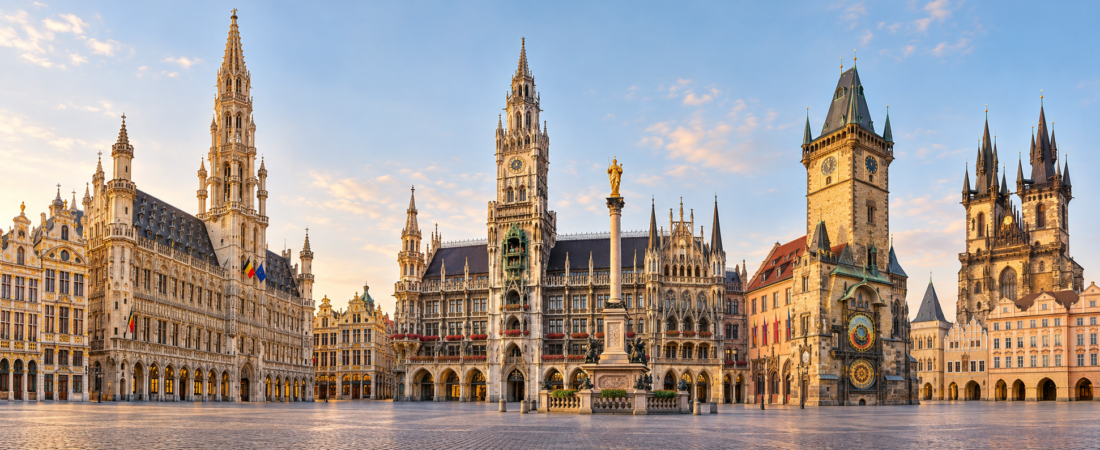
Grand-Place in Brussels, Marienplatz in Munich and Old Town Square in Prague grew around markets and municipal government. Today, each brings historic buildings into daily use through sightseeing, cafés, public gatherings and events. Their layouts make the strongest immediate difference: Brussels encloses visitors within a compact rectangle of decorated façades, Munich connects directly to shopping streets and an underground railway interchange, and Prague opens into an irregular space between churches, houses and the Old Town Hall.
| Feature | Grand Place | Marienplatz | Old Town Square |
|---|---|---|---|
| City | Brussels | Munich | Prague |
| Layout | Enclosed rectangle | Square opening into shopping streets | Irregular square with several approaches |
| Main landmarks | Gothic Town Hall and guildhouses | New Town Hall and Marian Column | Astronomical Clock and Týn Church |
| Railway access | Walk from Central or Bourse | Station beneath the square | Walk from Staroměstská |
| Heritage status | UNESCO property | Protected old town ensemble | Within UNESCO Historic Centre |
Historical development
Grand-Place developed as a market in the 12th century. Trade guilds occupied its houses, and the Town Hall was built in stages during the 15th century. French bombardment destroyed much of the surrounding square in 1695. Reconstruction followed quickly, with further restoration in the 19th century. The Town Hall continues to accommodate the mayor and other municipal officeholders. [1]
Marienplatz has been central to Munich since the city’s foundation in 1158. Its former name, Schrannenplatz, referred to the grain market. The present name dates from 1854. The Marian Column, erected in 1638, commemorates Munich being spared destruction during the Thirty Years’ War. In 1807, part of the food market moved to the site of today’s Viktualienmarkt as trading outgrew the square. [2][3][26]
Old Town Square developed at a crossroads of trade routes from the 10th century. Prague’s Old Town Hall was founded in 1338. The execution of 27 leaders of the anti-Habsburg uprising in 1621 is commemorated in the paving beside it. Fighting in May 1945 destroyed a Town Hall wing. The surviving building now receives visitors and still accommodates ceremonial uses. [4][5][6]
Urban setting and layout
Grand-Place has the strongest sense of enclosure. Buildings line its edges, with narrow streets providing brief approaches before the whole square comes into view. The continuous frontage makes it easy to examine several neighbouring façades from one position. The cobbled centre remains largely open between events. [1][7]
Marienplatz connects to the pedestrian shopping area west towards Karlsplatz and to streets leading towards Viktualienmarkt. People cross it to reach shops, trains and other parts of the centre. Station entrances and the Town Hall frontage provide useful orientation points. [2][8]
Old Town Square has more varied sightlines. The Town Hall projects into the space, and the Jan Hus monument forms another focus within it. Celetná connects the square with the Powder Gate area; the route through Malé náměstí and Karlova continues towards Charles Bridge. Pařížská leads towards the Jewish Quarter. [4][9]
Architecture and visual character
Brussels combines a Gothic Town Hall, a neo-Gothic King’s House and guildhouses with Renaissance and Baroque details. Gold ornament, sculpted figures and shaped gables create much of the square’s visual density. Its architectural coherence comes from the closely arranged frontages and the rebuilding campaign after 1695. The King’s House contains the Brussels City Museum. [7]
Munich’s New Town Hall occupies a large part of Marienplatz’s northern frontage. Its Gothic Revival towers, windows and carved decoration dominate the view across the square. Construction began in 1867; the building belongs to Munich’s 19th-century expansion. The older Town Hall and the Marian Column give the square additional focal points. [10]
In Prague, the twin towers of Týn Church rise behind the houses on the eastern side. The Old Town Hall and its clock draw attention to the opposite side, while St Nicholas Church, Kinský Palace and the Jan Hus monument add different building periods and forms. The square’s irregular outline allows these landmarks to appear in changing combinations as visitors move through it. [4]
Everyday use and activities
At Grand-Place, everyday visits centre on the buildings, the City Museum, Town Hall visits and the cafés and restaurants around the edges. The municipal offices also give the square a continuing working function. [1][7]
Marienplatz combines sightseeing with shopping and routine journeys through the centre. The Glockenspiel performs at 11 am and noon, with an additional 5 pm performance from March to October. Its figures and bells bring people to a standstill in front of the New Town Hall. Guided visits provide access to parts of the building. [2]
Prague’s Astronomical Clock can be watched from the square. A separate visit to the Old Town Hall covers its historic interiors, tower and underground spaces. Outdoor restaurant terraces also occupy parts of the square’s edge; U Prince has a patio facing the clock. [5][11]
Events and seasonal conditions
Grand-Place hosts the biennial August Flower Carpet and the Ommegang historical pageant in early summer. Temporary installations can occupy much of the open space. At Christmas, a tree and seasonal lighting form part of the city’s celebrations. [1][12][13]
Munich’s Christkindlmarkt takes place on Marienplatz. City anniversary celebrations and football championship receptions also use the square. In Prague, Christmas and Easter markets bring stalls and seasonal food into Old Town Square. Event dates and layouts vary by edition. [2][4]
Summer visits involve exposure to sun across the open paving. Building shadows shift through the day, so a shaded place to stand may be some distance from the landmark being viewed. Rain makes café interiors and covered passages useful for breaks. In winter, warm clothing and footwear with grip matter, particularly during long periods spent standing outdoors.
Transport access
Grand-Place is reached on foot from Brussels Central railway station or Bourse. Gare Centrale serves metro lines 1 and 5. Bourse serves trams 4 and 10. Both approaches continue through the central streets to the square. [14][15]
Munich has the most direct railway arrival of the three. Marienplatz station sits beneath the square, with U3 and U6 services and the central S-Bahn suburban rail route. The station plan identifies exits, lifts and connections between levels. [8]
In Prague, Staroměstská station on metro line A provides an approach from the west, followed by a walk through the Old Town. The final route matters for visitors with reduced mobility because historic paving and kerbs vary between streets. Prague City Tourism publishes a detailed accessible Old Town walking route. [5][9]
Physical accessibility
Grand-Place’s cobbles can make wheelchair and stroller travel uncomfortable. Allow time to cross the square and check access arrangements separately for any building visit. Historic entrances and interior routes need individual assessment.
At Marienplatz, lifts connect station levels and the street. Check their operating status before travelling if stairs are unsuitable. Munich’s tourist information office at Marienplatz 8 can advise on accessible attractions and facilities. [8][16]
Prague’s Old Town route includes rough paving and some awkward cross-slopes. The Old Town Hall has lifts and a platform connecting parts of the visitor route, with access available to portions of the building and tower. The official accessibility guide gives entrance details and equipment dimensions. Wheelchair users should confirm the route with staff before visiting. [5][9]
Facilities and comfort
Food and drink are available around all three squares. Café terraces provide seated breaks at commercial premises; their menus, opening times and access arrangements vary.
Brussels publishes a public-toilet map showing charges, opening hours and accessibility. Munich provides a municipal WC finder and an accessibility information service. These are useful for locating facilities along the approach to the square. [16][17][18]
Prague’s accessible Old Town guide identifies a partially accessible toilet inside the Old Town Hall and additional facilities along its suggested route. The square’s landscaped resting area was replanted with maples and fitted with benches in 1998. Seating there offers a break from standing in the main open space. [4][9]
Crowding and atmosphere
The two clocks create predictable gathering points in Munich and Prague. People stop to watch while others continue across the square, producing congested patches around the viewing areas. In Brussels, major installations and performances can alter how much of the centre remains available for walking.
For architectural viewing, choose a time outside the main performances or event programme. Visitors who want to watch the clocks should arrive early enough to find a position without blocking an entrance or through-route. A quiet visit depends on the day’s activities as well as the hour.
After dark, the buildings remain visible from the public space, and nearby restaurants extend activity beyond shop hours. Seasonal lighting changes the appearance of Grand-Place particularly strongly. Event programmes and individual businesses determine the evening’s activity. Marienplatz itself has no shop-style closing time.
Safety
Keep phones, wallets and bags secure when attention is directed towards a clock, performance or photograph. Pickpocket prevention is especially relevant in dense gatherings and on the transport journey. Prague police publish visitor warnings, and Munich police issue advice for Christmas-market crowds. [19][20]
During large events, follow signed routes and staff instructions, leave room at entrances and keep an agreed meeting point for anyone who becomes separated. Wet or icy paving also calls for care.
LGBT openness
Brussels’s RainbowHouse, on Rue du Marché au Charbon near Grand-Place, brings together LGBTQIA+ organisations. It provides a documented community contact close to the square. [21]
Marienplatz has a long association with Munich Pride. In 2026, the main street festival moved to Ludwigstraße, where the organisers had more space. Pride’s programme retained RathausClubbing at the Town Hall. Visitors should use the current programme to locate individual events. [22]
Prague City Tourism lists an LGBT+ community centre in the Old Town offering meetings, workshops and support activities. Contact details and opening arrangements are available through the official listing. Personal experiences of public space vary, and harassment should be reported to local authorities or an appropriate support organisation. [23]
Heritage protection and management
Grand-Place was inscribed on the UNESCO World Heritage List in 1998. The property includes the square and its architectural ensemble. More than 150 buildings are protected in the surrounding buffer zone. UNESCO identifies commercial and tourism pressure on this historic area as a conservation concern. [7]
Old Town Square lies within the Historic Centre of Prague, inscribed in 1992. Its protection forms part of the wider historic city, including the medieval street pattern and buildings from successive periods. UNESCO describes conservation requirements covering historic materials, architectural details and the relationship between buildings and streets. [24]
Marienplatz belongs to Munich’s protected old town ensemble. Municipal guidance addresses alterations within that area under Bavarian heritage protection law. Its conservation framework is local and national; it has no UNESCO World Heritage designation. [25]
For these urban squares, environmental comfort depends heavily on paving, shade and access to shelter. Conservation also involves maintaining the buildings and accommodating temporary structures, deliveries and visitors within limited space. Event size has practical consequences: Munich Pride’s 2026 relocation followed crowding and rising safety-related costs at its former site. [22]
Nearby places
From Grand-Place, the Royal Saint-Hubert Galleries provide a nearby covered shopping arcade. [7]
From Marienplatz, Viktualienmarkt continues the food-market history discussed earlier. The Frauenkirche and the Residenz are also within walking distance, allowing a visit to include churches and former court buildings. [2][3]
From Old Town Square, continue towards the Jewish Quarter or the House at the Black Madonna and Powder Gate. [9]
Conclusion
Grand-Place suits a visit concentrated on the architecture surrounding a single enclosed space. Marienplatz fits easily into a day combining public transport, shopping and nearby attractions. Old Town Square offers several substantial monuments together and routes onward through Prague’s historic centre. The choice of visiting time matters most when a market, installation or scheduled performance occupies the space.