
Snapshot
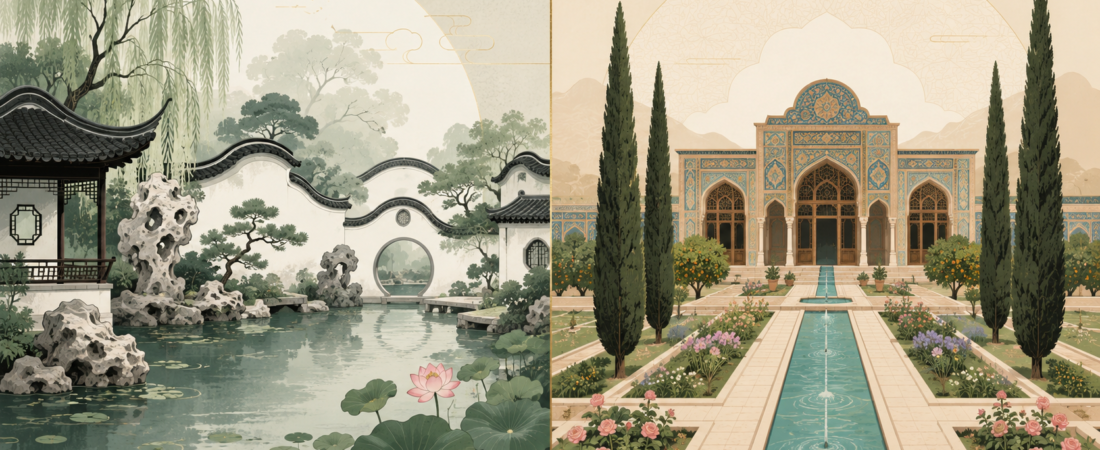
These two gardens create beauty in very different ways. Humble Administrator’s Garden unfolds through ponds, pavilions, bridges and views that appear a little at a time. Eram Garden makes its impression more quickly: a long pool, tall cypresses, flowers and a Qajar mansion set against the dry landscape of Shiraz. Suzhou offers the fuller visit for someone choosing a single garden, while Eram has the clearer botanical character and the more direct composition.[2] [3]
| Humble Administrator’s Garden | Eram Garden | |
|---|---|---|
| Setting | A compact garden in Suzhou’s old city, close to canals, museums and other classical gardens. | A large garden in modern Shiraz, with cypresses, a long pool and a mountain-backed setting. |
| Garden tradition | A Chinese scholar garden built from ponds, rocks, pavilions, corridors and framed views. | A Persian garden organised around water, planting, enclosure and a strong central axis. |
| Present form | Created in 1509 and altered over later centuries. | Its precise origins are uncertain; the surviving mansion is mainly Qajar in character. |
| Area | About 5.2 hectares. | About 12.7 hectares for the UNESCO component. |
| How it feels | Layered, enclosed and slow to reveal itself. | Open, axial and easy to take in at first sight. |
| Typical visit | Around two to three hours; crowding is the main complaint. | Around one to two hours; heat and limited palace access can shape the visit. |
| Best season | Spring and autumn are comfortable; summer lotus is a major draw. | Spring and autumn bring softer temperatures and stronger garden colour. |
Setting and first impression
Humble Administrator’s Garden sits at 178 Dong Bei Street in Suzhou’s Gusu District. The address places it inside one of the city’s richest areas for historic sights. Suzhou Museum and Lion Grove Garden are close by, and the canals and lanes of the old city continue the visit beyond the garden gate. The garden itself covers about 5.2 hectares, yet it rarely feels small. Water, walls and buildings keep dividing the view into new scenes.[1] [2]
Eram Garden occupies about 12.7 hectares in Shiraz. It once stood near the northwestern edge of the city; Shiraz has since grown around it. The garden now feels like a broad green enclosure inside a modern city. Its pool and main path lead the eye towards the mansion, while cypresses rise above the lower planting. The Zagros setting and dry climate give the water and shade a stronger presence than they have in Suzhou.[4] [5]
The contrast is clear from the entrance. Suzhou draws the visitor inward and keeps changing the view. Eram opens out along a central line and shows its main elements early. The larger garden is the simpler one to understand; the smaller garden contains the more intricate journey.
Origins and garden ideas
The present Humble Administrator’s Garden was created in 1509 by Wang Xianchen after he withdrew from official life. Its ponds, rocks, plants and buildings belong to the tradition of the Chinese scholar garden. UNESCO describes the classical gardens of Suzhou as miniature natural landscapes shaped by painting, poetry and the wish to live in harmony with nature. The garden’s identity comes from this union of private retreat, art and carefully arranged scenery.[2]
Eram’s beginnings are harder to fix to one year. Historical accounts suggest an older garden may have occupied the site, but the mansion visible today belongs mainly to the Qajar period. The garden passed through Qashqai and Qajar ownership before becoming connected with Shiraz University. Its wider tradition is much older. UNESCO describes the Persian garden as a four-part composition in which water serves both practical and decorative purposes and the whole garden evokes paradise.[3] [4]
Suzhou therefore has the clearer story as an individual work: a named owner, a date and a strong link with Ming scholar culture. Eram carries several periods at once. Its importance rests as much on the long life of Persian garden design as on the history of this particular mansion and plot.
Water, buildings and views
Water spreads through Humble Administrator’s Garden in irregular ponds. Pavilions, covered walks, bridges, islands and rocks sit beside it or appear across it. A visitor seldom sees the whole layout at once. Doorways and windows frame small scenes, and a turn in a corridor can replace one arrangement of water and buildings with another. The garden works like a painted scroll that is opened gradually.[1] [2] [11]
At Eram, water has a firmer direction. The long pool in front of the mansion forms the best-known view, with the façade reflected below and cypresses standing on either side. The scene is formal and easy to photograph. Smaller channels carry water through the planting, linking the central display to the practical irrigation system that lies behind the Persian garden tradition.[3] [4]
Humble Administrator’s Garden rewards looking sideways, through and around things. Eram asks the visitor to look forward. Suzhou offers more visual surprises; Eram leaves the stronger single image.
Planting and the seasons
Lotus is one of the signatures of Humble Administrator’s Garden. In summer it fills the ponds and changes the balance between open water and greenery. Spring flowers, autumn foliage and the bare structure of winter each bring out a different part of the design. Plants matter throughout the year, although they share attention with stone, water and architecture.[1] [2]
Plants occupy a more commanding role at Eram. Historical descriptions praise its flowers, fragrant myrtles, flowing water and tall cypresses, including a celebrated sarv-e nāz cypress. The garden later became a botanical garden, strengthening this horticultural identity. Roses and seasonal colour soften the formal axis and make spring especially attractive.[4]
A visitor mainly interested in plants may find more to hold their attention at Eram. Suzhou uses plants to complete a changing landscape; Eram lets trees and flowers become leading characters. Climate also changes the choice. Suzhou can be hot and humid in summer, while Shiraz is hot and dry. Spring and autumn are the easier seasons in both cities, though summer lotus gives Suzhou a reason to accept the heat.
Moving through the gardens
Humble Administrator’s Garden is usually described in eastern, central and western parts. The eastern section is broader and more rustic, the centre contains the strongest water scenes, and the west feels more enclosed and ornate. These areas help with orientation, but the garden still encourages wandering. Its paths, bridges and covered walks keep offering alternatives.[1]
Eram is easier to read. The pool, paths, planting and mansion provide a stable centre, so visitors can understand the plan without following a set route. Details then take over: tilework on the façade, the shape of the cypresses, flowers beside the channels and reflections in the water.[3] [4]
Someone who enjoys getting slightly lost will probably prefer Suzhou. Someone who wants to grasp the garden quickly may prefer Eram. This difference also affects the length of a visit. Two or three hours is common at Humble Administrator’s Garden, while Eram is often presented as a one- or two-hour stop.[6] [7]
Conservation and change
Both gardens are protected as parts of UNESCO World Heritage properties. Suzhou’s classical gardens have a detailed system of municipal conservation, legal protection and monitoring. Humble Administrator’s Garden feels closely managed, with visitor movement and the historic fabric kept under tight control.[2]
Eram is also protected, but its modern history is easier to see. Its old boundary walls were replaced in places, some trees gave way to lawns, a boulevard changed one side of the site and university use added another layer to the garden’s life. Encyclopaedia Iranica records these changes alongside the garden’s survival as a public and botanical space.[3] [4]
Neither garden is frozen in the past. Suzhou presents continuity through careful restoration and formal management. Eram shows more openly how a historic garden can be altered by a growing city and a modern institution.
Visiting today
Humble Administrator’s Garden is easier to plan from abroad. The Suzhou government publishes its address, opening hours, ticket prices and transport information, while Trip.com gives a typical visit of two to three hours. The drawback is popularity. Crowds can collect on narrow bridges and around famous viewpoints, making a garden designed for quiet observation feel hurried.[1] [6]
Eram needs less time and has a simpler route. Trip.com lists a visit of one to two hours and states that the mansion is not normally open to tourists. Opening hours and prices shown by third-party sites should be checked again before travelling. The weather deserves equal attention: the open parts of the garden can be tiring in strong sun, especially in summer.[7]
The practical choice depends on which inconvenience matters more. Suzhou supplies more information and more visitor services, but it also brings heavier crowds. Eram is calmer and easier to cover, but the visit offers less access to the building and fewer dependable details in English.
What visitors say
The online review records are too different for a clean numerical contest. In September 2026, Trip.com displayed 4.6 out of 5 for Humble Administrator’s Garden from more than 84,000 reviews. Tripadvisor displayed 4.4 out of 5 for Eram Garden from 769 reviews. Those figures come from different sites, audiences and collection methods, so the scores should not be placed side by side as though they were one survey.[6] [8]
The written comments are more useful. Reviews of Humble Administrator’s Garden repeatedly praise its water, pavilions, seasonal scenery and photographic views, then complain about congestion. Eram’s reviewers often mention peace, cypresses, flowers, the pool and the mansion façade. Less enthusiastic comments focus on the short visit, limited access to the mansion, heat and value for money.[6] [8]
Both places satisfy visitors who arrive for the qualities the gardens actually have. Problems arise when expectations are different: solitude at one of Suzhou’s busiest sights, or a long palace visit at Eram.
LGBTQ travellers and safety
The gardens themselves call for ordinary care around stone paths, water, heat and crowds. The national setting is more important for LGBTQ travellers. UK travel advice states that same-sex relationships are legal in China, but public attitudes can be less tolerant and Chinese law does not provide general protection from discrimination based on sexual orientation.[9]
The position in Iran is far more dangerous. UK travel advice states that same-sex relationships are illegal and can carry the death penalty. This legal risk applies far beyond Eram Garden and changes the meaning of any travel recommendation for an openly gay visitor.[10]
Humble Administrator’s Garden is therefore the safer of the two choices for LGBTQ travellers. This conclusion concerns national law and social conditions; it is not a claim about the conduct of staff or visitors inside either garden.
Conclusion
Humble Administrator’s Garden gives the richer journey. Its ponds, buildings and framed views take time to understand, and the surrounding historic district extends the experience into Suzhou. It is the better choice for a first visit if garden design, cultural history and a full half-day outing matter most. Crowds are the price of its fame.
Eram Garden is more immediate. The long pool, cypresses, flowers and Qajar mansion form a memorable scene without demanding a long visit. It is the better choice for someone drawn to Persian garden history, botanical character or a clear, formal composition. Heat and limited access to the mansion are its main weaknesses.
Neither garden replaces the other. Suzhou turns walking into a sequence of discoveries. Eram turns water, planting and architecture into one calm view. The stronger choice depends on which of those experiences the visitor wants.