Snapshot
| Criterion | Iguazú Falls | Victoria Falls |
|---|---|---|
| Location | Argentina/Brazil border; subtropical Atlantic Forest setting | Zambia/Zimbabwe border; basalt plateau and gorge setting |
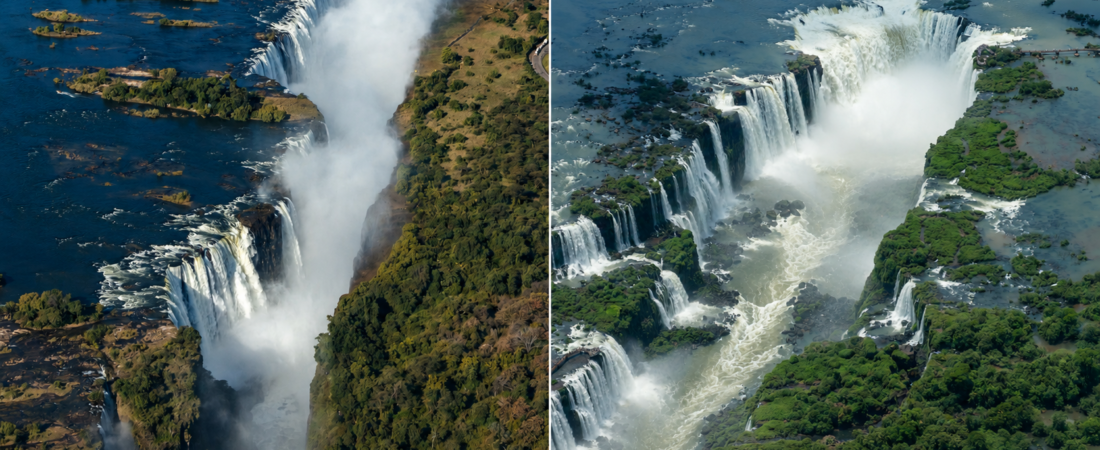
| Spatial form | Broad multi-fall system; fragmented, forested, immersive | Long single curtain; frontal, axial, gorge-based |
| Visitor experience | Many circuits and viewpoints; varied and enveloping | Linear rim viewpoints; more concentrated and monumental |
| Access | Two nearby gateways: IGR/Puerto Iguazú and IGU/Foz do Iguaçu | Two nearby gateways: VFA/Victoria Falls and LVI/Livingstone |
| Core identity | Rainforest-waterfall labyrinth | Thunderous gorge spectacle |
Location and physical setting
Iguazú Falls lies on the Iguazú/Iguaçu River, on the border between Argentina and Brazil, near Puerto Iguazú and Foz do Iguaçu. It sits in a humid subtropical Atlantic Forest setting within protected national parks. The site is generally in the UTC−3 time zone. UNESCO describes Iguazú as one of the world’s most spectacular waterfalls, set within subtropical rainforest of exceptional biodiversity.
Victoria Falls / Mosi-oa-Tunya lies on the Zambezi River, on the border between Zambia and Zimbabwe, near Livingstone and Victoria Falls town. It sits on a basalt plateau and drops into a narrow gorge system. The site is in UTC+2, so Victoria Falls is usually five hours ahead of Iguazú. UNESCO describes it as the largest curtain of falling water in the world and a transboundary World Heritage property.
The straight-line distance between the two sites is approximately 8,200 km. Iguazú is a forest-embedded waterfall system; Victoria is a plateau-and-gorge waterfall.
Physical dimensions and form
Iguazú is broader and more fragmented. It is a multi-part waterfall system, with many individual falls separated by islands and rock formations. UNESCO describes the waterfall system as about 80 m high and 2,700 m across, while Wikipedia gives the number of drops as 275 and notes that the smaller waterfalls can fluctuate from 150 to 300 depending on water level.
Victoria Falls is more unified. UNESCO gives its width as 1,708 m, with major sections dropping between 61 m and 99 m into basalt gorges. Its visual force comes from one river crossing one long edge and disappearing into a deep chasm.
Conclusion: Iguazú wins for complexity, width and multiplicity. Victoria wins for geometric clarity, gorge drama and the impression of one immense waterfall wall.
Water volume and seasonal reliability
Iguazú is generally more reliable as a full-site spectacle because its many falls and viewpoints remain visually rich across seasons, even when water levels vary. It does not depend on snowmelt; rainfall and upstream river conditions are the main drivers.
Victoria Falls has a sharper wet-season/dry-season contrast. At high water, the fall is overwhelming but may be partly hidden by spray. At low water, visibility improves, but parts of the rock face can be exposed. UNESCO states that up to 500 million litres per minute descend over Victoria Falls in high-flow conditions.
Conclusion: Iguazú is more dependable for a complete waterfall experience. Victoria is more extreme: more overwhelming at peak flow, but more visibly reduced in dry periods.
Visual drama and viewing experience
Iguazú is immersive. Visitors experience it through several angles: upper views, lower views, forest walkways, river channels, side cascades and the Devil’s Throat / Garganta del Diablo. Its power is cumulative: many falls, many sounds, many spray zones, and a sense of being surrounded by falling water.
Victoria is frontal and monumental. The main experience is the rim opposite the fall, where the Zambezi drops into the First Gorge. The visual drama is simpler but more concentrated: one long edge, one abyss, one vast cloud of mist.
Conclusion: Iguazú is more varied and enveloping. Victoria is more severe, axial and monumental.
Accessibility, entry points and effort
Iguazú has two main entry systems. The Argentine side is entered near Puerto Iguazú and is organised around the Devil’s Throat Trail, Upper Circuit and Lower Circuit. The Brazilian side is entered near Foz do Iguaçu and is centred on a shorter panoramic route. Accessibility sources describe several Iguazú routes as highly accessible, with the Devil’s Throat and Upper Circuit often presented as accessible, while the Lower Circuit is largely accessible depending on conditions.
Victoria Falls also has two main waterfall-entry systems: the Zimbabwean rainforest entrance near Victoria Falls town and the Zambian Mosi-oa-Tunya side near Livingstone. The main experience is more linear, following rim viewpoints opposite the gorge. Accessibility is more variable: some paths are accessible, but sources mention cobbles, inclines, bumpiness, spray and slippery surfaces.
Iguazú is stronger as a multi-route walking/circuit experience. Victoria Falls is more compact and easier to understand spatially, but less rich as a trail network.
Guide dependence: standard viewing at both sites can be done independently. Special experiences at both sites require operators: Iguazú for boat rides and full-moon walks; Victoria for Devil’s Pool/Livingstone Island, rafting, gorge swing, helicopter flights and river activities. Guide dependence is therefore not a major differentiator.
Both Iguazú Falls and Victoria Falls have strong two-sided airport access, but in both cases the best airport depends on which national side you plan to visit. Cross-border visits may require passport, visa, transfer and timing considerations.
Conclusion: Iguazú is more circuit-based and generally easier for older visitors and children. Victoria is manageable for many visitors but less predictable because of spray, wet paths and uneven sections.
Crowd pressure, visitor management and anthropogenic noise
Iguazú attracts heavy crowds at famous points, especially Devil’s Throat, but its multiple circuits help disperse visitors. Human-made noise comes mainly from crowd concentration at platforms and commercial helicopter flights on the Brazilian side. Road noise appears less central at the main viewpoints because the visitor experience is mostly inside park circuits rather than beside a major through-road.
Victoria Falls has a more concentrated visitor structure because the main viewpoints follow the gorge rim. Its anthropogenic-noise risk is stronger because of helicopter flights, adventure tourism, road/bridge infrastructure and concentrated viewing areas. Visitor-review evidence includes complaints about helicopter noise at Victoria Falls, including a review titled “Noise pollution.”
Conclusion: Victoria has the higher human-made noise risk. Iguazú is crowded and commercialised, but Victoria combines rim crowding, helicopters, bridge/road context and adventure activities more tightly around the core experience.
Safety and natural risk
Iguazú’s main risks are wet walkways, crowding at Devil’s Throat, heat and humidity fatigue, insects, boat-tour exposure and small-wildlife nuisance, especially coatis that approach visitors for food. It generally offers more shade because many paths pass through forest.
Victoria Falls has wet and slippery paths from spray, reduced visibility at high water, exposed gorge edges, adventure-activity risks, and wider Zambezi/national-park wildlife context. Large-wildlife risk is mainly outside the controlled waterfall viewpoints, especially near the river and wider park areas where animals such as hippos, crocodiles, elephants, baboons or monkeys may be present.
Iguazú has the safer country-level context on the Argentine side, but the wider tri-border area around Puerto Iguazú / Foz do Iguaçu / Paraguay carries organised-crime and smuggling risk; tourist risk is mainly opportunistic theft rather than waterfall-specific violence. Victoria Falls has a weaker country-level crime/security context on the Zimbabwe side, where official advice warns about opportunistic and sometimes violent crime, but the actual tourist zone is usually treated as calmer than major cities.
Conclusion: Iguazú’s risk is mainly managed-circuit risk. Victoria’s risk is more edge-, spray-, adventure- and wider-wildlife-related.
Climate and seasonality
Iguazú is humid and rainy throughout the year. The wettest period is generally spring to early summer, especially October–November, with hot, humid and rainy summer conditions continuing into December–February. Travel guidance often recommends late March–May or August–early October for more comfortable temperatures and easier trail conditions.
Victoria Falls has a clearer rainy/dry rhythm. The rainy season usually runs November–March, with rainfall peaking around December–January. The falls are normally most powerful after the rains, especially February–May, while May–October generally offers clearer views, less spray and better photography.
Conclusion: Iguazú is easier to plan year-round. Victoria is more season-sensitive: high water gives power, low water gives visibility.
Ecological and protected-area context
Iguazú is stronger as a rainforest biodiversity site. UNESCO identifies the surrounding subtropical forest as exceptionally rich, and the protected area is part of the Atlantic Forest context.
Victoria Falls is not rainforest in the same broad Atlantic-Forest sense. Its distinctive ecosystem is a Zambezi riverine spray forest / gorge ecosystem, set within a wider mopane woodland and riverine landscape. UNESCO highlights the basalt gorges, islands and bird habitats, including endangered and migratory species such as the Taita Falcon and Black Eagle.
Hydropower pressure: both sites are vulnerable to upstream water management. At Victoria, reduced flows are particularly important because the dry-season visual experience can change dramatically. At Iguazú, upstream dams and river regulation also matter, but the multi-cascade system usually remains visually rich.
Iguazú appears better protected in practical terms inside the core park area; Victoria Falls has strong formal protection, but protection seems more fragile because tourism development, fire, water pressures and urban/tourism expansion sit closer to the core visitor landscape.
Conclusion: Iguazú has the stronger biodiversity setting. Victoria has the stronger visible vulnerability to dry-season flow reduction.
Main POIs and complementary features
Iguazú main POIs: Devil’s Throat / Garganta del Diablo; Upper Circuit; Lower Circuit; Brazilian Cataratas Trail; Porto Canoas area; Macuco Trail; Arrechea Waterfall; boat-tour areas; visitor centres; Parque das Aves near the Brazilian entrance; and the Three Borders Landmark if the wider area is included.
Victoria Falls main POIs: Main Falls viewpoints; Devil’s Cataract; Rainbow Falls; Danger Point; Knife-Edge Bridge; Victoria Falls Bridge; Livingstone Island; Devil’s Pool in season; Zambezi river-cruise areas; gorge viewpoints; Mosi-oa-Tunya National Park; Victoria Falls town and Livingstone tourism zone.
Conclusion: Iguazú is better as a forest-waterfall trail landscape. Victoria is better as a waterfall-gorge-adventure landscape.
Social openness / gay friendliness
This criterion must be treated at country and town context level, not at waterfall-platform level.
Iguazú benefits from the Argentina/Brazil context. Argentina legalised same-sex marriage in 2010 and is comparatively stronger for LGBT legal recognition; Brazil also has legal same-sex marriage. Puerto Iguazú and Foz do Iguaçu are tourist towns, not major LGBTQ districts, but the country-level legal context is significantly more open.
Victoria Falls is weaker on this criterion because Zambia criminalises homosexual activity and Zimbabwe bans same-sex marriage, with male same-sex activity illegal according to Equaldex comparisons. Victoria Falls and Livingstone are international tourism centres, but the surrounding national legal context is much less favourable.
Conclusion: Iguazú is clearly stronger for gay openness because Argentina/Brazil offer a more protective legal context than Zambia/Zimbabwe.
Symbolic, cultural or spiritual meaning
Iguazú is commonly linked to Guarani/Tupi roots meaning “big water.” Its symbolism is abundance, multiplicity and rainforest power.
Victoria Falls has a stronger naming contrast. Its Indigenous name Mosi-oa-Tunya means “the smoke that thunders,” while “Victoria Falls” reflects David Livingstone’s colonial-era naming in honour of Queen Victoria.
Conclusion: Iguazú symbolises abundance. Victoria symbolises thunder, mist, colonial naming and sublime danger.
Curious facts
Iguazú Falls: the park offers special full-moon night walks to Devil’s Throat, allowing visitors to experience the falls by moonlight rather than only during daytime. These tours are usually organised around the full-moon period and are separate from the standard daytime circuits.
Victoria Falls: sprays from this giant waterfall can be seen from a distance of 30 km from the Lusaka road, Zambia and 50 km from Bulawayo road, Zimbabwe.
Final conclusion
Iguazú Falls is stronger for variety, biodiversity, accessibility, viewpoint diversity, gay-openness context and a more reliable full-site experience.
Victoria Falls is stronger for monumental geometry, gorge drama, symbolic force, seasonal contrast and concentrated sublimity.
Sources
- UNESCO World Heritage Centre — Iguazú National Park / Iguaçu National Park.
- UNESCO World Heritage Centre — Mosi-oa-Tunya / Victoria Falls.
- Wikipedia — Iguazú Falls: location, drops, flow variability, naming.
- Wikipedia — Victoria Falls: geography, naming, pre-Livingstone cartographic history.
- Iguazú visitor/accessibility guides — Devil’s Throat, Upper Circuit, Lower Circuit.
- Victoria Falls visitor/accessibility sources — rim trail, wheelchair limitations, slippery paths.
- Victoria Falls Guide — Livingstone weather and rainy season.
- Go2Africa and other travel-climate sources — Victoria Falls seasonal timing.
- Travel-climate sources for Iguazú — best months and rainy-season context.
- Equaldex — LGBT legal context for Argentina, Brazil, Zambia and Zimbabwe.
- Google Maps satellite screenshots
- AllTrails