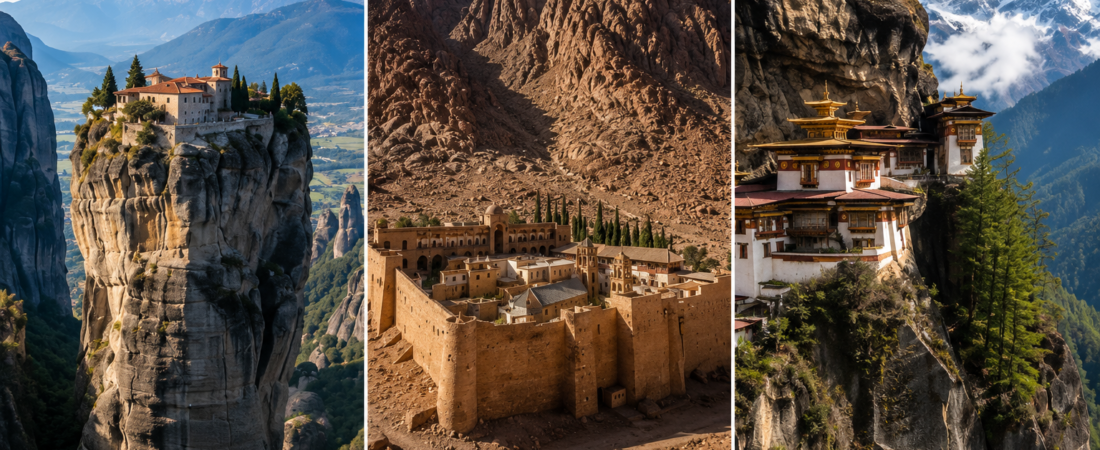
Meteora in Greece, Saint Catherine’s Monastery in Egypt, and Paro Taktsang in Bhutan are often grouped together because each joins sacred architecture to dramatic terrain. Their resemblance is real, but limited. Each place emerged from a different religious tradition, historical sequence, settlement pattern, and system of governance. Those differences determine how the sites function, how visitors encounter them, and what conservation means in practice.
At a glance
| Feature | Meteora | Saint Catherine’s | Paro Taktsang |
|---|---|---|---|
| Setting | Sandstone pillars above Thessaly, Greece | Granite massif of South Sinai, Egypt | Cliff above the upper Paro Valley, Bhutan |
| Religious tradition | Eastern Orthodox Christianity | Eastern Orthodox Christianity | Bhutanese Vajrayana Buddhism |
| Historical formation | Hermits from the 11th century; major monasteries from the 14th–16th centuries | Founded in the 6th century under Emperor Justinian | Sacred association from the 8th century; temple complex built 1692–1694 |
| Spatial form | Separate compounds on individual rock pillars | One fortified monastic enclosure | Interconnected temples, ledges, stairs, and caves on a cliff face |
| Living religious use | Four monasteries still house religious communities | Continuous monastic use since the 6th century | Active pilgrimage and ritual site reconstructed after the 1998 fire |
| World Heritage status | UNESCO mixed property, inscribed 1988 | UNESCO cultural property, inscribed 2002 | Not inscribed on the World Heritage List |
| Principal access | Road network and stairways | Road access to the monastery area | Uphill trail; travel on foot or partly by horse |
| Central stewardship issue | Balancing monastic life, mass visitation, landscape protection, and development control | Safeguarding the wider sacred landscape during major development and tourism planning | Maintaining a reconstructed cliff complex and its pilgrimage setting under national stewardship |
A shared type, three distinct places
All three sites use difficult terrain to create distance from ordinary settlement. Height, enclosure, and effort become parts of religious experience rather than neutral scenery. Meteora turns a field of sandstone towers into a dispersed monastic territory. Saint Catherine’s occupies a walled precinct at the foot of a mountain sacred to Christianity, Islam, and Judaism. Paro Taktsang binds a sequence of Buddhist temples and meditation caves to a sheer Himalayan cliff.
The similarities end at the level of broad structure. Meteora is a network of separate monasteries within a monumental rock landscape. Saint Catherine’s is a continuously occupied fortified institution with exceptional manuscript and icon collections. Taktsang is a pilgrimage complex whose identity joins sacred narrative, caves, reconstructed architecture, and the physical ascent from the Paro Valley. Treating the three as interchangeable examples of remote spirituality would erase the features that give each place meaning.
Physical setting and landscape structure
Meteora rises above the towns of Kalabaka and Kastraki in Thessaly. UNESCO describes sandstone peaks more than 400 metres above the surrounding ground, formed from ancient river deposits and shaped by tectonic activity, rain, and wind. The monasteries occupy selected summits rather than a single ridge. Their visual power comes from repetition: rock, monastery, gap, and another rock. The sacred landscape therefore includes the spaces between compounds as well as the buildings themselves.
Saint Catherine’s belongs to a much larger sacred mountain system. The monastery stands at the foot of Mount Horeb, also known as Jebel Musa or Mount Sinai, within an arid granite landscape containing pilgrimage paths, chapels, archaeological remains, a mosque, and a summit chapel. The low, defensive mass of the enclosure contrasts with Meteora’s exposed silhouettes. Its sense of remoteness comes from the surrounding desert basin and mountain routes rather than from occupying a summit.
Paro Taktsang stands at about 3,120 metres above sea level on a cliff roughly 900 metres above the wider Paro Valley. White walls, dark timber, and gilded roofs occupy narrow ledges while caves remain integral to the sacred topography. The vertical approach compresses the relationship between exertion and arrival: forest, viewpoints, stairs, bridge, waterfall, and temple form a single sequence. The commonly cited 900-metre figure describes the site’s height above the broader valley, not a universal trailhead-to-monastery elevation gain.
Origins and historical formation
At Meteora, hermits and ascetics settled from about the 11th century. A small church at Doupiani existed by the late 12th century, and systematic monastery building followed during the political instability of 14th-century Thessaly. By the end of the 15th century there were twenty-four monasteries. Six principal complexes survive, and UNESCO states that four—Great Meteoron, Varlaam, Holy Trinity, and Saint Stephen—still house religious communities. The 16th-century fresco programmes, including work associated with Theophanes the Cretan, made Meteora important to the development of post-Byzantine painting.
Saint Catherine’s was founded in the 6th century under the Byzantine emperor Justinian. Its walls, church, domestic buildings, collections, and uninterrupted religious function make it exceptional among early Christian monasteries. Later repairs and additions did not turn it into a series of disconnected historical layers; they sustained a living institution within the form of the Justinianic enclosure. The monastery’s Christian history exists within a landscape revered by three monotheistic religions.
Taktsang’s chronology has two connected strands. Bhutanese tradition associates the caves with Guru Rinpoche in the 8th century and with later Buddhist masters. The architectural complex belongs principally to the late 17th century. Paro district administration records that Gyalsey Tenzin Rabgye initiated construction in 1692 and completed it in 1694. Fire destroyed much of the complex in 1998, followed by reconstruction. Its continuity is therefore religious and spatial as well as architectural; the sacred location and ritual associations survived a major loss of built fabric.
Spatial form and built environment
Meteora’s architecture is distributed. Each monastery forms a compact world on a separate rock, typically combining a main church, chapels, cells, service buildings, terraces, and circulation adapted to the summit. Historic rope ladders, nets, and hoisting systems made the cliff itself part of the boundary. Modern stairs and paths have changed access, but the separation between compounds remains legible.
Saint Catherine’s is concentrated behind Byzantine walls. The enclosure gathers the Church of the Transfiguration, chapels, monastic accommodation, courtyards, service spaces, a library, and collections within a dense precinct. The walls formed part of Justinian’s mid-6th-century project. Their significance is both defensive and institutional: they define a durable interior community in a demanding environment.
Taktsang is neither a dispersed territory nor a single courtyard enclosure. Its buildings cling to ledges and connect through stairs, passages, and bridges. Paro district administration lists nine temples accessible after reconstruction. Sacred caves remain central to the arrangement, so the complex cannot be understood only from its exterior silhouette. Its architecture operates as a route through chambers, thresholds, rock, and changing views.
Religious continuity and cultural meaning
Meteora and Saint Catherine’s belong to Eastern Orthodox Christianity, yet their religious geographies differ. Meteora’s surviving communities share a wider monastic landscape with monuments, former foundations, towns, roads, and visitors. Saint Catherine’s concentrates continuous monastic life within one self-governing institution. UNESCO identifies it as the oldest Christian monastery still used for its initial function and emphasizes its exceptional manuscripts, icons, and Byzantine architecture.
Taktsang belongs to Bhutan’s Vajrayana Buddhist sacred geography. The narrative of Guru Rinpoche’s arrival on a tigress, meditation in the cave, and subjugation of local forces explains the choice of place and the name Tiger’s Lair. The site’s national prominence comes from the union of this religious narrative with a visually unmistakable location. Reconstruction after the fire restored a functioning sacred complex, not simply an image for tourism.
Across the three cases, continuity takes different forms. At Saint Catherine’s it is strongly institutional and liturgical. At Meteora it survives through several active communities within a reduced historic network. At Taktsang it joins pilgrimage, sacred narrative, ritual practice, caves, and reconstructed architecture. A single label such as ‘living monastery’ cannot capture those different patterns.
Access, movement, and visitor experience
Access determines how remoteness is experienced. Meteora’s road network brings visitors close to the surviving monasteries, after which stairways complete the ascent. This makes several compounds accessible within one visit and concentrates pressure around roads, parking, viewpoints, entrances, and opening hours. UNESCO reports roughly 200,000 visitors a year, although its property page does not date the estimate. The monasteries regulate access through visiting hours and tickets.
Saint Catherine’s can be reached by road, but the monastery remains embedded in a wider terrain of pilgrimage paths and mountain movement. The enclosed interior has limited capacity, and visitor circulation affects both the buildings and monastic life. UNESCO records a new entry circuit intended to reduce crowding around the main church and icons. It also identifies rockslides, flash floods, slight earthquakes, and intensive foot traffic as risks within the property.
Taktsang preserves the strongest physical separation from vehicle access. Paro district administration states that visitors reach it on foot or may ride a horse uphill for part of the route. The final encounter still depends on movement through the cliff landscape. The ascent is therefore part of the site’s meaning, but it also creates practical concerns: trail wear, safety, visitor conduct, and the management of service points must be handled without weakening the sacred sequence.
Conservation pressures and responses
Meteora faces both natural and human pressures. Extreme weather and earthquakes can affect the rock formations and buildings; tourism, infrastructure, construction, waste, forestry, and other land uses can affect the wider setting. Conservation works are approved through Greece’s heritage authorities and generally use traditional forms and techniques where possible. The property also lies within the Natura 2000 network, connecting monument care to biodiversity and landscape protection.
Saint Catherine’s combines building conservation with a major landscape-planning challenge. In 2025 the World Heritage Committee called for a conservation plan covering the whole property, a management plan with a tourism component, and urgent reactive monitoring. It also urged that further elements of the Great Revelation development initiative remain halted while advisory bodies evaluate the heritage impact assessment submitted in June 2025. The decision treats the property’s rugged environment and remoteness as attributes of its heritage value, not as empty land around the monastery.
Taktsang’s 1998 fire is the defining modern conservation event. Reconstruction recovered the complex’s religious function and cliff-side form, while inevitably making the survival of historic fabric different from that of Saint Catherine’s. Future stewardship must address fire prevention, the vulnerability of timber construction, slope and trail conditions, and visitor pressure. The absence of World Heritage inscription means that international UNESCO monitoring used at the other two sites does not apply; responsibility remains within Bhutan’s religious, district, and national cultural systems.
Governance and surrounding communities
Meteora is managed through cooperation between the Hellenic Ministry of Culture, the Ephorate of Antiquities of Trikala, and the six monastic communities. Heritage law controls building activity, while environmental protection adds another layer of responsibility. Kalabaka and Kastraki are not incidental neighbours: tourism is central to the local economy, and decisions about roads, services, development, and landscape views affect both residents and monasteries.
Saint Catherine’s has the most complex formal governance structure of the three. The monastery belongs to the Greek Orthodox Church and is self-governed under its abbot, while the Egyptian Supreme Council of Antiquities and environmental authorities exercise statutory responsibilities across the property and nature protectorate. Bedouin communities are part of the cultural and economic landscape. Effective stewardship therefore depends on coordination among a religious institution, national agencies, local communities, tourism interests, and World Heritage bodies.
Taktsang has no settlement on the cliff itself, but it is closely tied to the Paro Valley through pilgrimage, guiding, transport, and national identity. Paro district presents the monastery as an active religious site and records its history and accessible temples. The landscape relationship extends beyond the buildings to the trail, forest, viewpoints, and the valley from which the monastery is approached. Stewardship must keep those elements connected rather than treating the temple façade as the whole place.
Distinctive place identities
Meteora’s identity lies in multiplicity: a constellation of monastic summits, post-Byzantine art, active religious communities, and towns beneath a protected rock landscape. Saint Catherine’s identity lies in continuity: a 6th-century monastery, exceptional collections, an enduring Orthodox institution, and a multi-religious sacred mountain setting. Taktsang’s identity lies in embodied ascent: Buddhist sacred narrative, caves, reconstructed temples, forest, cliff, and the long approach from the Paro Valley.
Their strongest common theme is the conversion of difficult terrain into sacred structure. Their most important differences concern how that structure is organized and sustained. Meteora distributes sanctity across multiple heights. Saint Catherine’s protects continuity within walls and a wider pilgrimage landscape. Taktsang makes the route to a cave-centred cliff complex inseparable from the religious encounter. Together, the three sites show how sacred landscapes can share structural themes while retaining distinct histories, institutions, and cultural meanings.