Snapshot
| Dimension | Neuschwanstein Castle | Peleș Castle |
| Geographic setting | Germany. A castle above Hohenschwangau, shaped by Alpine foothills, forest, cliffs, lakes and an uphill final approach. The visit feels like a controlled ascent toward a separate image. [S2][S3] | Romania. A royal estate attached to Sinaia, shaped by Carpathian forest, palace grounds, gardens and a mountain-resort town. The visit feels more integrated with its urban base. [S10][S11] |
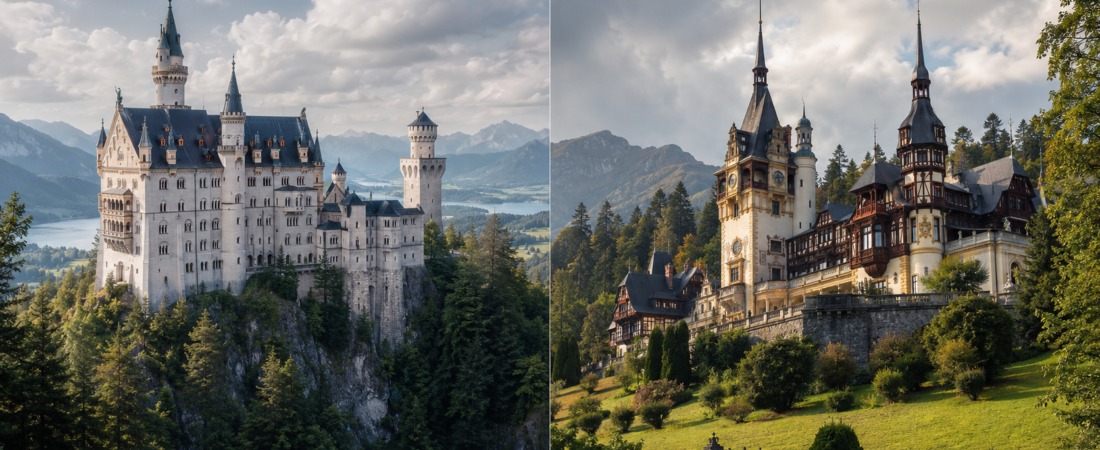
| Main visual logic | Exterior-first: towers, height, Marienbrücke viewpoints and the silhouette above the landscape carry much of the memory. [S1][S3] | Ensemble-first: façades, terraces, carved detail, gardens, forest and estate composition build the impression at close range. [S10][S11] |
| Historical role | Ludwig II’s private retreat, later opened to the public shortly after his death. The narrative is personal, theatrical and deliberately medievalising. [S1][S9] | Carol I’s royal summer residence and dynastic monument. The narrative is institutional, national and tied to Romania’s modern monarchy. [S10] |
| Interior rhythm | Short, timed, guided route. The rooms matter, but the exterior and viewpoint sequence dominate the traveller experience. [S3] | Broader palace experience with richer room variety, decorative craft, gardens and nearby Pelișor. [S10][S11] |
| Planning pressure | High demand, timed tickets, steep access, weather exposure and viewpoint crowding. Official sources report around 1.4 million annual visitors and up to 6,000 daily summer visitors. [S1][S3] | Easier town-based logistics, but still structured by timed entry, capacity limits, uphill access from Sinaia and historic-building restrictions. [S11] |
Location and geographic setting
Neuschwanstein is near Schwangau and Füssen in the Allgäu, with Hohenschwangau functioning as the practical arrival base. From the ticket centre, the final approach is either a 30-40 minute uphill walk of about 1.5 km, a horse-carriage option with additional walking, or a shuttle-supported approach that still requires descent on foot. [S2]
The geography creates a staged visit: village arrival, uphill movement, castle terraces, Pöllat gorge, Marienbrücke/Jugend lookout and views toward lakes and Alpine foothills. The castle is not merely located in a landscape; the landscape controls how the object is revealed. [S2][S9]
Peleș belongs to the Royal Domain of Sinaia. UNESCO describes the domain as a designed park with Peleș, Pelișor, Foișor and annexes, surrounded by secular forests and mountain cliffs. The visitor portal places access through Sinaia by road from Bucharest or Brașov, or by train followed by taxi or a 30-40 minute forest walk. [S10][S11]
Traveller fit: Neuschwanstein suits visitors who want ascent, separation, height and a dramatic reveal. Peleș suits visitors who prefer a resort-town base, forest access, gardens, nearby buildings and a visit that can expand into Sinaia.
Role and historical narrative
Neuschwanstein was one of Ludwig II’s private retreats. UNESCO describes the Ludwig palaces as residences created for seclusion, art, beauty and staged poetic worlds influenced by Wartburg, Versailles, German fairy tales and Wagner’s operas. [S9] The Bavarian Palace Department states that Neuschwanstein opened to the public seven weeks after Ludwig II’s death in 1886. [S1]
That reversal matters: a private refuge became a managed mass-visitor site. The traveller reads a personal fantasy through public systems: tickets, timed tours, controlled rooms, crowd flow and conservation rules.
Peleș has a different function. UNESCO describes it as the main royal residence of the Sinaia domain, a dynastic monument, the ‘cradle of the new monarchy’ and a symbol of Romania’s independence after the War of Independence. [S10] Its story is not only about Carol I’s taste. It is also about state identity, royal legitimacy and the creation of a European-style monarchy in the Carpathians.
Traveller fit: Neuschwanstein serves biography, Romantic self-invention and theatrical kingship. Peleș serves royal statecraft, modernization, dynasty and national memory.
Scale, layout and spatial hierarchy
Neuschwanstein is spatially simple for visitors. The official page says the castle can only be visited on a guided tour, the tour lasts about 30 minutes and the ticket is valid for a specific time. [S3] The public route is therefore compact: approach, exterior, courtyard and a concentrated interior sequence. The official tour language mentions 14 rooms, while the building-history material shows a hierarchy of gatehouse, lower courtyard, upper courtyard, Palas, tower, bower, kitchen and connecting structures. [S3][S7]
Peleș is broader as a domain. UNESCO describes three castles, economic and security annexes, hosting buildings, a designed park, gardens, walkways and planned viewpoints. [S10] Widely cited figures give approximately 3,200 square metres and more than 170 rooms. [S12]
The difference is spatial, not only stylistic. Neuschwanstein behaves like a vertical object with a short interior core. Peleș behaves like a royal estate: palace, terraces, gardens, Pelișor, forest, annexes and town all shape the visit.
For neurodivergent visitors, Neuschwanstein’s short timed route may be predictable, but high demand and punctual entry can add pressure. Peleș may offer a more distributed day outdoors, though interiors can still be dense and timed. No retrieved source listed dedicated quiet hours, sensory maps or low-stimulation tours for either site.
Architectural identity
Neuschwanstein is not a medieval survival. The Bavarian Palace Department describes it as a historicist work combining Wartburg references, medieval-book illustration motifs and modern building technology. [S7] The official interior page is explicit: the Middle Ages were an illusion. Behind the medieval image were hot-air heating, running water, automatic flushing toilets, telephones, lifts, steam-powered cranes, steel construction and large industrially advanced windows. [S6]
Peleș is also historicist, but its identity is plural rather than single-image. UNESCO describes German neo-renaissance, Fachwerk, Italian neo-renaissance, German, Italian and English neo-renaissance interiors, Louis XVI, Austrian neo-baroque, Art Nouveau and Mauresque elements, plus integrated lighting, heating, drainage and cleaning systems. [S10]
Both places are 19th-century reinventions. Neuschwanstein concentrates fantasy into a highly legible silhouette. Peleș distributes meaning through materials, rooms, craft and stylistic variation. Neuschwanstein is theatrical coherence; Peleș is curated density.
Viewpoints
At Neuschwanstein, viewpoints are part of the product. The shuttle bus stops above the castle, from where visitors walk about 500 metres downhill to the entrance, with gradients of 12-19 percent. [S2] UNESCO also frames the Ludwig palaces as carefully integrated into Alpine and foothill landscapes of high natural and aesthetic quality. [S9]
The result is an outward-facing visit. Many travellers experience Neuschwanstein most strongly from paths, bridge areas and surrounding slopes. The castle is consumed as an object in scenery before it is read as an interior.
Peleș works differently. UNESCO describes gardens, walkways and planned viewpoints running through secular forest toward an alpine meadow, while the visitor portal notes that Peleș and Pelișor are about 300 metres apart. [S10][S11] Its viewpoint logic is estate-facing: terraces, garden approaches, façades, forest paths and nearby royal buildings create a sequence of framed proximities.
Weather matters in both cases. Neuschwanstein’s official pages state that snow and ice can stop shuttle service and that Alpine climate affects conservation. Sinaia’s mountain setting can also bring winter snow, making footwear, timing and access choices practical parts of the visit. [S1][S2][S16]
Local economic impact and tourism ecosystem
Neuschwanstein is a high-volume destination node. The Bavarian Palace Department reports around 1.4 million visitors per year and up to 6,000 visitors per day in summer. [S1] The surrounding visitor economy is specialised: Hohenschwangau ticket centre, car parks, shuttle buses, horse carriages and Füssen as the train-arrival point. [S2][S3][S4]
Peleș has a more urban-development story. UNESCO states that the royal domain helped Sinaia grow from a small village into a modern town with villas, hotels, casino, park and a railway station connected to international luxury train routes. [S10] The visitor portal lists cafés and restaurants near the castle complex and states daily capacity of 2,000 visitors for Peleș and 1,500 for Pelișor. [S11]
The tourism difference is structural. Neuschwanstein concentrates demand around a globally recognized object and its access choreography. Peleș anchors a wider Sinaia day: palace, Pelișor, gardens, town, cafés, monastery/casino context and mountain-resort atmosphere.
Interior experience
Neuschwanstein’s interior is short but symbolically loaded. The official interior page says its picture cycles draw on medieval legends also used by Wagner, with figures such as Tannhäuser, Lohengrin and Parzival; the swan recurs as a leitmotif. [S6] The Throne Hall occupies the third and fourth floors and the west section of the Palas, but the planned throne was never built after Ludwig’s death. [S8]
The visit is therefore not a long palace immersion. It is a compressed reading of Ludwig’s imagined world: kingship, medieval legend, religion, technology and theatrical solitude.
Peleș offers a fuller interior sequence. UNESCO describes multiple room styles and integrated technical systems, while the visitor portal lists access to interiors, main exhibition rooms and gardens, with most visitors spending around 1.5-2 hours. [S10][S11] Peleș better serves travellers who want decorative craft, furniture, woodwork, glass, lighting and a stronger sense of royal domestic life.
Practical restrictions apply to both. Neuschwanstein does not allow bulky items such as rucksacks, prams and child carriers inside; Peleș rules restrict large bags, food, drinks and umbrellas. [S3][S11]
Visitor access, cost, safety and social openness
For 2026, Neuschwanstein lists regular admission at 21 euros, with children under 18 admitted free of charge, although they still need a free ticket and the online booking fee applies. Children under 14 may enter Bavarian Palace Department objects only with an adult supervisor. [S4]
The main access issue is terrain. Visitors face a steep 1.5 km uphill walk, carriage service that still leaves about 450 metres of walking, or shuttle service that stops above the castle and requires a downhill walk of about 500 metres at 12-19 percent gradient. Shuttles do not run when snow or ice affects roads. [S2]
For reduced mobility, Neuschwanstein provides documented procedures: advance reservation, a lift inside the castle and participation limits of one wheelchair or walker user per hour for fire and safety reasons. The same page says there is no guidance system for visually impaired visitors and no induction loop for hearing aids, though written information is available. [S5]
The Peleș visitor portal lists adult entry at 29 euros, senior/student at 20 euros, child 7-17 at 15 euros and children under 7 free. It also lists Wednesday-Sunday opening, timed entry, non-refundable scheduled tickets, restricted car access, train access via Sinaia and a 30-40 minute forest walk or taxi from the station. The portal warns that accessibility may be limited by the historic structure and that pets are not allowed except service animals. [S11]
For families, Neuschwanstein has a clearer under-18 price advantage but tougher terrain and stricter timing. Peleș has gardens and nearby Pelișor, but prices and rules should be checked before booking because the retrieved ticket portal states it is an independent concierge service. [S4][S11]
For gay travellers and women, no retrieved site-level rule treats access differently by sexuality or gender. The wider social context differs: Germany has stronger current public legal protections than Romania, while AP reported in June 2026 that Romania ranked last among EU countries in ILGA-Europe’s 2025 Rainbow Map. This affects destination context, not castle-entry policy. [S14][S15]
Heritage status, conservation and site management
Neuschwanstein is now part of the UNESCO World Heritage serial property ‘The Palaces of King Ludwig II of Bavaria,’ inscribed in 2025 under criterion iv. UNESCO states that the property is owned by the Free State of Bavaria and managed by the Bavarian Palace Department with conservation oversight and a management-plan framework. [S9]
The Bavarian Palace Department links high visitor numbers, Alpine climate and light exposure to stress on furniture and textiles. It also notes foundation monitoring, repeated securing of sheer rock walls and renovation needs for limestone façades. [S1]
Peleș is not a UNESCO World Heritage property. It is part of Romania’s Tentative List entry ‘Royal Residences of Sinaia.’ UNESCO states that the royal domain is listed as a historic monument of national and international interest and that the park and nearby secular forests have protected natural status. [S10] The same file states that after 1989, Peleș and Pelișor became state museums and preserve a relatively untouched historical image. [S10]
Neuschwanstein suits travellers interested in the pressure between private fantasy, mass tourism and fragile heritage. Peleș suits travellers interested in a preserved royal ensemble where buildings, movable heritage, gardens and town development operate as one cultural landscape.
Sensory atmosphere and traveller needs
Neuschwanstein’s atmosphere is built from altitude, steep movement, timed entry, crowd flow, Alpine weather and a short interior filled with murals, swan symbolism, kingship imagery and concealed modern technology. [S2][S3][S6][S8] It serves travellers who want an Alpine castle image, a strong exterior, high viewpoints and a concentrated Ludwig/Wagner narrative.
Peleș’s atmosphere is built from forest, gardens, terraces, room-to-room variation, carved interiors and the option to extend the visit into Pelișor and Sinaia. [S10][S11] It serves travellers who want a furnished royal residence, a longer interior visit, craft detail, estate grounds and Carpathian resort-town context.
For sensitive travellers, Neuschwanstein may feel more pressured because of visitor volume, punctual tour starts, shuttle queues and viewpoint crowding. Peleș may feel more distributed outdoors, but its interiors can still be ornate, busy and guided. Evidence for dedicated sensory-access accommodations remains weak for both.
Traveller-needs matrix
| Traveller need | Neuschwanstein serves it when… | Peleș serves it when… |
| Visual landmark | The priority is towers above forest, Alpine height, bridge viewpoints and a castle staged above the landscape. | The priority is façade, terraces, gardens, royal estate, forest and Sinaia forming one visual field. |
| Photography | The goal is wide exterior composition: silhouette, elevation, cliffs, lakes, forest and weather. | The goal is closer architectural and estate photography: carved façades, gardens, sculpture, terraces and detail. |
| Interiors | The visitor accepts a short symbolic route through Ludwig II’s constructed world. | The visitor wants decorative variety, royal rooms, craft, technology and a longer palace rhythm. |
| Families | The group can manage timed entry, steep access, crowds, stroller limits and a compact interior. | The group wants palace exterior, interiors, gardens, Pelișor nearby and a town-based day. |
| Reduced mobility | The visit is planned in advance around official procedures, outdoor terrain and strict capacity limits. | The visitor verifies current access carefully because historic-building constraints are explicit and detailed official evidence was weaker. |
| Public transport | The traveller accepts a multi-leg route: train to Füssen, local transfer, then uphill access. | The traveller wants a clearer rail-town-castle connection via Sinaia, then taxi or forest walk. |
| Crowd-sensitive visitors | The visit is booked early, off-peak and with tolerance for queues, punctual entry and narrow circulation. | The day is spread across grounds, gardens and Sinaia, with interior timing chosen carefully. |
| Heritage/history | The focus is Ludwig II, Romantic monarchy, historicist fantasy and the management of a mass-visited royal retreat. | The focus is Carol I, dynastic state-building, craftsmanship, technology, estate planning and national memory. |
Source note
- [S1] Bavarian Palace Department. Neuschwanstein Castle today.
- [S2] Bavarian Palace Department. Neuschwanstein Castle: visitor access and directions.
- [S3] Bavarian Palace Department. Neuschwanstein Castle: opening hours, admission and guided tours.
- [S4] Bavarian Palace Department. Neuschwanstein Castle: ticket prices and admission rules.
- [S5] Bavarian Palace Department. Neuschwanstein Castle: information for visitors with disabilities.
- [S6] Bavarian Palace Department. Neuschwanstein Castle: interiors and modern technology.
- [S7] Bavarian Palace Department. Neuschwanstein Castle: building history.
- [S8] Bavarian Palace Department. Neuschwanstein Castle: Throne Hall.
- [S9] UNESCO World Heritage Centre. The Palaces of King Ludwig II of Bavaria.
- [S10] UNESCO World Heritage Centre. Royal Residences of Sinaia.
- [S11] Peleș Castle visitor portal. Peleș Castle and Pelișor Castle: tickets, visiting rules and access information.
- [S12] Peleș Castle Museum / official visitor information. Peleș Castle: history, rooms and visitor information.
- [S13] Sinaia tourism information. Sinaia: geography, mountain setting and visitor context.
- [S14] Associated Press. Pride marches in Romania and Bulgaria; ILGA-Europe Rainbow Map context. June 2026.
- [S15] ILGA-Europe. Rainbow Map 2025: Germany and Romania country context.
- [S16] Romanian climate and tourism information. Sinaia mountain climate and seasonal conditions.