Snapshot
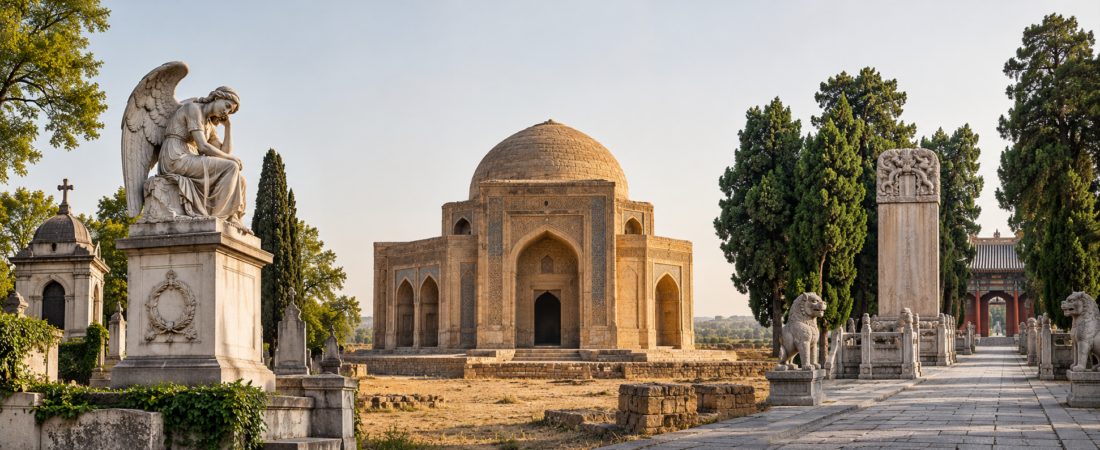
Père Lachaise occupies about 44 hectares within Paris. Makli spreads over roughly 10 square kilometres beside Thatta. The Cemetery of Confucius, known as Kong Lin, is a walled and wooded burial ground north of Qufu. Père Lachaise still accepts burials under Paris municipal rules. Makli grew over several centuries around rulers’ tombs and saints’ shrines. Kong Lin was the cemetery of Confucius and his descendants. These histories account for the different paths, monuments and present uses found at the three sites.
| Comparison point | Père Lachaise, Paris | Makli Necropolis, Thatta | Cemetery of Confucius, Qufu |
|---|---|---|---|
| Main period of development | Opened in 1804; enlarged five times between 1824 and 1850 | Most surviving monuments date from the fourteenth to the eighteenth centuries | Began with Confucius’s burial in 479 BCE and expanded through later Kong-family burials |
| Area | About 44 hectares | About 10 square kilometres | UNESCO gives 183 hectares |
| Layout | Dense graves and monuments along about 15 kilometres of curved and straight paths | Tombs, graves and shrines scattered in clusters across an open plateau | Burial mounds, stelae and ceremonial routes within a wooded enclosure |
| Who was buried there? | People eligible under Paris burial rules and holders of family concessions | Rulers, officials, saints, scholars, followers and many others | Confucius and members of the Kong lineage |
| Use today | Working cemetery, crematorium and heavily visited historic site | Protected necropolis with active shrines; current burial practice is poorly documented | Ancestral cemetery and visitor site; current burial rules are not publicly stated |
| UNESCO status | Not a World Heritage property | World Heritage property since 1981 | One part of Qufu’s three-part World Heritage property, inscribed in 1994 |
Where the cemeteries sit
Père Lachaise opened beyond built-up Paris in 1804, when burial grounds were being moved away from crowded churchyards. The city later grew around it. Today its walls meet the apartment streets of the 20th arrondissement, and several métro stations lie close to its gates. Entering the cemetery means leaving ordinary street life for a quieter interior, but the separation is narrow: traffic and housing remain just beyond the wall.
Makli occupies a plateau near Thatta and the Indus delta. UNESCO defines a property of about 10 square kilometres along a ridge roughly 6.5 kilometres long.[1] It is not enclosed and read as a single urban block. Groups of tombs and shrines stand apart from one another, with open ground between them. The distances matter. A visitor sees selected clusters rather than the whole necropolis in one continuous walk.
Kong Lin lies about 1.1 kilometres north of Qufu’s old city.[2] It is connected historically and ceremonially with the Temple of Confucius and the Kong Family Mansion in the city. The route north leads through gates into a wooded enclosure and towards Confucius’s grave. The cemetery is outside the old urban core, yet it belongs to the same group of family and ritual sites.
Père Lachaise can be crossed on foot from several city gates. Makli has to be visited in sections because of the distances between its monuments. Kong Lin leads visitors from Qufu towards Confucius’s grave along a ceremonial route.
Who was buried there?
Père Lachaise was established by the municipal authorities and opened on 21 May 1804. Alexandre-Théodore Brongniart prepared its early plan.[3] Few Parisians wanted burial in what was then a distant cemetery, so the authorities transferred prominent remains there and encouraged the construction of monuments. The cemetery gained prestige, but it remained part of the public burial system.
Burial at Père Lachaise is still regulated by the City of Paris. Eligibility may come from residence, death in Paris or an existing family grave, and new concessions depend on available space.[4] Famous graves draw attention, but most concessions belong to families outside guidebook history. The cemetery combines public administration with private decisions about monuments, inscriptions and family memory.
Makli did not begin with one municipal decision or one master plan. Its principal monuments accumulated between the fourteenth and eighteenth centuries, when Thatta served successive Samma, Arghun, Tarkhan and Mughal rulers. UNESCO lists rulers, queens, governors, saints, scholars and philosophers among the people buried there.[1] Monumental tombs stand among large fields of simpler graves, many of them unnamed in general accounts of the site.
Kong Lin began with the grave of Confucius, traditionally dated to 479 BCE. Later generations of the Kong family were buried around him. UNESCO reports more than 100,000 graves of descendants.[2] Family descent set the limit of admission, while the placement and form of graves marked rank and generation. The cemetery served one lineage rather than the general population of Qufu.
The difference was institutional: municipal eligibility in Paris, status and affiliation at Makli, and ancestry at Qufu.
Paths, monuments and vegetation
Père Lachaise packs about 70,000 graves into roughly 44 hectares. Its oldest sections use sloping ground, curved paths, trees and views across the cemetery. Later additions are straighter and more tightly divided. About 15 kilometres of paths pass family chapels, headstones, sculpture, retaining walls and collective memorials.[5] Some stretches resemble a park; others are dense rows of stone with little open ground.
Makli is far larger and much less regular. UNESCO estimates that the site contains about half a million tombs and graves, a rounded figure that conveys scale rather than an exact count.[1] Stone canopies, carved graves, brick mausoleums, domes and glazed tiles appear in separate groups. The buildings draw on local, Indic and Islamic forms, often within the same monument.[6] Their exposed position also leaves stone, brick and tile open to rain, wind, salts and large changes in temperature.
Kong Lin is composed mainly of earthen burial mounds, stone tablets, inscribed markers, gates and mature trees. The graves do not form the close architectural rows found in Paris, and monumental buildings do not dominate the ground as they do at Makli. Their placement records family relationships. Research on the cemetery links this order to zhao mu, a principle used to arrange generations within ancestral space.[7]
Trees change the experience of both Père Lachaise and Kong Lin, though for different reasons. Paris records more than 4,000 trees and over 220 wild plant species at Père Lachaise; pesticide use ended in 2015.[8] The trees provide shade, habitat and much of the cemetery’s park-like character. At Kong Lin, woodland surrounds graves tied to the long history of one family. Makli is more exposed, with long views across open ground and between isolated monuments.
Burial, worship and commemoration today
Père Lachaise remains a working cemetery. The City of Paris reports nearly 10,000 funeral ceremonies and almost three million visitors each year.[9] Funeral parties, relatives tending graves, maintenance workers and tourists use the same paths. The large visitor numbers have not replaced the cemetery’s original purpose.
The crematorium and columbarium add forms of burial that were not part of the 1804 cemetery. France’s first cremation took place there in 1889. The columbarium now contains about 26,000 niches, and ashes may also be scattered in the garden of remembrance.[10] These facilities are still in use.
At Makli, worship continues around saints’ graves. A UNESCO-linked management report described the necropolis as a place of veneration, gathering and recreation, and a 2018 conservation report counted more than twenty active shrines.[11][12] Pilgrims and local visitors keep parts of the site in religious use. Reliable public records do not show how many new burials take place across the property, so Makli cannot be described with the same administrative detail as Père Lachaise.
Kong Lin remains a focus of ancestral and Confucian commemoration. Confucius’s grave and the surrounding graves of descendants are maintained as part of the Qufu heritage property. Current public documentation establishes commemorative use but does not confirm routine new burials.
Visiting the sites
Père Lachaise is free to enter and has several public gates. Maps identify divisions, roads and well-known graves.[9] The paths are not uniformly accessible. Old paving, steep slopes, earth tracks and narrow passages can impede wheelchairs and people with limited mobility; the Amandiers and Réunion entrances have stairs.[13] Tourists may move freely through much of the cemetery, but funerals and private visits continue around them.
At Makli, the distances determine the visit. Roads and paths give access to prominent monuments and shrines, while much of the property remains open, uneven and exposed. Moving between clusters reveals its size, but it also makes comprehensive interpretation, maintenance and supervision difficult. The best-known buildings can easily stand in for the whole site even though large areas contain less monumental graves.
Kong Lin is visited as one part of the Qufu group, together with the temple and family mansion. Gates and principal paths lead towards Confucius’s grave and important family monuments. Many smaller graves lie outside this main sequence. Published visitor totals cover the complete Qufu property, so they cannot be used as a count for the cemetery alone.
A visitor can roam a dense network in Paris, travel between distant clusters at Makli or follow a ceremonial approach towards Confucius’s grave in Qufu.
Protection and conservation
Père Lachaise is not a UNESCO World Heritage property. It is owned and managed by the City of Paris as an operating cemetery, with additional protection for many monuments. The city lists roughly 30,000 funerary monuments on its historic inventory and thirteen as classified historic monuments. The crematorium and columbarium were registered in 1995.[14]
Maintenance includes trees, paths, working burial facilities and monuments whose concessions may have lapsed. Under a recent city scheme, successful applicants restore selected abandoned monuments before receiving the associated burial concessions.[15] This arrangement keeps the monument in place while allowing the grave plot to return to use.
Makli has been a UNESCO World Heritage property since 1981, listed under criterion (iii).[1] Its size and exposed materials make conservation difficult. UNESCO reports damage from earthquakes, heavy rain, temperature changes, salt-bearing winds, vegetation, encroachment, vandalism and theft. The 2022 monsoon left several structures in urgent need of stabilisation, including the tomb of Shaikh Jiyo and nearby Samma tombs.[16]
The Cemetery of Confucius is not listed separately. It is one component of The Temple and Cemetery of Confucius and the Kong Family Mansion in Qufu, inscribed by UNESCO in 1994 under criteria (i), (iv) and (vi).[2] The cemetery also has national protection in China, and the Qufu Cultural Heritage Management Committee manages the larger property. UNESCO gives its area as 183 hectares, although the 2023 periodic report calls for better digital mapping.[17]
Paris deals with ageing family monuments, heavy footfall, vegetation and daily funerary services. Makli faces structural failure and surface loss across a very large open site. Qufu must protect graves, inscriptions, paths and old trees without erasing the family order recorded in their positions.
Public and cultural meaning
At Père Lachaise, personal graves have entered public history. Visitors seek writers, musicians, artists and political figures; the Communards’ Wall and war memorials draw collective remembrance. These well-known sites sit among family graves that receive no tourist attention. Public fame and private mourning occupy the same cemetery.
Makli records the history of Sindh through buildings as well as names. Dynastic tombs show political power and patronage. Saints’ graves draw worshippers. Carving, inscriptions and tilework show the work of local craftspeople and contacts with other architectural traditions. Its historical value extends beyond the rulers represented by the largest monuments.
Kong Lin gives physical form to descent from Confucius. His grave is the focal point, but the many generations buried around it make the cemetery a family record written across the ground. Confucius’s later place in education, public ritual and political thought gave that family cemetery significance far beyond Qufu.
Conclusion
The right to burial—municipal in Paris, linked to status and devotion at Makli, inherited by descent at Qufu—produced the patterns still visible on the ground. Père Lachaise’s paths still carry funeral parties, Makli’s shrines remain in religious use, and Kong Lin preserves the burial order of the Kong family.