Snapshot
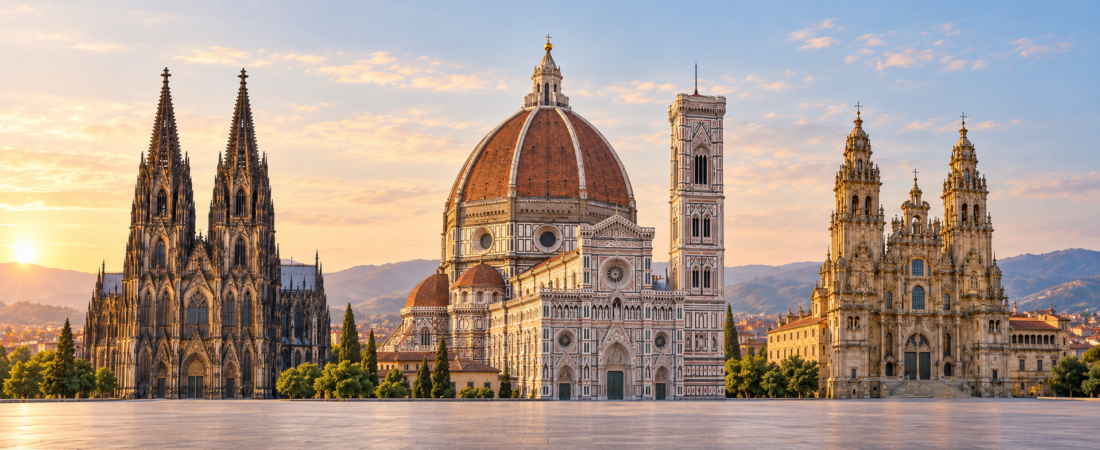
All three are active Roman Catholic cathedrals, urban landmarks and major visitor destinations. Their identities rest on different foundations. Florence is inseparable from Brunelleschi’s dome and the wider cathedral complex. Cologne combines Gothic scale with the Shrine of the Three Kings and a position beside one of Germany’s busiest railway stations. Santiago is the destination of the Camino, where pilgrimage routes, city streets and worship converge at the cathedral.
| Feature | Santa Maria del Fiore | Cologne Cathedral | Santiago Cathedral |
|---|---|---|---|
| Sacred identity | Cathedral of Florence; Marian dedication; relics of St Zenobius | Cathedral of the Archdiocese of Cologne; Shrine of the Three Kings | Cathedral and archiepiscopal seat; tomb and relics venerated as those of St James |
| Architectural identity | Florentine Gothic basilica with Brunelleschi’s Renaissance dome and a nineteenth century facade | High Gothic cathedral begun in 1248 and completed in the nineteenth century | Romanesque pilgrimage church with later Gothic Renaissance and Baroque work |
| Urban position | Dense historic centre within the cathedral baptistery and campanile ensemble | Domplatte beside Cologne Central Station and close to the Rhine | Old town cathedral surrounded by Obradoiro Praterias Quintana and Acibecheria squares |
| Main spatial experience | Contrast between the patterned marble exterior restrained interior and dome route | Immediate encounter with a 43 metre nave followed by a long route toward the choir and shrine | Processional movement through nave transept ambulatory tomb and separate cultural routes |
| Principal vertical visit | Dome 463 steps; campanile 414 steps | South tower 533 steps | Ticketed roofs and Ratchet Tower route |
| Main church access | Free cathedral entry during visitor hours; other monuments ticketed | Sightseeing costs EUR 12; prayer and worship remain free | Basilica and tomb free; museum Portico and roof routes ticketed |
| Heritage status | Part of the UNESCO Historic Centre of Florence | The cathedral itself is a UNESCO World Heritage property | Principal monument within the UNESCO Old Town of Santiago de Compostela |
Religious Identity and Sacred Life
Santa Maria del Fiore remains the liturgical centre of Florence. Tourist visits stop on Sundays and during religious celebrations, giving worship clear priority in the timetable. The body of St Zenobius, an early bishop and patron of the archdiocese, is kept in a reliquary designed by Ghiberti. Santa Reparata beneath the cathedral preserves the earlier sacred site. Florence’s religious identity is spread across the cathedral, baptistery, campanile, crypt and museum rather than concentrated around one international pilgrimage cult. [1][5]
Cologne’s devotional centre is the Shrine of the Three Kings behind the high altar. Rainald von Dassel brought the remains claimed as those of the Magi from Milan in 1164, and the cult helped establish Cologne as a medieval pilgrimage centre. The transfer and subsequent veneration are historical facts; the identity of the bones remains a matter of faith. The annual Three Kings pilgrimage, feast days and published bell schedule keep that tradition active. The cathedral also distinguishes between sightseeing and religious use: ordinary visitors pay, while entry for prayer and worship remains free. [7][9][11][12]
Pilgrimage shapes Santiago more completely. The cathedral chapter guards the relics venerated as those of St James and welcomes pilgrims at the end of the Camino. Four Pilgrim Masses are scheduled daily, alongside Eucharistic adoration and the rosary. The Botafumeiro is a liturgical censer used on specified solemnities, including St James’s Day and Christmas; it does not swing at every Pilgrim Mass. Holy Years occur when 25 July falls on a Sunday, with the next in 2027. [14][15]
Historical Development and Conservation
Florence began the present cathedral in 1296 under Arnolfo di Cambio. Francesco Talenti enlarged it in the fourteenth century, and Brunelleschi built the dome between 1420 and 1436. The current polychrome facade is a nineteenth century design by Emilio De Fabris, replacing an unfinished earlier front. Conservation continues across the complex: the campanile and baptistery mosaics are undergoing major work, affecting views and access even while parts remain open. UNESCO lists tourism pressure, air pollution, residential decline and flood risk across the Historic Centre of Florence; these are citywide concerns rather than a diagnosis of the cathedral fabric. [1][2][3][4][6]
Cologne began its Gothic cathedral in 1248 after earlier churches had occupied the site. The choir was consecrated in 1322, but construction stopped around 1520 and remained dormant for more than three centuries. Work resumed in the nineteenth century using the surviving medieval facade design, and the cathedral reached its completed form in 1880. Fourteen high explosive bombs and more than seventy incendiaries struck it during the Second World War. Repairs restored the choir and transept by 1948 and the nave by 1956. The permanent Dombauhutte now addresses stone weathering, stained glass and continuing repair. Cologne entered UNESCO’s danger list from 2004 to 2006 because planned high rises threatened its setting, then left the list after planning controls changed. [9][10]
Santiago’s Romanesque cathedral grew from the shrine established around the claimed apostolic tomb. The main building campaign ran from the late eleventh to early thirteenth century, with Master Mateo’s Portico de la Gloria completing the western end. Later chapels, towers and facades accumulated around that Romanesque structure; the Baroque Obradoiro facade now stands in front of the medieval portico. Recent conservation has covered roofs, facades, vaults, the ambulatory, cloister and paintings. Repairs to the Botafumeiro mechanism followed the discovery of cracks and corrosion after a component detached in 2024. UNESCO also records overcrowding and changes to traditional commerce in the surrounding old town. [13][15][16]
Urban Setting and Relationship to the City
Florence’s cathedral complex occupies a tight network of streets at the centre of the historic city. Close approaches reveal fragments of marble wall, baptistery or campanile before the spaces of Piazza del Duomo and Piazza San Giovanni open around them. The dome works at another scale: it rises over the low city and remains visible far beyond the square. Ticket offices, guides, restaurants and retail share the immediate streets with residents and worshippers, placing the complex at the centre of Florence’s pressure from mass tourism. [2][6]
Cologne offers the most abrupt arrival. The cathedral stands beside Cologne Central Station, so rail passengers can meet its twin towers almost immediately and at close range. The Domplatte gathers commuters, tourists, pilgrims and local foot traffic on a large postwar platform. UNESCO notes that much of the cathedral’s earlier urban setting has been lost; nineteenth and twentieth century infrastructure now frames the building. This transport connection makes the cathedral exceptionally accessible while exposing its threshold to continuous metropolitan movement. [10][12]
Santiago has the strongest relationship with routes of arrival. Camino streets converge on the cathedral, and many pilgrims finish in Praza do Obradoiro before its Baroque west front. Ordinary basilica entry is now on the south side at Praterías, requiring visitors to continue around the building after the symbolic arrival. Obradoiro, Praterías, Quintana and Acibechería give each side a different urban role and architectural view. Pilgrim accommodation, luggage services, food businesses and religious administration extend the cathedral’s influence through the old town. [13][15]
Architecture Spatial Organisation and Defining Features
Santa Maria del Fiore is about 153 metres long, with three naves leading to an octagonal crossing and three large apses. White, green and red marble revetment gives the exterior a strongly patterned surface. Inside, broad Gothic bays lead toward the painted dome, where Vasari and Zuccari’s Last Judgment fills the inner shell. Brunelleschi’s double shell changes both the skyline and the internal plan: the crossing expands beneath it while stair passages occupy the space between the shells. [1][2]
Cologne is the most vertical interior. Its five aisles, high choir, triforium, clerestory and flying buttresses follow thirteenth century French Gothic models. The nave rises about 43 metres, while the twin west towers reach slightly more than 157 metres. The medieval choir retains important furnishings, stained glass, pillar figures and the high altar. The Shrine of the Three Kings and the earlier Gero Crucifix anchor the east end, preventing the interior from reading as a nineteenth century reconstruction despite the late completion of the towers and nave. [9][10][11]
Santiago uses a Romanesque pilgrimage plan: an aisled nave, broad transept, galleries, ambulatory and radiating chapels support movement around the sanctuary. Its 22 metre nave is lower and heavier than Cologne’s, with barrel vaults and substantial piers directing attention along the processional route. The Apostle’s tomb lies below the high altar. The Portico de la Gloria survives behind the Baroque west facade, so the interior structure and the urban exterior belong to different periods. [13][15]
Visitor Journey and Spatial Experience
Florence functions as a group of separate visits. The cathedral floor is free, while Santa Reparata, the baptistery, museum, campanile and dome follow different routes and ticket rules. The dome ascent passes close to the Last Judgment before entering narrow passages between the structural shells and emerging near the lantern. Giotto’s campanile provides a separate climb and a lateral view of the dome. Visitors therefore move repeatedly between interiors, queues and the surrounding squares rather than following one continuous route. [2][3][4]
Cologne’s main church is more continuous. Entry opens directly into the long Gothic nave, where the height is immediately visible and the route proceeds east toward the choir, ambulatory and shrine. The south tower is a separate visit reached from the Roncalliplatz side. Its spiral and upper metal stairs end at a platform around 97 metres above ground. The step free cathedral floor and the strenuous tower route serve very different visitors. [8][10][11]
In Santiago, the journey begins outside the building for anyone arriving by Camino. Inside, the nave, transept and ambulatory preserve the movement pattern of a pilgrimage church, while the tomb beneath the sanctuary remains an active devotional destination. The museum, cloister, treasury, Xelmírez Palace, Pórtico de la Gloria and roof route are separately controlled visits. A free basilica visit can therefore be brief, while the full cultural circuit requires several bookings and movements around the cathedral. [13][17]
Atmosphere Crowds and Tourism Pressure
Florence’s exterior is more visually intense than its broad, comparatively restrained interior. Crowding spreads across the whole complex because cathedral queues, dome appointments, the campanile, baptistery and museum share the same limited public space. The cathedral’s shorter tourist window concentrates demand, but no official hourly count supports claims about a reliably quiet time. [1][6]
Cologne moves from station and plaza noise into a tall interior shaped by stained glass, bells, organ music and liturgy. The cathedral reports about six million visitors in a typical year, although that figure should not be treated as an audited 2026 total. The sightseeing charge introduced in July 2026 appears to have reduced crowding according to former cathedral master builder Barbara Schock-Werner, but this remains an informed observation rather than a measured result. [11][12]
Santiago mixes pilgrims, worshippers and tourists more thoroughly than the other two. Pilgrim Masses, visits to the tomb and museum traffic overlap with daily Camino arrivals. When the 53 kilogram Botafumeiro operates, incense and its sweep across the transept become part of the liturgy and the sensory experience. UNESCO identifies overcrowding around the cathedral as a management problem, giving firmer support to the pressure claim than visitor impressions alone. [14][15]
Access Accessibility and Visitor Rules
Florence allows free entry to the cathedral from Monday to Saturday, currently 10:15 to 15:45, while tourist visits stop on Sundays and during religious celebrations. The Brunelleschi Pass costs EUR 30 and includes a timed dome reservation. The dome has 463 steps and the campanile 414; neither has a lift. A mobility entrance at Porta dei Canonici gives step free access to the principal cathedral floor. Dress rules cover shoulders and legs, and larger bags must be left at official storage before paid monument visits. [1][2][3][4]
Cologne is generally open from 06:00 to 20:00. Since 1 July 2026, ordinary sightseeing costs EUR 12, while prayer and services remain free. The south tower costs EUR 8 and has 533 steps with no lift. The cathedral floor and treasury provide step free access, staff assistance, a wheelchair area, tactile resources and hearing loops. Published rules also specify dress, bag dimensions, security checks and limits on photography during services. [7][8][12]
Santiago’s basilica and tomb are open daily from 07:00 to 21:00 and remain free. The museum, Portico, palace and roofs require separate tickets, with timed arrival for some routes. Backpacks are prohibited in the basilica; paid routes reject bags over 40 by 40 centimetres. Official English pages do not provide a detailed route by route mobility guide, so the accessibility of specialist visits should be confirmed directly. [13][17]
Safety Environmental Conditions and Visitor Comfort
Florence’s main physical risks arise on the vertical routes. The dome combines confined passages, height and sustained climbing; official guidance discourages the ascent for people with vertigo, claustrophobia or certain heart conditions. The campanile requires similar exertion. These constraints apply to the climbs, not to the accessible cathedral floor. [2][4]
Cologne is neither heated in winter nor cooled in summer, and its interior can become very cold after prolonged winter weather. The tower adds a confined spiral stair, metal upper stairs and height exposure. Santiago’s roof route is more exposed to rain and wind, which can make exterior stone uncomfortable underfoot. The available sources do not provide comparable accident data for the three sites, so they support practical cautions rather than a safety ranking. [8][11][13][17]
No comparable cathedral level data support a ranking for theft, harassment or solo travel. The surrounding national legal context is clearer for LGBT visitors. ILGA Europe’s 2026 legal and policy index scores Spain at 89 percent, Germany at about 70 percent and Italy at about 24 percent. These figures describe national protections, not personal treatment in cathedral precincts or Catholic teaching. None of the published visitor rules reviewed imposes a restriction based on sexual orientation. [18]
Conclusion
Florence is experienced as an architectural ensemble. The dome, marble exterior, baptistery, campanile and separate visitor routes spread the visit across a tightly packed part of the historic centre. It offers the clearest encounter with construction and engineering because the dome route passes through the structure itself.
Cologne gives the strongest sense of vertical scale and the most direct connection to metropolitan transport. Its medieval choir, relic shrine, nineteenth century completion and postwar repair remain visible within one building. The new admission system creates a sharper division between sightseeing and prayer than at Florence or Santiago.
Santiago joins cathedral and journey most completely. The Camino, Obradoiro arrival, pilgrimage plan, tomb and daily worship make movement toward and through the building part of the same religious system. Its principal limitation is practical: the free basilica, museum, Portico and roof visits operate as separate circuits, and published accessibility information is incomplete.
Sources
1. Opera di Santa Maria del Fiore. Cathedral and Santa Maria del Fiore visitor information.
2. Opera di Santa Maria del Fiore. Brunelleschi Dome.
3. Opera di Santa Maria del Fiore. Tickets Access the Monuments and Brunelleschi Pass.
4. Opera di Santa Maria del Fiore. Giotto Pass and Giottos Bell Tower.
5. Opera di Santa Maria del Fiore digital catalogue. Relics of St Zenobius.
6. UNESCO World Heritage Centre. Historic Centre of Florence.
7. Hohe Domkirche Koln. Opening hours visitor information and sightseeing tickets.
8. Hohe Domkirche Koln. Tower accessibility house rules security and photography information.
9. Hohe Domkirche Koln. Geschichte.
10. UNESCO World Heritage Centre. Cologne Cathedral.
11. Hohe Domkirche Koln. The cathedral in figures bells and temperature guidance.
12. Associated Press Anadolu Agency The Guardian and Welt. Reporting on Cologne admission charges and the 2026 Three Kings pilgrimage.
13. Catedral de Santiago de Compostela. Visits and cathedral information.
14. Catedral de Santiago de Compostela. Liturgy masses confessions and Botafumeiro.
15. UNESCO World Heritage Centre. Old Town of Santiago de Compostela.
16. Catedral de Santiago restoration records and El País reporting on the Botafumeiro mechanism.
17. Catedral de Santiago de Compostela. Booking culture ticket and permit pages.
18. ILGA Europe. Rainbow Map 2026.