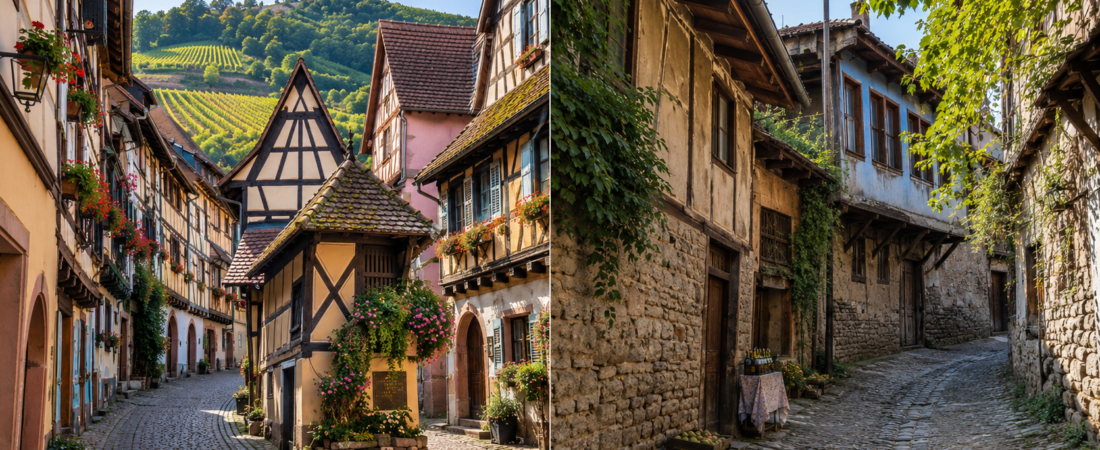
Eguisheim and Cumalıkızık are easy to flatten into postcard formulas: Alsatian timber and flowers on one side, Ottoman houses and stone lanes on the other. Eguisheim works as a disciplined wine village whose circular centre, maintained facades and vineyard edge make the visit immediately legible. Cumalıkızık works through a tighter relation between house, slope, street and Bursa’s early Ottoman hinterland. One place offers polish and orientation; the other offers friction, closeness and a stronger domestic-historical texture.
Eguisheim appears in recorded history around 720, when settlement developed around the first castle; its mean elevation is about 282 m across the commune, which helps explain the gentle wine-road setting. Cumalıkızık belongs to Bursa’s early Ottoman formation in the fourteenth century, when rural waqf villages helped sustain the first capital; at about 337 m on the lower Uludağ slope.
Location and geographic setting
Eguisheim sits in Haut-Rhin (France), south-west of Colmar, where the Alsace wine road meets the lower Vosges. Its geography is open, readable and already prepared for visitors: road access, cellar visits, signposted villages, walking circuits and a quick transition from compact houses to vines. The village belongs to a chain of wine settlements, so the traveller rarely experiences it as an isolated place. It feels like one polished node in a larger Alsatian route.
Cumalıkızık stands east of Bursa (Turkiye) on the lower slopes of Uludağ. The mountain explains the gradient, the older agricultural relation with Bursa and the feeling of a settlement held between city and hillside. The village makes less sense as a detached attraction. Its depth comes from Bursa, the rural support system behind the early Ottoman capital, and the slope that compresses movement into narrow lanes.
Scale, population and resident structure
Eguisheim has the scale of a small French commune with a preserved centre and an inhabited edge. The 2022 population figure used in the source file is 1,735 residents, with a visibly older profile and a local economy tied to wine, hospitality and maintenance. The traveller feels scale through buffers: parking edges, restaurants, cellars and public routes absorb visitors before they press too strongly against private life.
Cumalıkızık is smaller and more exposed. The accessible 2022 neighbourhood figure used in the source file is 707 residents. Its old fabric leaves less distance between visitor movement and domestic thresholds. Lanes, courtyards, shopfronts and house fronts sit close together.
Layout and spatial hierarchy
The historic core of Eguisheim turns around the castle and church area, with concentric lanes creating the village’s circular form. The walk has a built-in rhythm: curve, facade, small opening, return. A visitor can understand the plan without a guide, and that clarity is one reason the place performs so well as a short excursion from Colmar.
Cumalıkızık has a different order. Its hierarchy comes from slope, drainage, mosque area, house fronts, small commercial openings and upper floors leaning over the street. The village is not read in a clean circle. It is read through incline, compression and thresholds. The route feels less staged, but also less forgiving. Orientation depends on the body and on attention to the lane structure.
Walkability and street experience
Eguisheim is the easier walk. Distances are short, the centre is compact, and visitor movement is slow. Cobblestones can be uncomfortable, especially in rain or with poor shoes, but the basic visit remains physically straightforward for most travellers. The main weakness is crowding. In peak moments, narrow sections can feel decorative rather than lived, because many visitors stop at the same corners for the same photograph.
Cumalıkızık asks more from the body. Uneven stones, drainage lines, slope and tight passages give the lanes a physical presence that stays in memory. That texture is part of the value, but it reduces comfort. Travellers with limited mobility, pushchairs, unstable footwear or low tolerance for crowded irregular streets will find it harder. A weekday morning is the better version of the visit.
Vernacular architecture and materials
Eguisheim presents Alsatian material language with unusual concentration: half-timbering, coloured plaster, steep roofs, narrow lanes, signs, shutters, winegrower houses and flowered windows. The ensemble is coherent and carefully maintained. Its strength is continuity of form. Its risk is excessive tidiness. When every surface is ready for photography, the village can begin to resemble an approved image of itself.
Cumalıkızık has a rougher architectural register. The old houses combine local stone at ground level with timber above, roof variation, courtyards, overhanging floors and domestic thresholds that still matter. Repairs, weathering and commercial insertions sit beside older fabric. The result is less polished and more vulnerable. Its value comes from the visible relation between material, household life and rural Ottoman inheritance.
Historical function and regional role
Eguisheim’s historical weight is local and Alsatian. Its story is tied to fortified village form, the Counts of Eguisheim, Pope Leo IX, church and castle memory, and the persistence of viticulture in the foothills. The traveller reads history in a compact circuit: the central religious and castle area, the defensive logic of the streets, and the wine landscape pressed close to the houses.
Cumalıkızık carries a heavier regional function. It is part of the UNESCO property Bursa and Cumalıkızık: the Birth of the Ottoman Empire, where urban and rural components show the making of the first Ottoman capital. Cumalıkızık matters because it is the rural village component. Ignoring Bursa weakens the visit. The houses and lanes are evidence of a support structure, not simply a picturesque settlement. For a traveller, this means the village should be approached through Bursa first, then through the lanes, because the settlement’s value lies in its supporting role as much as in individual houses and in the agricultural slope itself.
Heritage protection and authenticity
Eguisheim is protected and promoted through French heritage culture, municipal upkeep, wine-route visibility and the Les Plus Beaux Villages de France label. Authenticity here depends on continuity of form, disciplined maintenance and a recognisable Alsatian building language. The result is clean, coherent and easy to interpret.
Cumalıkızık has the heavier formal designation. Since 2014 it has belonged to a UNESCO World Heritage property. UNESCO’s language is precise: the village retains rural character and a high degree of authenticity, but resident presence and commercial pressure remain management concerns. Authenticity therefore cannot be reduced to old walls and roofs. It also depends on whether inhabitants can continue to live inside the heritage.
Viewpoints and photographic logic
Eguisheim photographs through curvature and closure. Lanes bend, facades lean into the frame, windows and signs add detail, and the castle-chapel area gives an easy landmark. The village is forgiving to casual photography because public surfaces are already arranged for looking. The edge of the village adds vineyard context and releases the eye from the tight centre.
Cumalıkızık photographs through compression. The strongest frames are often narrow lanes, stone channels, patched walls, wooden upper floors, doorways, rooflines, slopes and small pockets of shadow. Closeness carries the image more than panorama. The best photographs are not only colourful house views.
Local economic impact and tourism ecosystem
Eguisheim sits inside a developed Alsace Wine Route economy. The visit is supported by wine producers, restaurants, hotels, guest accommodation, tastings, walking routes, events and Colmar-based day trips. Accommodation is part of the village offer, not only a nearby-city option: hotels and guest stays are available in and around Eguisheim, including in the historic centre. Tourism helps maintain the polished public face of the village, but it also places Eguisheim inside a repeated Alsatian visitor image: half-timbered houses, flowered lanes, vineyards, wine tastings and Christmas atmosphere.
Cumalıkızık depends more directly on Bursa, about 10–12 kilometres away. It is better read as a short heritage excursion from the city than as a hotel-based village stay. Its economy comes mainly from day visitors, breakfast venues, small shops, souvenirs and photography around the old Ottoman houses. The pressure is not simply that tourists come. The stronger issue is that UNESCO specifically links Cumalıkızık’s integrity to keeping local inhabitants in place and avoiding intense commercialisation.
Visitor access, cost, safety and social openness
Eguisheim is practical for travellers already in Alsace. It is close to Colmar, reachable by road, and the old centre functions as an open village environment. Spending is optional but likely if the visit includes parking, food, wine tasting or seasonal events. The main constraint is not social difficulty; it is crowd management, old paving and bottlenecks in a compact historic core.
Cumalıkızık is also an open village environment, best treated as a half-day visit from Bursa with current transport and parking details checked close to travel. Access difficulty comes from weekend demand, uneven ground, narrow streets and the need to keep private space private. Evidence is too thin for strong crime comparisons, so the correct guidance is practical: good shoes, normal care with belongings, daylight timing and respect for thresholds.
Natural hazards, climate and environmental risk
Eguisheim’s travel risks are modest. Summer heat can sit in stone lanes, rain makes cobbles slick, and winter cold or Christmas-season crowds change the mood of the visit. The environmental experience is shaped by the Rhine plain, the lower Vosges and vineyard agriculture. For the visitor, season affects comfort more than safety.
Cumalıkızık belongs to the Bursa and Uludağ setting, so heat, winter dampness, slope and seismic history matter more in the long-term reading of the place. UNESCO notes damage to Bursa’s historic components from the 1855 earthquake. For travellers, the practical implications are ordinary: footwear, hydration, weather awareness and patience. For conservation, the implications are larger because old fabric sits under both physical and tourism pressure.
Noise and sensory atmosphere
Eguisheim is strongest when it is quiet. Its soundscape is modest: footsteps on stone, restaurant voices, cellar doors, bells, occasional service vehicles and the open edge of vineyards. At peak times, the same streets can become acoustically flat, with many visitors stopping at identical corners. The village then loses depth and becomes a sequence of attractive pauses.
Cumalıkızık has a denser sensory field. Voices carry in narrow lanes; vendors, breakfast rooms, animals and visitors overlap; stone and timber hold sound differently from plastered Alsatian streets. It can feel more alive than Eguisheim, but also more tiring. The emotional payoff is stronger when the visitor accepts friction rather than expecting a smooth heritage set.
Traveller types and visit suitability
Eguisheim suits first-time Alsace visitors, wine-route travellers, photographers, couples, older travellers who can manage cobbles, and people who want a compact visit without much preparation. It is also the easier option for neurodivergent visitors outside peak hours because the circular layout is simple and the visitor economy is predictable. Its weakness is overexposure: at busy times, the village can feel too arranged.
Cumalıkızık suits travellers interested in Ottoman houses, inhabited heritage, Bursa history, street texture and domestic architecture. It is less comfortable for those who need smooth surfaces, wide pedestrian space, low noise or clear separation between public and private areas. Gay travellers can visit, but discretion is safer in conservative settings; women travellers should favour daylight, reliable transport and modest behaviour near domestic or religious spaces.
Conclusion
Eguisheim is the cleaner and more immediately readable traveller place. It is tied to an active Alsace wine landscape, with vineyards, cellars, restaurants and services close to the historic core. The circular street plan, half-timbered houses, Saint-Leon cluster, fountains and church make the visit easy to understand without much preparation. Its beauty is controlled, accessible and sometimes too familiar.
Cumalıkızık is less smooth but historically denser. Its main value is the Ottoman rural house and street: stone lower level, timber upper structure, projecting floor, courtyard, narrow lane and the threshold between public movement and private family space. Its link to Bursa and Uludağ gives it wider meaning, while its present-day pressure makes the visit more delicate. Eguisheim gives the clearer wine-village experience. Cumalıkızık gives the stronger house-and-street reading of Ottoman rural heritage.
Sources
– INSEE – Dossier complet, Commune d’Eguisheim (68078), published 5 May 2026 – https://www.insee.fr/fr/statistiques/2011101?geo=COM-68078
– Les Plus Beaux Villages de France – Eguisheim, Haut-Rhin – https://www.les-plus-beaux-villages-de-france.org/fr/nos-villages/eguisheim/
– Visit Alsace / local tourism pages for Eguisheim and the Eguisheim wine trail – https://www.visit.alsace/
– Office de Tourisme du Pays d’Eguisheim et de Rouffach – https://www.tourisme-eguisheim-rouffach.com/
– UNESCO World Heritage Centre – Bursa and Cumalıkızık: the Birth of the Ottoman Empire – https://whc.unesco.org/en/list/1452/
– UNESCO World Heritage Centre – documents for property 1452 – https://whc.unesco.org/en/list/1452/documents/
– Bursa local tourism / GoToBursa pages on Cumalıkızık, where accessible – https://www.gotobursa.com.tr/
– Turkish address-based population source as reflected in public settlement listings for Cumalıkızık, 2022 – https://biruni.tuik.gov.tr/
– Météo-France / French climate zoning and nearby station context for Eguisheim area – https://meteofrance.com/
– Turkish State Meteorological Service / Bursa climate context – https://www.mgm.gov.tr/
– UNESCO discussion of 1855 earthquake damage in Bursa components – https://whc.unesco.org/en/list/1452/
– The Times travel feature on French villages, used only as public-image context for Eguisheim – https://www.thetimes.co.uk/
– Wikipedia pages used only as secondary cross-checks where official pages did not expose stable text: Eguisheim, Cumalıkızık, Bursa, 1855 Bursa earthquake – https://www.wikipedia.org/
– Lonely Planet — travel guide pages for Eguisheim / Alsace and Bursa / Cumalıkızık