Comparative overview
Buckingham Palace, Stockholm’s Royal Palace and Vienna’s Hofburg reveal different relationships between court architecture, political authority and public life. Buckingham acquired its familiar form as the British sovereign’s London residence in the nineteenth century. Stockholm’s palace replaced a fire-damaged medieval castle with a planned Baroque building, while the Hofburg accumulated wings and courtyards over centuries of Habsburg rule. Those histories still shape how the sites are used and encountered: a ceremonial residence set behind a forecourt, a royal palace embedded in an old town, and a former imperial complex crossed by public streets and passages. [1, 4, 5, 6]
Their present uses give the comparison a further distinction. Royal functions continue to govern access in London and Stockholm. At the Hofburg, the monarchy’s former rooms belong to a complex shared by republican government, museums and cultural institutions. Comparing their architecture, collections and public spaces shows how each accommodates visitors within buildings whose purpose extends well beyond tourism. [2, 3, 8]
Setting and relationship with the city
Buckingham Palace stands at the western end of The Mall, behind the Victoria Memorial. The long approach gives its east front a clear place in London’s ceremonial landscape. Gates, walls and the private garden separate the palace from surrounding streets. [5]
Stockholm’s palace stands close to the streets and waterfront of Gamla Stan. Its predecessor, Tre Kronor, occupied a position from which shipping between Lake Mälaren and Saltsjön could be controlled. The present palace retains that close relationship with the water, with Logården forming a ceremonial entrance on the eastern side. [6, 7]
The Hofburg developed through successive additions within central Vienna. Its passages and courtyards connect several parts of the city, and visitors can cross public spaces without entering a museum. [4]
History and architecture
Buckingham began as an aristocratic house acquired by George III in 1761. John Nash enlarged it for George IV, and Queen Victoria made it the sovereign’s official London residence in 1837. Edward Blore’s east wing enclosed the quadrangle; Aston Webb refaced it in 1913. The familiar façade and the richly decorated nineteenth-century interiors belong to different stages of the building’s development. [1]
Stockholm’s rebuilding followed the fire of 1697, which destroyed most of Tre Kronor. The recently rebuilt north wing survived structurally, although its interiors burned. Nicodemus Tessin the Younger used that wing as the starting point for a palace inspired by Roman Baroque architecture. Carl Hårleman continued the work after Tessin’s death; the palace was completed in 1754, a year after Hårleman died. Its regular exterior encloses rooms altered by successive royal households. [6]
The Hofburg grew from a medieval castle into the Habsburg court and government complex. Its wings record several centuries of construction rather than a single design. The end of the monarchy in 1918 changed its political role, and the Austrian president’s office has occupied the Leopoldine Wing since 1946. [4, 8, 9]
The Neue Burg terrace was also the scene of a major event in Austria’s Nazi history. On 15 March 1938, Hitler addressed the crowd in Heldenplatz from the Neue Burg terrace after Austria’s annexation by Nazi Germany. The House of Austrian History examines the terrace’s use for public addresses and the later debates about remembrance. Buckingham’s balcony remains associated with royal appearances; the Neue Burg terrace carries a different political history. [28]
Scale and layout
The Royal Household gives Buckingham’s total as 775 rooms, including 19 State Rooms. Stockholm’s operator lists more than 600 rooms across eleven floors, with major apartments facing outward and smaller rooms facing the inner courtyard. The Hofburg’s building authority records approximately 2,600 rooms, 18 wings and 19 courtyards. These totals describe whole buildings and complexes, including areas outside the visitor routes. They do not indicate how many rooms a ticket allows visitors to see. [1, 2, 4]
Buckingham and Stockholm have recognisable central blocks arranged around courtyards. The Hofburg has several entrances and separately operated attractions. Its larger room count reflects that broader extent; treating it as a palace of the same kind, simply several times bigger, obscures the difference in layout and use.
Viewpoints and exterior visits
At Buckingham, the Victoria Memorial and The Mall place the east front within a long, largely frontal view. This is the side associated with balcony appearances and public ceremony. It gives a clear impression of the palace’s formal entrance, but reveals little of the garden or the arrangement of rooms behind it. [1, 5]
Stockholm can be viewed from several sides over a shorter circuit. The eastern façade and Logården face the water, while the western approach leads towards the Outer Courtyard. The garden’s sculptures can be seen from Skeppsbron even when the garden itself is closed. Views from the quays show the palace beside the Old Town rather than against a broad private landscape. [7]
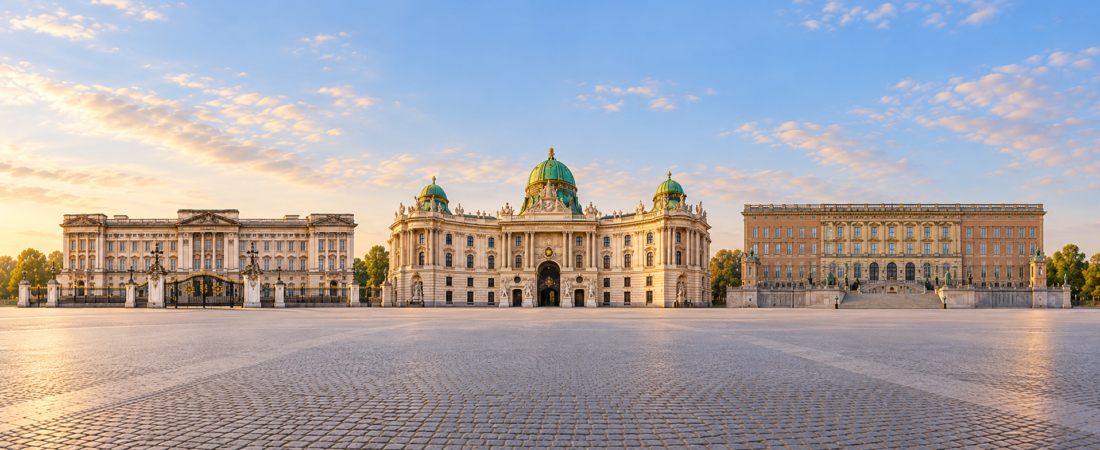
The Hofburg requires a longer exterior route to connect its principal fronts. Michaelerplatz presents the domed entrance; the older courtyards expose the joins between wings; Heldenplatz gives space to view the Neue Burg. Josefsplatz belongs to another part of the ensemble around the court library. The building authority’s free audio guide uses 23 stops across wings, courtyards and squares. [29]
Interiors and collections
Buckingham’s summer route passes through rooms used for official receptions and entertaining, including the Throne Room, Ballroom, drawing rooms and Picture Gallery. Paintings, furniture and decorative objects from the Royal Collection remain in a ceremonial setting. The visit concentrates on the public rooms of the monarchy, with little access to private domestic accommodation. [10]
Stockholm’s Royal Apartments contain reception rooms from several reigns. The palace also incorporates the Royal Chapel, with its own opening arrangements, and museums in spaces ranging from formal galleries to the surviving vaults of the earlier castle. [2]
At the Hofburg, the Imperial Apartments show rooms associated with Franz Joseph and Elisabeth. The Sisi Museum presents Elisabeth’s life through a biographical exhibition. [3]
Buckingham’s Picture Gallery contains a concentrated display of Old Master paintings. Its 2026 rehang increased the display from 63 to 120 paintings, with works by Rubens, Caravaggio and Zoffany among them. Historic records informed the new arrangement, alongside changes to the wall coverings and lighting. Stockholm’s apartments offer a different kind of sequence: Gustav III’s state bedchamber, Oskar II’s writing room and the modern Jubilee Room show how successive occupants altered the palace. The paintings dominate this part of Buckingham’s route; in Stockholm, furniture and room decoration show the tastes of successive monarchs. [11, 30]
Buckingham’s East Wing has a different decorative history from the State Rooms. Its principal rooms draw on Chinese art and European interpretations of Chinese design, with furnishings transferred from George IV’s Royal Pavilion at Brighton. The Yellow Drawing Room, Principal Corridor and Centre Room preserve this association with the Pavilion within the wing behind Buckingham’s familiar façade. [31]
Stockholm’s Tre Kronor Museum occupies surviving parts of the earlier castle. The entrance passes through a defensive wall about five metres thick, and the displays combine rescued objects with models of the former castle. This adds evidence of construction and destruction beneath the later palace. Gustav III’s Museum of Antiquities introduces a separate history of collecting: it opened in 1794 and displays sculptures acquired by the king, including purchases made in Italy. Its stone galleries place the sculptures within the eighteenth-century museum created for the collection. [32, 33]
For visitors interested in regalia, Stockholm and the Hofburg offer a more direct comparison than Buckingham. Stockholm’s Treasury holds crowns, swords of state and a silver baptismal font still used by the royal family. Vienna’s Imperial Treasury includes the crown of the Holy Roman Empire and material associated with the Habsburg dynasties. Buckingham’s State Rooms do not contain the British Crown Jewels, which are displayed at the Tower of London. [34, 35, 36]
The Austrian National Library’s State Hall offers access to the Hofburg’s former court library. Built between 1723 and 1726, with its decoration completed by 1730, it combines a domed hall, frescoes, bookcases and approximately 200,000 historic books. It was designed to present the court library as an expression of imperial learning and authority. Its frescoes and scale express that public role, while the Imperial Apartments show the surroundings in which Franz Joseph and Elisabeth lived. [37]
Opening and admission
Buckingham’s main State Rooms route has a regular summer opening, while guided visits to other parts of the palace follow separate programmes. The distinction matters because the building’s name can conceal substantial differences between tours. The East Wing and State Rooms have different decorative histories and contain different rooms; access to one should not be assumed to include the other. The scope of the ticket is more useful to this comparison than a price that changes between seasons. [13, 31]
Stockholm admits visitors to much of the palace throughout the year, but reception rooms remain available for royal business. State visits and official receptions can interrupt access to individual apartments or close the palace. These are consequences of its continuing function as a working royal residence. The museums also have different opening patterns: Gustav III’s Museum of Antiquities, for example, has a summer season. A year-round palace opening therefore does not imply simultaneous access to every collection. [2, 12, 33]
At the Hofburg, admission follows the individual institutions occupying the complex. The Imperial Apartments and Sisi Museum form one visitor attraction; the Imperial Treasury and court library are separate visits. There is no single admission covering the entire Hofburg, and walking through its public courtyards does not require a museum ticket. A visit can consequently be built around selected collections, with each additional interior requiring its own arrangements. [3, 4, 35, 37]
These differences affect the organisation of a visit: Buckingham requires a choice of seasonal route, Stockholm requires attention to the availability of working reception rooms, and the Hofburg requires a choice of institutions. Current timetables and charges belong on the operators’ booking pages. [2, 3, 13]
Accessibility and visitor rules
Buckingham provides step-free access by prior arrangement. Its ordinary summer route includes a garden exit along approximately half a kilometre of gravel. The palace uses timed admission, airport-style screening and a one-way visitor route. Pushchairs must be checked in, and photography is prohibited inside. [13]
Stockholm publishes detailed access limits for its Royal Apartments. The West Gate lift serves the Bernadotte and State Apartments, but its door is approximately 75 centimetres wide. Some connecting steps lack ramps, and a stair climber must be booked in advance. Prams cannot be taken inside the palace. Private photography is generally permitted without flash, tripods or selfie sticks, subject to the palace’s rules. [12, 14]
The Sisi Museum route has lifts, ramps and accessible toilets, but its access page also identifies limits: the lift door is 78.5 centimetres wide, and the mobile wheelchair rails are unsuitable for some heavy or specialised chairs. The operator recommends consultation before booking. Personal photography is generally allowed without flash or support equipment. These provisions apply to this museum route, not every Hofburg attraction. [3, 15]
The published information supports a comparison of particular routes and facilities, rather than a general accessibility ranking. Likewise, entry screening and timed tickets do not establish which palace is safer. The sources checked do not provide comparable palace-level crime or accident data.
Practical arrangements also affect the length and pace of a visit. Royal Collection Trust suggests allowing two to two and a half hours for Buckingham’s summer opening. Toilets and baby-care facilities are near the end of that route. Stockholm places visitor facilities in the Outer Courtyard and several museum areas, while the Sisi Museum has no cloakroom or luggage storage. [3, 13, 14]
Stockholm’s Treasury has its own access arrangements, separate from the Royal Apartments. Staff assist with its lift, whose door is 89 centimetres wide. Fire-evacuation rules allow only one wheelchair user in the Treasury at a time. This can affect a group’s visit even if every chair fits the lift. [39]
Gardens and outdoor space
Buckingham’s garden covers about 16 hectares and includes lawns, a lake and planted borders. It serves royal garden parties and opens through specified visitor programmes; it is not available for an ordinary public-park visit. St James’s Park and Green Park provide nearby places to walk or rest without palace admission. [5, 16]
Stockholm’s Logården is much smaller, with hedges, ponds and sculpture. It opens on special occasions rather than as a routine part of the visit. The quays and Outer Courtyard provide more regularly accessible outdoor space, alongside the surrounding streets of Gamla Stan. [7]
The Hofburg has historic gardens as well as courtyards. The Burggarten was an imperial garden and opened to the public in 1919. The Austrian Federal Gardens service groups it with the Volksgarten, Heldenplatz and Maria-Theresien-Platz as the Hofburg gardens. For a casual outdoor visit, this public network offers more freedom than Buckingham’s private garden or Stockholm’s Logården. [18, 19]
Ceremony and the experience of visiting
Buckingham and Stockholm both combine visitor access with continuing royal duties. Buckingham’s Ballroom hosts state banquets and investitures, while Changing the Guard takes place outside. Stockholm’s Royal Guards have served at the palace since 1523, and their public ceremony takes place in the Outer Courtyard. Neither palace’s official-residence designation alone tells visitors where the monarch normally lives: Sweden’s King and Queen have had their private residence at Drottningholm since 1981. [10, 17, 20]
The physical experience also varies. Buckingham’s timed route keeps the visit within a prescribed sequence of formal interiors. Stockholm offers changes of scale and light between apartments, vaults and courtyards. At the Hofburg, visitors alternate between city walking and individual indoor attractions.
The relationship between ceremony and the objects on display differs as well. Stockholm’s royal apartments still host council meetings, formal audiences and reception dinners. Its Treasury preserves objects whose ceremonial uses have changed: Sweden’s most recent coronation took place in 1873, although some regalia continue to appear at weddings, funerals and christenings. Buckingham’s throne chairs and reception rooms also belong to continuing royal practice. The Hofburg’s imperial regalia represent monarchies that no longer govern, while the Spanish Riding School maintains a learned equestrian practice associated with the court. [10, 30, 34, 38]
Conservation and UNESCO status
Buckingham Palace is Grade I listed, and its garden is registered at Grade II*. Its conservation includes a major programme to renew building services. Royal Collection Trust’s ticket and retail income contributes to caring for the collection; this should not be confused with funding all maintenance of the palace itself. [5, 21, 22, 23]
Stockholm Palace is a Swedish state historic monument managed by the National Property Board. Its porous Gotland sandstone has weathered for centuries. A falling baluster in 2005 prompted investigation, and the façade restoration began with a trial phase in 2011. Work includes reproducing damaged carved stone and renewing rendered surfaces in stages. The board has described the programme as a project lasting almost 50 years, illustrating the scale of maintaining the façades while the palace remains in use. [6, 24]
The Hofburg’s building authority coordinates conservation across wings occupied by numerous institutions. The Sisi Museum is operated by the Schönbrunn Group, while responsibility for the wider building complex extends beyond that visitor attraction. Works must accommodate the requirements of occupied historic buildings as well as the preservation of their fabric. [26, 27]
The Hofburg lies within the UNESCO World Heritage property Historic Centre of Vienna and also holds the European Heritage Label. Vienna’s historic centre was on the World Heritage in Danger list from 2017 until 2026. The concerns related to the wider city’s development and historic setting. Neither Buckingham Palace nor Stockholm’s Royal Palace has an equivalent World Heritage inscription; Stockholm’s palace should not be confused with the separately listed Drottningholm estate. [4, 9, 20, 25]
The Spanish Riding School has an additional UNESCO recognition distinct from Vienna’s World Heritage status. Classical horsemanship and the school’s High School tradition were inscribed on the Representative List of the Intangible Cultural Heritage of Humanity in 2015. That designation concerns skills and practices transmitted between people, including the training and riding of Lipizzaner horses. [9, 38]
Tourism and local economies
Buckingham contributes to the concentration of visitor attractions around Westminster and St James’s. Stockholm’s palace sits within the walking routes and visitor services of Gamla Stan. At the Hofburg, museums, performances and events generate visits to several parts of the complex. In each case, an exterior visit can take place without buying a palace-interior ticket.
Royal Collection Trust reports 590,000 Buckingham Palace visitors in 2025/26. That figure excludes people who only view the exterior or attend a public ceremony. The Schönbrunn Group reported 5.26 million visits and €97.3 million in turnover in 2025 across four sites: Schönbrunn Palace, the Sisi Museum, the Vienna Furniture Museum and Schloss Hof. Its totals cannot be presented as Hofburg attendance or revenue. These figures provide historical context for the scale of operations, rather than a common attendance measure for the three palaces. [23, 27]
Choosing between the three
Choose Buckingham for British state interiors, Stockholm for a visit spanning royal apartments and the earlier castle, or the Hofburg for a day combining several institutions. The booking decisions differ: select the appropriate seasonal tour in London, check royal-function closures in Stockholm, and choose individual attractions in Vienna.