Location and geographic setting
Deer Cave: Deer Cave is in Sarawak, Malaysia, and the visit is shaped by Mulu before the cave appears. Flight access, limited services, cash planning, weather risk and a park-based stay are part of the experience. The raised plank walk makes the rainforest part of the cave visit, not a neutral access corridor.
Škocjan Caves: Škocjan Caves are in Slovenia, tied to the Classical Karst, village edges and regional transport. The visitor centre at Matavun is reachable by car, by train to Divača plus a marked walk, or by local transport options. The cave fits a Slovenia, Trieste, Istria or Karst route without making the whole trip revolve around one site.
Deer Cave is isolated. Škocjan is logistically easier.
Cave identity and geological type
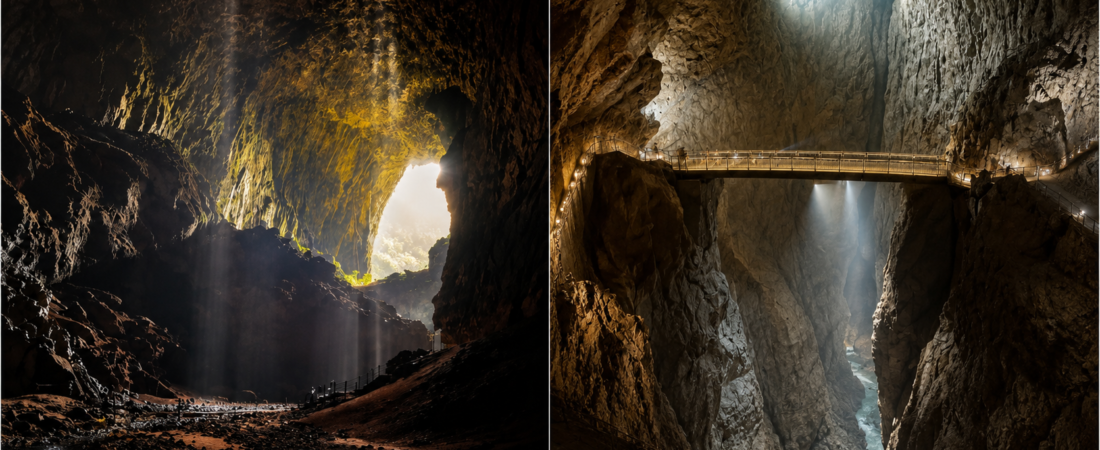
Deer Cave: Deer Cave is experienced as a huge fossil river passage in a tropical limestone system. The official route points to passage scale, scalloped walls, old water action and the Garden of Eden opening. Its identity is concentrated: one large void, bats, heat, rainforest and evening timing.
Škocjan Caves: Škocjan is an active karst river-canyon system. The Reka River disappears underground, cuts the canyon and structures the route. The identity comes from linked conditions: dry fossil passages, river canyon, bridge, collapse dolines and surface karst.
Deer Cave reads as mass and aperture. Škocjan reads as hydrology and vertical incision.
Scale, volume and spatial hierarchy
Deer Cave: Deer Cave gives scale through breadth, ceiling height and cave-mouth openness. The visitor reads one dominant space rather than many contrasting rooms. The bat population intensifies that volume because the space is visibly inhabited and used at scale.
Škocjan Caves: Škocjan gives scale through depth, layering and river distance. The UNESCO description gives about 6 km of underground passages and more than 200 m of depth. The Reka canyon, Cerkvenik bridge, large chambers and collapse dolines create a stronger hierarchy: upper dry spaces, lower river space and surface collapse space.
Deer Cave is immediate. Škocjan is more staged.
Layout and visitor route
Deer Cave: Deer Cave has a long approach and a simple interior rhythm. The public tour starts from park headquarters, follows raised plank walks to the bat observatory, continues to Deer Cave and returns broadly the same way, with Lang Cave added on the same excursion. Distance and humidity matter more than technical difficulty.
Škocjan Caves: Škocjan has a tighter sequence: reception centre, entrance area, artificial tunnel, Silent Cave, Great Hall, Murmuring Cave, Reka canyon, daylight exit, collapse dolines and return toward Matavun. The route has many steps and a colder cave environment.
Deer Cave takes longer as an outing; Škocjan is denser underfoot. The official Deer & Lang tour is listed as 3 hours plus the bat exodus, 9 km total distance, afternoon start times and a likely return around 18:30-19:00 if the bats fly. The effort is spread across the rainforest walk, the cave visit and the wait. Škocjan’s main cave visit is shorter and more compressed: 2.5-3 hours, 5 km and about 1000 steps, with an early-exit option after daylight returns. Deer Cave consumes more of the day. Škocjan packs more structure, stairs and group movement into a tighter visit.
Deer Cave is a forest walk with a cave core. Škocjan is a choreographed underground route with a surface-karst finish.
Signature visual moments
Deer Cave: Deer Cave has three anchors: the cave mouth, the Garden of Eden opening and the bat exodus. The strongest visual memory often comes outside the cave, when bats leave after late afternoon. The cave interior supports that moment instead of replacing it.
Škocjan Caves: Škocjan builds its scene inside the route: dry formations in Silent Cave, the Great Hall, the shift into Murmuring Cave, the underground Reka River canyon, the Cerkvenik bridge and the collapse dolines after daylight returns. Its strongest scene sits inside the controlled route.
Deer Cave concentrates drama at the cave mouth and evening sky. Škocjan concentrates it in the underground canyon and bridge crossing.
Wildlife and living cave atmosphere
Deer Cave: Deer Cave is the clearer living-cave experience for ordinary visitors. The official tour is timed around the bat exodus, and the cave is publicly described as home to more than three million wrinkle-lipped bats and many swiftlets. Wildlife shapes timing, expectation and visitor behaviour.
Škocjan Caves: Škocjan has important cave fauna and protected habitats, including bats, cave animals and specialised underground species. Most travellers will experience it more as a river and rock system than as a visible wildlife site. Its biological value is serious; its animal visibility is lower.
Deer Cave feels inhabited. Škocjan feels geologically active.
Soundscape and sensory atmosphere
Noise and crowd pressure are not proven as major complaints for either cave. The evidence shows where people are likely to concentrate. Deer Cave has the looser pattern: a 3 km plank walk, a bat observatory, then a large cave passage, with crowd build-up most likely while visitors wait for the bat exodus after 17:00. Škocjan has the tighter pattern: guided movement through rooms, canyon and bridge, 5 km of path and about 1000 steps, with no interior photography and limited freedom to pause. Deer Cave is more open, but less predictable at the bat-viewing point. Škocjan is quieter in tone, but more fixed in movement.
Heritage protection and scientific value
Deer Cave: Deer Cave sits inside UNESCO-listed Gunung Mulu National Park, a major tropical karst and biodiversity area. Its heritage value is strongest when read as part of Mulu’s wider system: rainforest, caves, bats, swiftlets, explored passages, closed zones and scientific research.
Škocjan Caves: Škocjan itself is the UNESCO property. It carries a tighter cave-specific heritage profile: karst science, Reka River hydrology, underground canyon morphology, archaeology, protected villages and a managed regional park. Its cultural and scientific layers are unusually concentrated for a visitor cave.
Deer Cave gains depth from Mulu park. Škocjan carries more of the heritage argument inside the cave-and-park unit itself.
Access, visitor management and social openness
Deer Cave: Deer Cave is managed by remoteness, park permits, guided entry and limited services. Deer Cave has a low cave-tour price and high total-trip friction. The tour price is modest, but Mulu requires flight planning, a park pass, flexible timing, cash, rain gear and acceptance of limited services. Heavy rain can affect flights. Travellers with mobility limits are advised to enquire before booking.
Škocjan Caves: Škocjan has higher ticket-window pricing and much easier regional access. The main tour price varies by season, and the site publishes route length, steps, temperature and rules. It is socially easier for independent travellers, families and road-trippers, but demanding for people who struggle with stairs, cold, damp paths or height exposure.
Deer Cave is cheaper locally and costlier logistically. Škocjan is costlier locally and easier logistically. Slovenia has normal European travel precautions; Malaysia requires more discretion for gay travellers and more caution for solo women, according to official travel advice.
For Deer Cave, the best window to visit is June to August, with September still workable: the cave can be visited year-round, but Mulu’s afternoon rain pattern affects both the walk and the bat-exodus wait. For Škocjan, May–June and September–early October are stronger than midsummer or winter: the cave temperature stays stable, but the wider Karst route is easier, less crowded and more pleasant above ground.
Tourism ecosystem and local economic role
Deer Cave: Mulu’s tourism economy is concentrated around the park: guides, cave tours, park accommodation, a cafe, a gallery/shop, the nearby Marriott, river activities and rainforest activities. The small service base reinforces isolation. Visitor spending is closely tied to the park system.
Škocjan Caves: Škocjan’s tourism system is tied to Matavun, Škocjan, Betanja, the visitor centre, education trail, museum collections and the protected Karst landscape. The park explicitly links conservation management with local development, residents and the Divača/Karst economy.
Mulu is a remote park economy. Škocjan is a protected landscape economy with village and regional layers.
Climate, hazards and environmental risk
Deer Cave: Deer Cave’s main traveller risks are tropical weather, heat, humidity, rain, flight disruption and isolation. The cave visit is only one exposure. Arrival, departure, supplies and fatigue belong to the same risk picture.
Škocjan Caves: Škocjan’s main risks are route conditions, cold, steps, wet paths, height exposure and Reka River behaviour. The river can rise sharply during heavy flooding, and specialist routes can be cancelled when water levels are unsafe.
Deer Cave needs weather buffers and tropical tolerance. Škocjan needs physical steadiness and respect for underground river conditions.
Viewpoints and photographic logic
Deer Cave: Deer Cave is more photographable for ordinary travellers. The rainforest approach, cave mouth, boardwalks, bat observatory and evening bat movement create external scenes. The strongest images can be made outside the strict cave interior.
Škocjan Caves: Škocjan is more memorable than photographable inside. Interior photography is not allowed, so the canyon and bridge cannot be casually captured. Surface dolines, village paths and education-trail viewpoints carry the photographic role.
Deer Cave gives images of approach, entrance and bats. Škocjan gives fewer personal images and a stronger private memory of the underground route.
Traveller types and visit suitability
Deer Cave: Deer Cave suits rainforest travellers, bat watchers, people comfortable with heat and humidity, and visitors willing to build a stay around Mulu rather than add one cave to a fast route. It is weaker for tight flight connections, limited time, low heat tolerance, strong insect aversion or gay travellers.
Škocjan Caves: Škocjan suits travellers interested in karst, geology, river canyons, protected landscapes and structured guided visits. It works well within a wider Slovenia or northern Adriatic itinerary. It is weaker for step-free access needs, dislike of guided pacing, need for interior photography or unease with height over underground water.
Deer Cave rewards commitment to rainforest and wildlife. Škocjan rewards interest in geological process.
Conclusion
Deer Cave is the clearer choice for living-cave atmosphere: rainforest approach, very large warm passage, bats, late-afternoon timing and the feeling of being inside a remote tropical park. Its cost is friction. The cave tour is simple enough; the whole visit depends on flights, weather, limited services, cash and enough time in Mulu.
Škocjan Caves are the clearer choice for spatial structure, river drama and heritage density: dry cave, underground canyon, bridge, collapse dolines, village landscape and a direct UNESCO cave identity. Its cost is control. The route is stair-heavy and not photographable inside.
Deer Cave is a wildlife-and-rainforest cave journey. Škocjan is a karst-river-canyon journey.
Sources
- Gunung Mulu National Park official site — Deer & Lang
https://mulupark.com/deer-lang/ - Gunung Mulu National Park official site — Plan Your Trip
https://mulupark.com/plan-your-trip/ - Gunung Mulu National Park official site — Accommodations & Facilities
https://mulupark.com/accommodations-facilities/ - UNESCO World Heritage Centre — Gunung Mulu National Park
https://whc.unesco.org/en/list/1013/ - Park Škocjanske jame official site — Škocjan Caves Guided Tours
https://www.park-skocjanske-jame.si/en/read/tourist-information/guided-tours - Park Škocjanske jame official site — How to Reach Us
https://www.park-skocjanske-jame.si/en/read/tourist-information/how-to-reach-us - Park Škocjanske jame official site — Position and Surface
https://www.park-skocjanske-jame.si/en/read/protected-area/position-and-surface - Park Škocjanske jame official site — Geology and Hydrology
https://www.park-skocjanske-jame.si/en/read/protected-area/geology-and-hydrology - Park Škocjanske jame official site — Flora and Fauna
https://www.park-skocjanske-jame.si/en/read/protected-area/flora-and-fauna - Park Škocjanske jame official site — Archaeology
https://www.park-skocjanske-jame.si/en/read/protected-area/archaeology - Park Škocjanske jame official site — Significance of the Škocjan Caves
https://www.park-skocjanske-jame.si/en/read/the-skocjan-caves/significance - UNESCO World Heritage Centre — Škocjan Caves
https://whc.unesco.org/en/list/390/