Great Smoky Mountains National Park is a large, accessible Appalachian mountain park. It is defined by biodiversity, scenic ridges, waterfalls, historic valleys, road access, and very high visitor numbers.
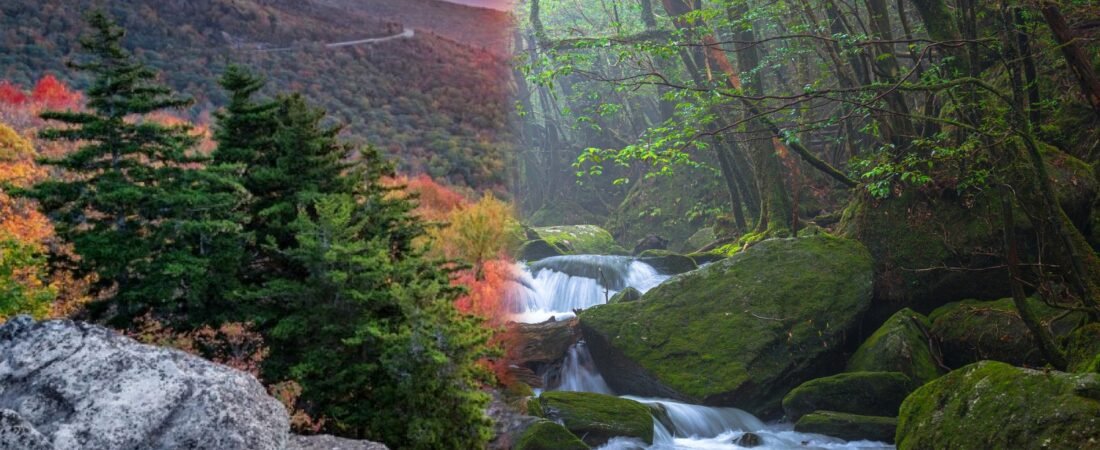
Yakushima National Park is a smaller, remote Japanese island park. It is defined by ancient Yakusugi cedars, mossy rainforest, heavy rainfall, steep mountains, waterfalls, endemic wildlife, and a more demanding nature experience.
The comparison is useful because both places are forest-first mountain destinations with UNESCO recognition. The difference is scale and experience: Great Smoky Mountains offers a broad public national park experience; Yakushima offers a concentrated ancient-forest journey.
Comparison at a glance
| Dimension | Great Smoky Mountains | Yakushima | Reader takeaway |
|---|---|---|---|
| Exact size | 522,427 acres, about 211,400 ha, divided almost evenly between Tennessee and North Carolina. [1] | 24,566 ha of land plus 7,987 ha of sea, for 32,553 ha total. Around 42% of Yakushima Island is inside the park. [12] | Great Smoky Mountains is far larger; Yakushima is smaller but includes land and sea. |
| UNESCO and protection status | UNESCO World Heritage Site; value linked to temperate biodiversity, plant diversity, tree diversity, and salamanders. [3] | UNESCO World Natural Heritage Site; around 10,747 ha, about 20% of the island, is registered as natural heritage. [13, 14] | Both have strong international status, but for different ecological reasons. |
| Landform | Mainland Appalachian mountain park with long ridges, coves, valleys, streams, and forested slopes. | Mountainous island south of Kyushu, rising from sea level to nearly 2,000 m. [13] | Great Smoky is broad and layered; Yakushima is steep and compressed. |
| Forest type | Temperate Appalachian forest with high tree diversity, old-growth remnants, spring wildflowers, and seasonal change. | Humid temperate rainforest with moss, ferns, ancient Yakusugi cedars, and strong vertical vegetation change. [13] | Great Smoky is stronger for broad forest diversity; Yakushima for ancient rainforest character. |
| Biodiversity | NPS describes it as the most biodiverse park in the U.S. National Park System; more than 17,000 species are documented. [2] | Biodiversity is shaped by island isolation, heavy rainfall, altitude, endemic species, deer, monkeys, sea turtles, and ancient cedars. [15] | Great Smoky has larger documented biodiversity; Yakushima has stronger island distinctiveness. |
| Main points of interest | Cades Cove, Kuwohi, Newfound Gap, Mount Le Conte, Alum Cave Bluffs, Laurel Falls, Abrams Falls, Rainbow Falls, Grotto Falls, Roaring Fork, Cataloochee, Oconaluftee. | Jomon Sugi, Shiratani Unsuikyo, Yakusugi Land, Mount Miyanoura, Wilson Stump, Taiko-iwa Rock, Okawa Falls, Senpiro Falls, Seibu Rindo, Nagata Inakahama, Kuchinoerabu-jima. | Great Smoky has more varied POIs; Yakushima has fewer but more distinctive forest icons. |
| Waterfalls and water landscapes | Laurel Falls, Abrams Falls, Rainbow Falls, Grotto Falls, Ramsey Cascades, streams, coves, and wet forest valleys. | Heavy rain, mossy ravines, rivers, Okawa Falls, Senpiro Falls, Toroki Falls, and coastal water landscapes. [20] | Great Smoky is stronger for classic waterfall hikes; Yakushima has the stronger island water identity. |
| Mountains and viewpoints | Kuwohi, Newfound Gap, Mount Le Conte, Charlies Bunion, Andrews Bald, Gregory Bald, Mount Cammerer. [4, 5] | Mount Miyanoura, Taiko-iwa Rock, Okudake mountains, and high forest viewpoints. [15, 17] | Great Smoky is better for accessible panoramas; Yakushima for island-mountain contrast. |
| Main trails | Alum Cave Trail to Mount Le Conte, Alum Cave Bluffs, Laurel Falls, Abrams Falls, Rainbow Falls, Charlies Bunion, Andrews Bald, Chimney Tops, Mount Cammerer, Gregory Bald, Ramsey Cascades. [5, 6, 7] | Jomon Sugi from Arakawa, Shiratani Unsuikyo, Taiko-iwa, Yakusugi Land, Mount Miyanoura, Wilson Stump, old forest railway sections. [17, 18, 19] | Great Smoky has a broader trail network; Yakushima has more concentrated forest-hiking identity. |
| Access and logistics | Easy road access from Gatlinburg, Cherokee, Townsend, and the Asheville region. No entrance fee, but parking tags are required for vehicles parked over 15 minutes. [1] | Requires ferry or flight to Yakushima, then rental car, local bus, taxi, or guided transport. Public transport is useful but limited for some trailheads. [15, 17] | Great Smoky is easier for casual visitors; Yakushima requires more planning. |
| Crowds and visitor pressure | Very high: NPS reported 11.5 million visitors in 2025 and a 20% visitation increase over the last decade. [2] | Lower overall volume, but pressure concentrates on Jomon Sugi, Shiratani Unsuikyo, Yakusugi Land, and shuttle/transport corridors. [21] | Great Smoky has mass-tourism pressure; Yakushima has fragile-site pressure. |
| Noise and quietness | Vehicle noise matters near roads, overlooks, parking areas, and gateway corridors. NPS recognizes excessive motorcycle noise as a concern for park enjoyment. [8] | Noise is less central. Main comfort issues are rain, slippery trails, limited transport, and concentration on famous forest routes. | Great Smoky is more vulnerable to road and motorcycle noise; Yakushima is quieter once away from access points. |
| Social openness / gay-friendliness | The park itself is public and neutral. Gatlinburg and Pigeon Forge are practical but not especially gay-oriented. Asheville is the stronger nearby gay-friendly base. [22] | Japan is generally safe for LGBTQ travelers, but public affection is uncommon and rural/island areas are less visibly queer than Tokyo or Osaka. [23, 24] | Great Smoky has better access to an openly gay-friendly nearby city; Yakushima is likely safe but discreet. |
| Curious facts | The “smoky” look is linked to natural blue mist. The park has synchronous fireflies at Elkmont, managed by lottery. Kuwohi was formerly Clingmans Dome. [10, 11] | Yakushima is often described as a place where it “rains 35 days a month.” Some cedars are over 1,000 years old. Shiratani Unsuikyo is linked to Princess Mononoke imagery. [17, 20] | Great Smoky has stronger mass-market facts; Yakushima has stronger mythic forest facts. |
Main points of interest
Great Smoky Mountains National Park
• Cades Cove: scenic valley, wildlife viewing, historic buildings, churches, cabins, and an 11-mile loop road.
• Kuwohi: highest point in the park and one of the main high-elevation viewpoints.
• Newfound Gap: major pass connecting Tennessee and North Carolina, useful for understanding the ridge structure of the park.
• Mount Le Conte: iconic hiking mountain reached only by trail, with several approach routes.
• Alum Cave Bluffs: major hiking landmark and shorter alternative for visitors not continuing to Mount Le Conte.
• Laurel Falls: famous waterfall route; visitors should check current rehabilitation or access status before planning.
• Abrams Falls: powerful waterfall hike from the Cades Cove area.
• Rainbow Falls: waterfall route and one of the routes toward Mount Le Conte.
• Grotto Falls: distinctive waterfall because visitors can walk behind the cascade.
• Roaring Fork Motor Nature Trail: scenic drive with forest, streams, historic structures, and trail access.
• Cataloochee Valley: elk viewing and historic valley setting.
• Oconaluftee: visitor orientation, cultural interpretation, and elk viewing nearby.
Yakushima National Park
• Jomon Sugi: symbolic ancient cedar and the island’s most famous natural attraction.
• Shiratani Unsuikyo: mossy forest ravine with shorter and longer walking routes.
• Yakusugi Land: accessible ancient-cedar forest area with several loop routes.
• Mount Miyanoura: highest mountain on Yakushima and in Kyushu.
• Wilson Stump: famous cedar stump on the Jomon Sugi route, important for forestry history and visitor interest.
• Taiko-iwa Rock: viewpoint above Shiratani Unsuikyo with a strong forest-to-mountain panorama.
• Okawa Falls: one of Yakushima’s major waterfalls.
• Senpiro Falls: waterfall framed by large granite scenery.
• Seibu Rindo Forest Path: western forest road with deer, monkeys, and dense island forest.
• Nagata Inakahama Beach: known for sea turtle nesting.
• Kuchinoerabu-jima: volcanic island included in Yakushima National Park.
Main hiking routes
Great Smoky Mountains National Park
• Alum Cave Trail to Mount Le Conte: classic strenuous Smokies hike with Arch Rock, Alum Cave Bluffs, forest, streams, exposed sections, and access to Mount Le Conte.
• Alum Cave Bluffs: shorter version of the route with one of the park’s best-known trail landmarks.
• Laurel Falls Trail: famous waterfall trail, but access status should be checked because of heavy pressure and trail work.
• Abrams Falls Trail: strong waterfall hike from Cades Cove.
• Rainbow Falls Trail: waterfall route and one of the routes toward Mount Le Conte.
• Charlies Bunion via Appalachian Trail: ridge-view hike with strong mountain scenery.
• Andrews Bald: high-elevation bald near Kuwohi.
• Chimney Tops Trail: steep, famous trail with dramatic terrain; current access and safety conditions should be checked.
• Mount Cammerer: longer hike with a lookout-tower reward.
• Gregory Bald: known for seasonal azaleas and open mountain views.
• Ramsey Cascades: major waterfall hike and one of the stronger forest-water routes.
Yakushima National Park
• Jomon Sugi from Arakawa Trailhead: main pilgrimage route to Yakushima’s most famous ancient cedar. Long, demanding, and central to the island’s identity.
• Shiratani Unsuikyo trails: best-known mossy forest experience, with routes of different lengths.
• Taiko-iwa Rock route: combines moss forest with a major viewpoint.
• Yakusugi Land loops: more accessible way to see ancient cedars.
• Mount Miyanoura route: serious mountain route to Yakushima’s highest peak.
• Wilson Stump route: important part of the Jomon Sugi route and forestry-history story.
• Old forest railway section: important because the Jomon Sugi route follows former rail infrastructure before entering deeper forest.
Noise and quietness
Great Smoky Mountains National Park
• Great Smoky Mountains should not be described as uniformly quiet. It can be quiet deep in the backcountry, but many visitors experience it through roads, overlooks, parking areas, scenic drives, and gateway towns.
• Vehicle noise matters near the main road corridors. Motorcycle noise should be mentioned because the park is road-accessible and part of a wider scenic-driving region.
• The best quiet experiences are deeper trails, early mornings, off-season visits, and areas away from the main road corridors.
Yakushima National Park
• Yakushima has a different sound profile. It is not mainly a road-noise park.
• Its strongest soundscape is rain, streams, insects, wind, and forest.
• The practical issue is not motorcycle noise but concentration of hikers on famous routes, especially Jomon Sugi and Shiratani Unsuikyo.
Social openness and gay-friendliness
Great Smoky Mountains National Park
• The park itself is a public nature destination. The surrounding base matters more than the park.
• Gatlinburg and Pigeon Forge are practical tourist bases, but they are not especially gay-oriented.
• Asheville is a better base if the traveler wants a more visibly gay-friendly environment while still accessing the North Carolina side of the Smokies.
Yakushima National Park
• Yakushima is likely safe for LGBTQ travelers in the general Japan-travel sense, but it should not be presented as visibly gay-friendly.
• Japan is generally safe, but public affection is uncommon and rural or island areas tend to be more discreet than Tokyo or Osaka.
• The fair phrasing is: Yakushima is probably safe but socially quiet and not visibly LGBTQ-oriented.
Best fit by visitor type
| Visitor type | Better fit | Reason |
|---|---|---|
| Broad national park experience | Great Smoky Mountains | Larger, easier, more varied. |
| Ancient forest immersion | Yakushima | Stronger ancient cedar and moss forest identity. |
| Waterfall-focused trip | Great Smoky Mountains | More classic waterfall hikes. |
| Rainforest atmosphere | Yakushima | Wetter, greener, denser, more primeval. |
| Mountain viewpoints | Great Smoky Mountains | More accessible ridge and summit viewpoints. |
| Serious island hiking | Yakushima | Jomon Sugi, Mount Miyanoura, and remote forest routes. |
| Wildlife variety | Great Smoky Mountains | Stronger general wildlife and biodiversity appeal. |
| Endemic island nature | Yakushima | Stronger island-specific species and ecosystems. |
| Family trip | Great Smoky Mountains | Easier logistics and more flexible activities. |
| Quiet forest trip | Yakushima | Less road-based, more immersive once on trail. |
| Cultural-history interpretation | Great Smoky Mountains | More preserved structures and visible settlement history. |
| Gay-friendly base | Great Smoky Mountains if based in Asheville | Asheville is a stronger social base than Yakushima’s rural/island context. |
Final takeaway
Great Smoky Mountains National Park is stronger for a broad, accessible, varied nature trip. It has more roads, more trail options, more waterfalls, more historic sites, more visitor infrastructure, and stronger mass-market appeal. Its weakness is that popularity brings congestion, parking pressure, and road noise.
Yakushima National Park is stronger for ancient forest immersion. It is smaller, harder to reach, wetter, and more demanding, but its cedar forests, moss, rainfall, waterfalls, and steep island mountains make it more distinctive. Its weakness is logistical complexity and pressure on a few famous routes.
Sources
[1] National Park Service — Great Smoky Mountains National Park statistics: https://www.nps.gov/grsm/learn/management/statistics.htm
[2] National Park Service — Visitor Experience Stewardship / visitation and biodiversity: https://www.nps.gov/grsm/learn/management/ves.htm
[3] UNESCO World Heritage Centre — Great Smoky Mountains National Park: https://whc.unesco.org/en/list/259/
[4] National Park Service — Kuwohi and Newfound Gap Area: https://www.nps.gov/grsm/planyourvisit/kuwohi-nfg.htm
[5] National Park Service — Hiking in Great Smoky Mountains National Park: https://www.nps.gov/grsm/planyourvisit/hiking.htm
[6] National Park Service — Hike to Alum Cave Bluffs: https://www.nps.gov/thingstodo/alum-cave-to-the-bluffs.htm
[7] National Park Service — Hike to Mount Le Conte on Alum Cave Trail: https://www.nps.gov/thingstodo/leconte-via-alum-cave-trail.htm
[8] National Park Service — Motorcycle Riding in National Parks / Natural Sounds: https://www.nps.gov/subjects/sound/rideright.htm
[9] National Park Service — Historic Buildings in Great Smoky Mountains National Park: https://www.nps.gov/grsm/planyourvisit/historicbuildings.htm
[10] National Park Service — Air profile and natural blue mist: https://www.nps.gov/articles/airprofiles-grsm.htm
[11] National Park Service — Synchronous fireflies: https://www.nps.gov/grsm/learn/nature/fireflies.htm
[12] Japan Ministry of the Environment — Outline of Yakushima National Park: https://www.env.go.jp/en/park/yakushima/ywhcc/np/np.html
[13] UNESCO World Heritage Centre — Yakushima: https://whc.unesco.org/en/list/662/
[14] Japan Ministry of the Environment — Yakushima World Heritage overview: https://www.env.go.jp/en/park/yakushima/ywhcc/wh/wh.html
[15] Japan National Parks — Yakushima National Park: https://www.japan.travel/national-parks/parks/yakushima/
[16] Japan National Parks — Explore the Ancient Cedar Forests of Yakushima: https://www.japan.travel/national-parks/parks/yakushima/see-and-do/itineraries/explore-ancient-cedar-forests-yakushima/
[17] Japan Guide — Shiratani Unsuikyo: https://www.japan-guide.com/e/e4654.html
[18] Japan Ministry of the Environment — Arakawa Trail Entrance to Jomon-sugi and Shirataniunsui-kyo route: https://www.env.go.jp/en/park/yakushima/ywhcc/route/4-1.html
[19] Hikes in Japan — Jomon Sugi route from Arakawa Trailhead: https://hikesinjapan.yamakei-online.com/course/137.php
[20] Japan Ministry of the Environment — Yakushima Outstanding Universal Value / rainfall: https://www.env.go.jp/nature/isan/worldheritage/en/yakushima/uiversal/index.html
[21] IUCN World Heritage Outlook — Yakushima: https://worldheritageoutlook.iucn.org/node/1061
[22] Romantic Asheville — Gay and lesbian LGBTQ vacation guide: https://www.romanticasheville.com/gayandlesbian.html
[23] Intrepid Travel — LGBTQIA+ travel in Japan: https://www.intrepidtravel.com/eu/japan/is-japan-lgbtqia-friendly
[24] World Nomads — LGBTQ+ travel in Japan: https://www.worldnomads.com/travel-safety/eastern-asia/japan/queer-travel-in-japan