Snapshot
Gullfoss is a short waterfall stop on Iceland’s Golden Circle. Detian and Bản Giốc occupy opposite sides of the China–Vietnam border, with separate entrances and visitor routes. At Cascadas Tulimán near Zacatlán, Mexico, a woodland walk leads to the falls within a community-run park with pools and outdoor activities.
| Feature | Gullfoss | Detian and Bản Giốc | Cascadas Tulimán |
|---|---|---|---|
| Setting | Exposed upland and narrow gorge | Limestone valley on the China–Vietnam border | Forested mountain slopes in Puebla |
| Waterfall character | Two angled drops carrying a substantial river | Broad, terraced falls with several channels | Tall cascade descending a wooded slope |
| Main experience | Views from developed paths | Riverbank views and raft trips; a larger built attraction at Detian | Walking between the waterfall and separate recreation areas |
| Main constraint | Weather exposure | Seasonal flow and separate national access rules | Slopes and uneven ground |
Setting and waterfall form
At Gullfoss, the Hvítá crosses open upland before turning into a narrow gorge. The falls drop 11 metres and then 20 metres over alternating layers of hard volcanic rock and softer sediment. The river’s change of direction partly hides the lower drop from some viewpoints. Iceland’s Environment Agency gives a mean discharge of 109 cubic metres per second. [1][2]
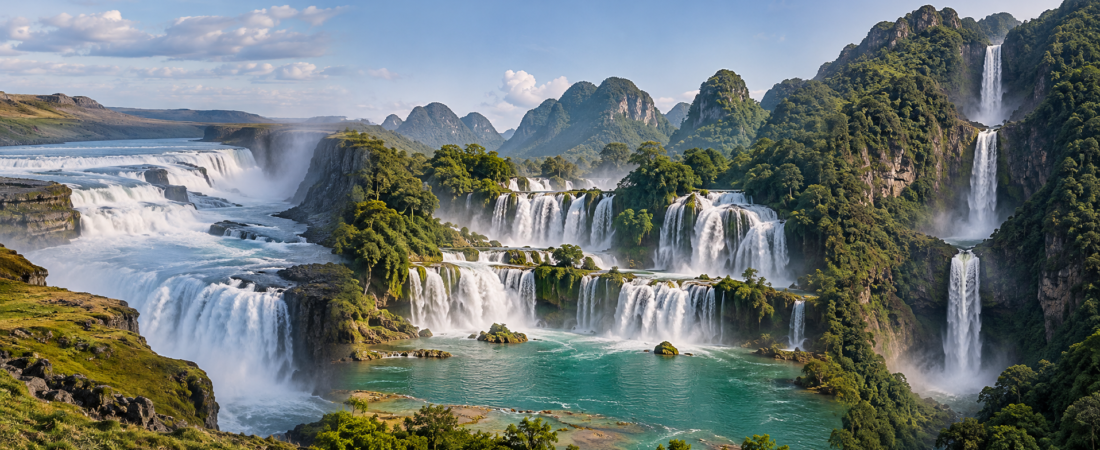
Detian and Bản Giốc spread across limestone ledges on the Quây Sơn, called the Guichun in China. Rice fields and steep limestone hills surround the river. Vietnamese tourism authorities describe the main cascade as three tiers falling more than 30 metres. Chinese authorities give a substantially greater height for Detian, though the extent measured in each description is unclear. Water divides into separate curtains across the broad terraces. [3][4]
Tulimán descends through forested slopes in the Sierra Norte de Puebla. Views open between trees and bends in the path during the descent. Tourism sources give a height of roughly 300 metres without citing a survey. [5][6]
Seasonality and water flow
Gullfoss carries a substantial flow throughout the year, with the Environment Agency reporting approximately 130 cubic metres per second in summer. Winter changes the appearance through snow and frozen spray, while summer brings longer daylight for viewing. Wind and precipitation can change quickly in either season. [2][7]
Bản Giốc becomes fuller during the June–September rainy season. A December 2023 management advisory warned of very low flow from late November to early April. Staff were coordinating with upstream hydropower operators and advised visiting between 10:30 and 15:00. For a dry-season trip, ask the waterfall management about current flow and release times. [3][8]
Rainfall affects the streams and walking conditions at Tulimán. The park publishes no monthly flow measurements. Ask about recent rain and trail conditions before travelling. [5][6]
Visitor journey and viewpoints
Gullfoss has a compact network of paths. The upper viewpoint looks down over the falls and gorge. When open, the lower route takes visitors closer to the water. Each angle reveals a different part of the two drops. [1]
At Bản Giốc, visitors face the broad cascade from the riverbank. Detian has six viewing platforms, giving a wider choice of positions along the Chinese side. From either bank, the view includes the neighbouring country. [3][9]
Tulimán requires a longer walk. The operator places the welcome area 1.5 kilometres from the waterfall zone, with two viewpoints on the descent. Paths through the woods continue toward the mineral-water area and river confluence. [5]
Access and entry arrangements
Gullfoss is reached by road on Route 35. General visitor parking is at the upper level, with coach parking below. Check weather and road conditions before departure. [1][7]
Detian is approached through Guangxi in China, while Bản Giốc is reached through Cao Bằng in Vietnam. Crossing between them requires separate permission through the organised cross-border tourism route. In December 2025, the two countries were still studying arrangements for visitors of other nationalities. Confirm eligibility before booking a visit to both sides. [4][10]
Tulimán is reached from the Zacatlán area. The park lists parking in all three zones and transport in Zone 3. Ask which routes that service covers if you need to avoid a long walk. [5]
Physical accessibility
Gullfoss has accessible parking at the lower level. Paths vary in gradient and steps, so wheelchair users should ask the ranger service which viewpoint they can reach and where to park. [1]
Wheelchair access at Detian and Bản Giốc is poorly documented. Before booking, check the route to the chosen viewpoint, toilet access and boarding arrangements for any raft trip. [3][9]
Tulimán’s waterfall route involves a sustained descent over sloping ground. The park does not publish a wheelchair-accessible route to the falls. Visitors who cannot manage uneven paths should contact the operator before travelling. [5]
Facilities and comfort
Gullfoss has refreshments and shops beside the upper parking area, and rangers work at the site year-round. The viewing paths offer little shelter. [1]
Detian has the larger service area, with food outlets, teahouses and shopping streets. At Bản Giốc, stalls and visitor services are grouped near the falls. [4][9][11]
Tulimán has toilets in each zone and cabins for overnight stays. Visitors needing frequent rests should allow for the walking between facilities. [5]
Activities and water use
At Gullfoss, visitors stay on the viewing paths. Detian and Bản Giốc offer raft trips toward the base of the falls, close enough to feel the spray. Neither waterfall visit includes swimming. [1][3]
Tulimán offers tree climbing, two ziplines, a mineral-water pool and designated natural pools. Check individual activity charges and opening arrangements when buying admission. [5]
Crowding and atmosphere
Gullfoss draws large numbers of visitors onto a small network of paths. Coach arrivals bring groups to the overlooks in quick succession. [1]
Detian’s shops and evening attractions keep the site active beyond daytime waterfall visits. Bản Giốc also receives large holiday crowds. Its management board reported more than 26,000 visits during the nine-day Lunar New Year holiday in 2026. [9][11]
At Tulimán, visitors spread between the waterfall paths, pools and activity areas. Recent attendance figures for the individual zones are unavailable. [5]
Safety and natural hazards
At Gullfoss, freezing spray can make the paths slippery enough to close the lower route. Strong wind adds to the difficulty at exposed viewpoints. Stay behind barriers and check current closure notices. [7][12]
At Detian and Bản Giốc, take care on wet paths and near steep edges. Wear the required safety equipment on raft trips and follow staff instructions. [3]
At Tulimán, check trail closures after heavy rain and bathe only in areas opened by the operator. Rainfall-triggered landslides are documented across the Sierra Norte. [5][13]
Ecology and environmental protection
Gullfoss has been a national nature reserve since 1979, protecting the waterfall, gorge and surrounding vegetation. Spray supports mosses and other plants, while the short growing season makes damaged ground slow to recover. Keeping visitors on established paths limits trampling. [1][2]
Bản Giốc lies within Non Nước Cao Bằng UNESCO Global Geopark, designated in 2018. The geopark covers Vietnamese territory only. Its status recognises geological heritage and community development under a separate UNESCO programme from World Heritage listing. China and Vietnam also have a joint agreement covering protection and tourism development at the falls. [4][14][15]
Zacatlán awarded Tulimán its municipal Punto Verde environmental recognition in 2025 and held a reforestation event at the park. In March 2026, the municipality marked pedestrian crossings, reorganised parking and cleared pavement space occupied by vendors around Tulimán and neighbouring parks. [16][17]
Cultural identity and local significance
Sigríður Tómasdóttir campaigned against hydroelectric development at Gullfoss. Her legal challenge failed, and the development agreement later lapsed when payments stopped in 1928. A memorial near the falls honours her campaign. She and her sisters guided early visitors and helped build the first path. [18]
Tày and Nùng communities live in the farming valley around Bản Giốc. Their stilt-house architecture and local food are part of a visit to the surrounding villages. At Detian, themed streets and organised cross-border visits feature Chinese and Vietnamese food and cultural activities. [3][4]
Tulimán is run through the local ejido, a form of communal landholding. Cabins, recreation facilities and other visitor businesses provide work around the waterfall. The park is included in Mexico’s community-tourism programmes. [16]
LGBT visitor comfort
Iceland recognises same-sex relationships in law. Mexico permits same-sex marriage nationwide, though Human Rights Watch continues to document anti-LGBT violence. Information about LGBT visitors’ experiences at Gullfoss and Tulimán is limited. [19][20]
UK travel guidance describes Vietnam as generally tolerant towards LGBT travellers. Same-sex sexual activity is legal in both Vietnam and China. For China, the guidance warns that public affection may attract negative attention and that national law does not guarantee protection from sexual-orientation discrimination. [21][22]
Complementary experiences nearby
Gullfoss has a marked walk toward Brattholt, approximately three kilometres each way, extending the visit along the canyon and toward the farm associated with Tómasdóttir. [18]
Near Bản Giốc in Vietnam, Ngườm Ngao Cave has illuminated paths among limestone formations. Phật Tích Trúc Lâm Bản Giốc Pagoda offers a view over the valley from the hillside. [3]
Near Tulimán, Zacatlán has a clockmaking museum, shops selling apple products and viewpoints over the surrounding ravines. [23]
Final assessment
Gullfoss is the simplest of the three for a short visit. Detian and Bản Giốc take more planning, particularly when choosing a bank and travelling in the dry season. Tulimán allows more time for walking and recreation, with a longer, steeper approach to the waterfall.
Sources
3. Vietnam National Authority of Tourism. Ban Gioc Waterfall Majestic beauty on the Northern border.
8. Báo Cao Bằng. Management advisory on waterfall viewing between 10:30 and 15:00. 23 December 2023.