Snapshot
All three are working libraries as well as architectural landmarks. Radcliffe Camera is a compact eighteenth-century reading library within Oxford’s Bodleian system. Tianjin Binhai Library is a large public library whose 2017 atrium was designed as both a reading environment and a civic spectacle. UNAM Central Library is a mid-twentieth-century university library whose stone-mosaic façades give a functional book tower national and institutional meaning.
| Comparison point | Radcliffe Camera, Oxford | Tianjin Binhai Library, Tianjin | UNAM Central Library, Mexico City |
|---|---|---|---|
| Origin | Built in 1737–49 to James Gibbs’s design and opened in 1749 through John Radcliffe’s bequest | Designed by MVRDV with the Tianjin Urban Planning and Design Institute; opened in 2017 | Designed by Juan O’Gorman, Gustavo Saavedra and Juan Martínez de Velasco; opened to readers in 1956 |
| Present role | Bodleian reading library, principally for History, English and Film Studies | Central building of a municipal public-library network, with reading rooms, children’s services, events and digital facilities | Multidisciplinary university library with books, periodicals, theses, historic material and digital services |
| Documented scale | More than 40 m high; two principal internal storeys, plus gallery and connection to the underground Gladstone Link | 33,700 m²; five levels above ground and service, storage and archive space below | Low base with two basements, a double-height reading floor and mezzanine, supporting an 11-storey stack tower about 43 × 16 × 27 m |
| Collection evidence | The History Faculty Library has more than 85,000 volumes distributed across the Camera and Gladstone Link; other subject material is also present | Published figures distinguish the multi-site network’s holdings from the central building’s design capacity; official descriptions give 1.2–1.35 million volumes as capacity, not an inventory | In 2026 UNAM reported 656,000 books, 338,000 periodical fascicles and 542,000 theses |
| Public access | Reader card required; the general public enters only on specified Bodleian tours | Public library with regular daily access apart from Monday morning; borrowing and some services require registration | Open daily for long hours; internal, external and interlibrary loans are offered under eligibility rules, and guided visits are available |
| Heritage position | Grade I listed building | Contemporary civic building completed in 2017 | Part of the 176.5-hectare Central University City Campus inscribed on the UNESCO World Heritage List in 2007; the library is not a separately inscribed property |
Location, origin and urban setting
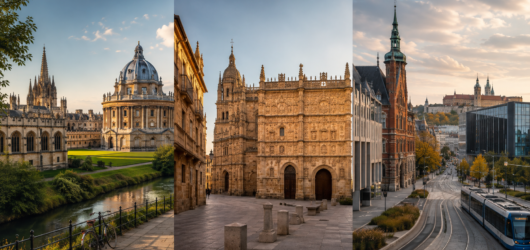
Radcliffe Camera stands in the centre of Radcliffe Square, surrounded by colleges, the Bodleian Old Library and the University Church of St Mary the Virgin. The circular building is detached, so its dome can be read from several approaches even though the surrounding streets and courtyards are tightly enclosed. Its location turns a specialised university library into one of Oxford’s most visible urban objects.[1][2]
The building began as the independent Radcliffe Library. John Radcliffe’s bequest financed the site, construction, a librarian and acquisitions. It opened in 1749 and remained institutionally separate from the Bodleian for more than a century. Its absorption into the Bodleian in 1860–61 changed its administrative role, but not its commanding position in the square.[2][3]
Tianjin Binhai Library occupies a very different urban condition. It forms part of the Tianjin Binhai Cultural Center, a planned complex intended to connect the central business district, older neighbourhoods, housing, commercial areas and government functions. The library is approached through a covered cultural gallery rather than an old academic square. Its outer volume was fixed by the larger masterplan; MVRDV concentrated the building’s identity inside, around the spherical auditorium known as the Eye.[4]
UNAM Central Library belongs to a planned campus in southern Mexico City. Ciudad Universitaria was constructed across the volcanic landscape of the Pedregal de San Ángel as a coordinated environment for education, administration, culture, sport and public space. The library faces the campus’s broad central lawns near the Rectoría. UNESCO evaluates this relationship among buildings, open space, circulation, landscape and art as an ensemble rather than treating the library as an isolated monument.[5]
The siting of each building therefore affects how it is seen. Radcliffe Camera is a freestanding object within a historic urban room. Tianjin’s principal image is an interior reached through a cultural complex. UNAM’s mural-covered tower works at campus scale, visible across a large open landscape.
Architecture, building size and visual identity
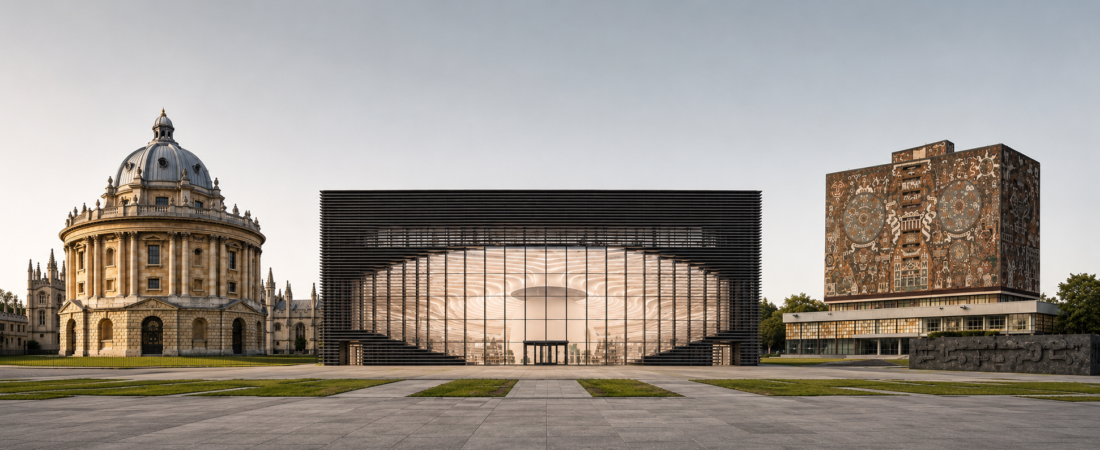
James Gibbs organised Radcliffe Camera as a circular classical composition with a rusticated lower stage, arched openings, paired Corinthian columns, a drum and a lead-covered dome. Headington stone was used in the lower parts and Taynton stone above; the dome structure is timber. Historic England’s technical description records a height of more than 40 metres and two internal storeys despite the exterior’s three main stages.[1][6] The plan is compact, and the dome devotes considerable volume to the reading-room interior rather than to dense storage.
Tianjin covers 33,700 m². Its five above-ground levels arrange reading rooms, books and lounges on the lower floors, with meeting rooms, offices, computing and audio facilities above. Subterranean spaces contain services, book storage and archive functions. In the atrium, white terraced shelves sweep around the spherical auditorium, forming steps, seating, circulation routes and louvres as well as places for books.[4]
The highest shelf bands are not usable as shelves. Access from rooms behind them was removed during the accelerated construction process, and MVRDV states that they were finished with perforated aluminium plates printed to resemble books. Usable shelving, seating and circulation occupy the accessible lower terraces, while the upper bands function as architectural surfaces.[4]
UNAM Central Library combines a low horizontal base with a largely windowless stack tower. The base contains two basements, a double-height main reading level and a mezzanine. Above it, the eleven-storey book tower is approximately 43 metres long, 16 metres wide and 27 metres high. Its opaque walls provided about 4,000 m² for Juan O’Gorman’s Representación histórica de la cultura.[7][8]
O’Gorman used coloured stones collected in Mexico for most of the mosaic and blue glass where an adequate natural blue was unavailable. The four elevations organise imagery associated with the pre-Hispanic past, the colonial period, the modern era and the university. The mural is not an applied sign added after construction: it transforms the stack enclosure into the building’s public face.[8][9]
Tianjin is clearly the largest building by the one complete floor-area figure available. UNAM has the most extensive external artwork and a much larger vertical storage structure than Radcliffe’s two main reading levels. Radcliffe’s height comes largely from its monumental dome, so height alone would exaggerate its usable library capacity.
Collections, circulation and everyday use
The three institutions publish collection data at different organisational levels. Radcliffe Camera is one component of the Bodleian system, Tianjin’s central building belongs to a multi-site municipal network, and UNAM reports several categories for its Central Library. A total for one site cannot be treated as directly equivalent to a network total or to a design capacity.
At Oxford, the Lower and Upper Camera provide reading rooms, open shelves, computers, scanning and staff support. The underground Gladstone Link connects the Camera to the Old Bodleian and adds two levels of shelving and study space. The History Faculty Library comprises more than 85,000 volumes distributed between the Camera and the Link. The building also holds teaching collections for English and Film Studies. Much History Faculty material can be borrowed by eligible university members, while other Bodleian material is for reference use only.[10][11][12]
Tianjin functions as a broad public library rather than a single-subject reading room. Its programme includes Chinese and foreign-language books, periodicals, children’s and family areas, services for older and visually impaired readers, study spaces, digital resources, training rooms, talks and specialist reading areas. The building’s civic use is measurable beyond its shelves: a Tianjin government platform reported more than 10.9 million visits between opening in October 2017 and May 2024, alongside an annual programme of more than 200 reading-promotion activities.[13]
Tianjin’s published book figures measure different things. The Binhai Cultural Center describes the central building as capable of holding 1.2 million volumes. A government public-legal-services case study gives a capacity of 1.35 million and reports 1.81 million volumes across the wider multi-building library system. Neither capacity figure is a count of books currently shelved in the iconic building. An official library-sector report from its opening period recorded nearly 200,000 books in the central library, while a 2018 national newspaper report gave nearly 600,000 for Binhai New Area Library. Later system growth is documented, but the institutional sources do not state a clearly dated current inventory for the central building.[14][15][16][17]
UNAM Central Library combines general and specialised collections with large-scale university service. In April 2026, UNAM reported 656,000 books, 338,000 periodical fascicles and 542,000 theses, as well as a historic collection containing material published between 1491 and 1800. The catalogue and digital services extend access beyond the building, while reading rooms, lending, instruction and specialist collections support daily campus use.[18][19]
UNAM’s 2026 total is the largest clearly dated single-building collection figure available here. Tianjin serves the wider municipal network, but its published central-building figures mix changing holdings with projected capacity. Radcliffe’s smaller on-site subject collection gains reach through the connected Bodleian system. Service scope therefore matters as much as shelf totals.
Public access and visitor experience
Radcliffe Camera is visually public but operationally restricted. Anyone can see it from Radcliffe Square, yet entry to the reading rooms requires an Oxford University or Bodleian Reader card. Members of the general public can enter only on specified guided tours. Visitors experience a functioning academic workplace, and tourist access is scheduled around library use.[10][20]
Tianjin offers the broadest casual entry. The cultural centre currently lists opening from 2:00 to 8:00 p.m. on Monday and from 9:30 a.m. to 8:00 p.m. Tuesday through Sunday, with Monday morning closed. The atrium encourages sitting, meeting, photography and movement as well as reading; conventional shelves and quieter study areas continue on other floors. This combination helps explain its success as both a neighbourhood service and a destination.[14]
UNAM’s directory lists service from 8:30 a.m. to 9:30 p.m. every day, including public holidays, subject to university closures. It records internal, external and interlibrary lending, although eligibility and registration determine which services an individual may use. The university also offers guided visits to the Central Library for members of the university and the general public.[19][21]
The visitor experience changes with the institution’s primary constituency. Oxford preserves a controlled reader environment. Tianjin accommodates routine public-library use and architectural tourism in the same interior. UNAM receives heritage visitors but remains oriented toward the rhythms and volume of a major university campus.
Change, maintenance and conservation
Radcliffe Camera is protected as a Grade I listed building. Its history nevertheless includes substantial adaptation: the ground-floor arches were glazed in the nineteenth century, an underground store was excavated beneath Radcliffe Square in 1909–12, the lower level became a reading room in 1941, and later works improved circulation and step-free entry. The Gladstone Link now allows the small historic building to function as part of a larger library network while limiting pressure for visible external expansion.[1][3][22]
Tianjin’s challenges are those of an intensively used contemporary building rather than a protected historic fabric. Its large white terraces, auditorium, conventional reading rooms and technical systems must absorb both everyday library traffic and heavy visitor use. The institution has continued adding themed reading spaces, digital resources and public programmes as its audience has grown.[13]
UNAM must maintain both an operating library and a major work of integrated art. In 2026 the university reported new quieter flooring, stronger shelving, ergonomic furniture and planned makerspace facilities. It also operates a conservation laboratory for library materials. These internal changes occur within a protected campus whose physical components, landscape and artworks are managed as a coherent whole.[5][18][23]
The World Heritage property is the 176.5-hectare Central University City Campus, inscribed in 2007 under criteria (i), (ii) and (iv). Central Library is an important component of that ensemble, not a separate World Heritage site. UNESCO also records the campus’s 2005 designation as a National Artistic Monument and its local heritage-conservation status.[5]
Cultural meaning and place identity
Radcliffe Camera’s image is inseparable from Oxford. Its classical dome marks the historic university centre, while the presence of students and researchers prevents it from becoming a ceremonial shell. The name also preserves an institutional change: the independent Radcliffe Library became part of the Bodleian and was known thereafter as the Radcliffe Camera.[2][3]
Tianjin Binhai Library represents a newer ambition. Its Eye and Book Mountain gave the Binhai cultural district an instantly recognisable interior, while its public programme channels that attention toward reading, family activities, lectures and digital services. Its identity is built through mass participation as much as through architectural form.[13]
UNAM Central Library links a university collection to a national historical narrative. O’Gorman’s four façades make the building legible from far beyond its entrances, and the surrounding campus gives the mural room to work as part of a larger modernist composition. Its architectural identity depends on the continued coexistence of library use, artwork and public higher education.[5][8]
Comparative conclusion
Radcliffe Camera offers the most historically concentrated experience and the least casual access. Tianjin Binhai Library provides the largest documented building and the most open civic interior, although its celebrated atrium is less functional as shelving than photographs imply. UNAM combines the most clearly documented large single-building collection with a campus-scale work of art and long daily service hours.
Their physical forms solve different institutional problems. Oxford extends a compact listed rotunda through underground connections. Tianjin uses a vast atrium to draw public life into a newly planned cultural district. UNAM turns a modern storage tower into the visual centre of a national university. Building size, collection size and cultural prominence do not rise together in a simple ranking: Radcliffe is the smallest yet dominates its historic square; Tianjin is the largest building but publishes capacity more readily than a current central-building inventory; UNAM places the most extensive verified single-site holdings behind the most narratively explicit exterior.